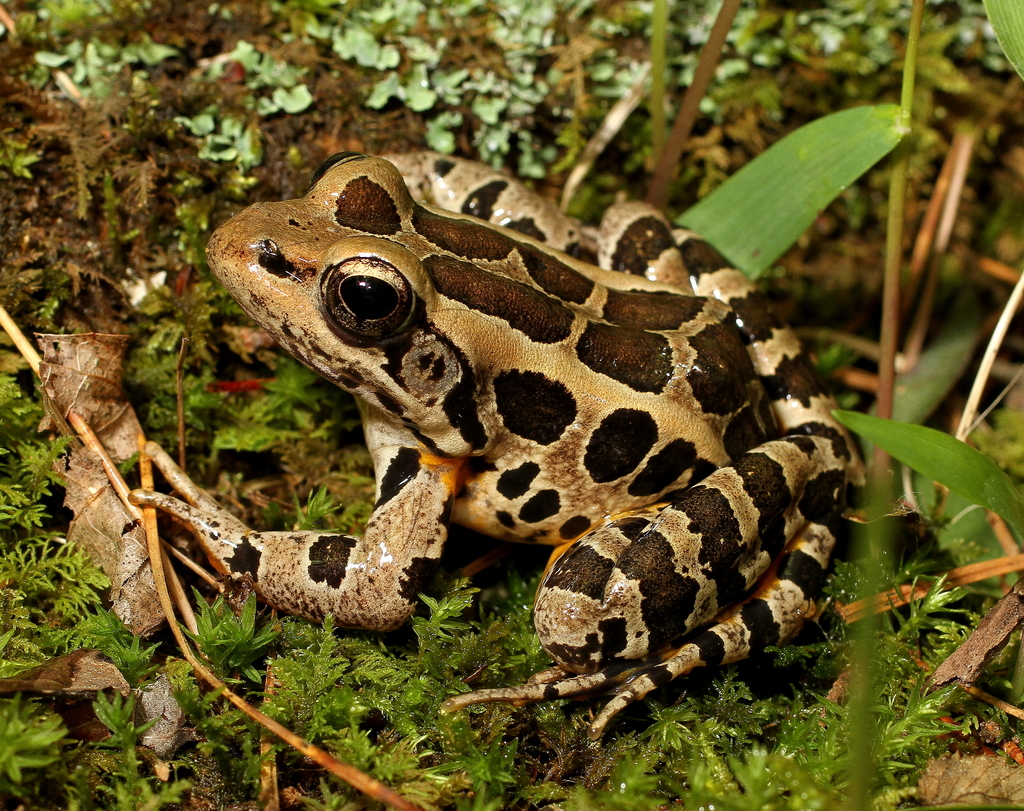
Pickerel Frog
Lithobates palustris
The pickerel frog (Lithobates palustris, formerly Rana palustris) is a small North American frog, characterized by the appearance of seemingly "hand-drawn" squares on its dorsal surface.
From the article Pickerel frog on Wikipedia (CC BY-SA), quoted section by section
Range & habitat
The pickerel frog ranges in the west from much they are of Wisconsin, southeast Minnesota, eastern Iowa, through Missouri and down to eastern Texas. To the east they extend through northern Louisiana, most of Mississippi, northern Alabama, Georgia, and South Carolina to the coast. Their northern range extends into Canada in the southern reaches of Ontario, Quebec, New Brunswick, and Nova Scotia. The range is spotty through the midwestern states and a field guide should be obtained for the specifics on ranges in a particular area. This frog has also been spotted in Newfoundland and Labrador, Canada.
Wikipedia: “Range”
What it does
Pickerel frogs typically emerge from hibernation around the end of March with the majority of the frogs arriving at breeding ponds by early May. No fall reproduction has been reported for this species. At the ponds, pickerel frogs are usually observed in large groups in the water. Mating behavior is not much different from other ranids. The males initiate breeding by emitting their low pitched call; this call is usually so low pitched that it is often not heard during calling surveys. Males can alter their call type based on interactions with other males. Males are known to call while submerged, although this is often inaudible in the air. Calls underwater vary among populations, suggesting that under certain circumstances it is better to vocalize underwater than into the air. Frogs reproduce by external fertilization while engaging in a behavior called amplexus; sometimes amplexus will last more than a day or two, even after the female has deposited the eggs. During the breeding season, males tend to lose body mass (with larger males losing more than smaller males).
Egg mass. Egg masses are typically laid in well-vegetated areas and are often difficult to locate. The masses superficially resemble those of wood frogs but at close inspection one can usually distinguish between the two. …
Wikipedia: “Reproduction”
Listen
Looking for field recordings…
Where it lives
Recorded sightings
—
geo-referenced records in GBIF, from museums, herbaria and field observers.
Drag the globe to turn it. Dots are where records exist, not a range map; darker means more records.
In the stacks
Searching the stacks…
Every page naming Lithobates palustris in the Biodiversity Heritage Library →
This page is assembled live from iNaturalist, GBIF, Wikipedia, the Source Library and the Internet Archive. It is not yet part of the hand-edited codex. iNaturalist taxon 66002.