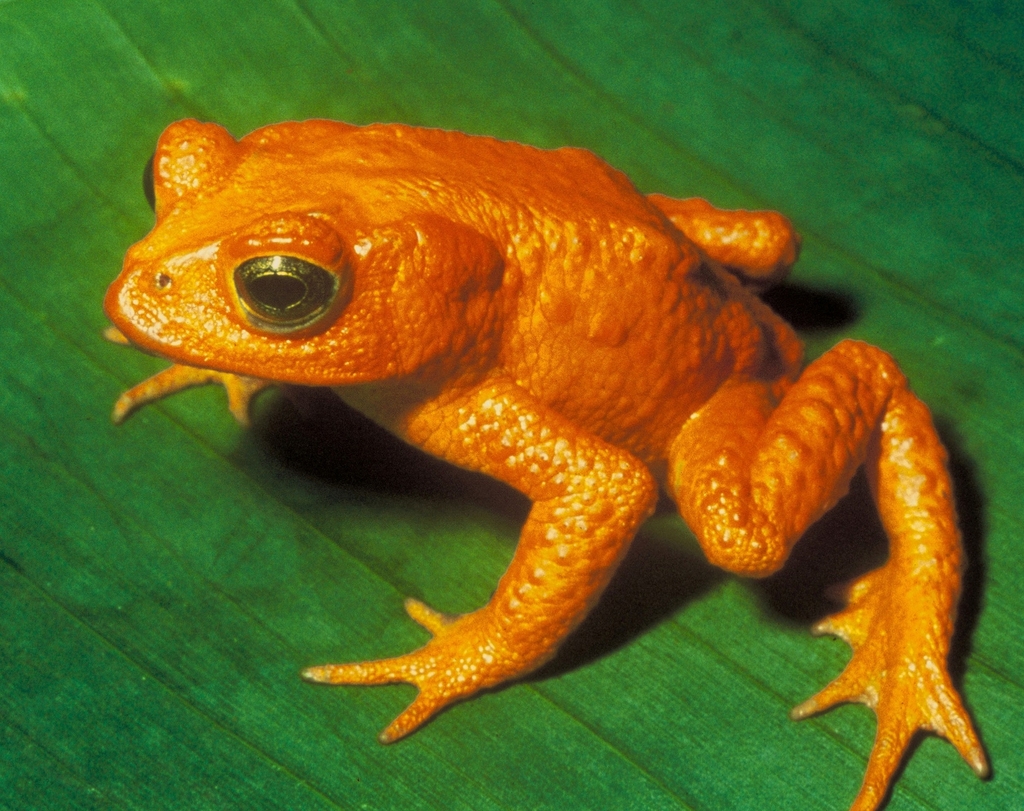
Golden Toad
Incilius periglenes
The golden toad (Incilius periglenes) is an extinct species of true toad that was once abundant in a small, high-altitude region of about 4 square kilometres (1.5 mi2) in an area north of the city of Monteverde, Costa Rica. It was endemic to elfin cloud forest. Also called the Monte Verde toad, Alajuela toad and orange toad, it is commonly considered the "poster child" for the amphibian decline crisis. This toad was first described in 1966 by herpetologist Jay Savage. The last sighting of a single male golden toad was on 15 May 1989, and it has since been classified as extinct by the International Union for Conservation of Nature (IUCN). The golden toad was declared extinct by the IUCN Red List in 2004.
From the article Golden toad on Wikipedia (CC BY-SA), quoted section by section
Description
The golden toad was one of about 500 species in the family Bufonidae—the "true toads". Males were orange and sometimes slightly mottled on the belly, while females showed a greater variety of colors, including black, yellow, red, green, and white; both sexes had smooth skin. While males had brilliant orange that attracted females to mate, females were covered with a dark, charcoal-color outlined with yellow lines. Sexual dimorphism played a key role in identifying females, who were typically larger than males. Body length ranged from 39 to 48 mm in males and from 42 to 56 mm in females. Males had proportionally longer limbs and longer, more acute noses than females. Females also had enlarged cranial crests above the level of the orbit (eye socket), while in males the crests were much lower. Individuals spent the majority of their lives in moist burrows, in particular during the dry season. The average lifespan of the golden toad is unknown, but other amphibian species in the family Bufonidae have an average lifespan of 10–12 years.
Range & habitat
The golden toad inhabited northern Costa Rica's Monteverde Cloud Forest Reserve, in a cloud forest area north of the town of Monteverde. It was distributed over an area no more than 8 km2 and possibly as little as 0.5 km2 in extent, at an average elevation of 1,500 to 1,620 m. The species seemed to prefer the lower elevations.
Wikipedia: “Habitat and distribution”
What it does
The golden toad's main habitat was on a cold, wet ridge called Brillante. They would emerge in late March through April to mate for the first few weeks in rainwater pools amongst tree roots, where they also laid their eggs. 1500 golden toads were reported to breed at the site since 1972. The last documented breeding episode occurred from April–May 1987. For a few weeks in April, after the dry season ended and the forest became wetter, males would gather in large numbers near ground puddles and wait for the females. Golden toads were found to breed explosively when it rained heavily from March to June. Males would clasp onto any other individuals encountered and only then identify the partner's sex. As soon as a male found a female golden toad, he would engage in amplexus with the female until she laid spawn. The males would fight with each other for opportunities to mate until the end of their short mating season, after which the toads retreated to their burrows. Males outnumbered females, in some years by as many as ten to one, a situation that often led bachelors to attack amplectant pairs and form what has been described as a "writhing masses of toad balls". During the 1977 and 1982 seasons, males outnumbered females by over 8 to 1 at breeding pools. Each toad couple produced 200–400 eggs each week for the six-week mating period, with each egg approximately 3 mm in diameter. …
Wikipedia: “Reproduction”
In human culture
Jay Savage discovered the golden toad in 1964. From their discovery in 1964 for about 17 years, and from April to July in 1987, population sizes of ~1500 adult toads were reported. As the population was very small and localized, a reserve of 4 km2 was established around the known locality, eventually expanded to cover 105 km2. Only ten or eleven toads were seen in 1988, including one seen by Martha Crump, and none have been seen since May 15, 1989, when Crump last saw the same solitary male toad that she had seen the year before. In the period between its discovery and disappearance, the golden toad was commonly featured on posters promoting the biodiversity of Costa Rica. Another species, Holdridge's toad, was declared extinct in 2008 but has since been rediscovered.
Extinction. The Global Amphibian Assessment (GAA) listed 427 species as "critically endangered" in its extensive analysis, including 122 species that could be "possibly extinct". A majority of species, including the golden toad, have declined in numbers even in seemingly undisturbed environments. As late as 1994, five years after the last sighting, researchers still hoped that I. periglenes continued to live in burrows, as similar toad species have lifespans of up to twelve years. By 2004 IUCN listed the species as extinct, after an evaluation involving Savage (who had first discovered them 38 years earlier). …
Wikipedia: “Conservation history”
Listen
Looking for field recordings…
Where it lives
Recorded sightings
—
geo-referenced records in GBIF, from museums, herbaria and field observers.
Drag the globe to turn it. Dots are where records exist, not a range map; darker means more records.
In the stacks
Searching the stacks…
Every page naming Incilius periglenes in the Biodiversity Heritage Library →
This page is assembled live from iNaturalist, GBIF, Wikipedia, the Source Library and the Internet Archive. It is not yet part of the hand-edited codex. iNaturalist taxon 65851.