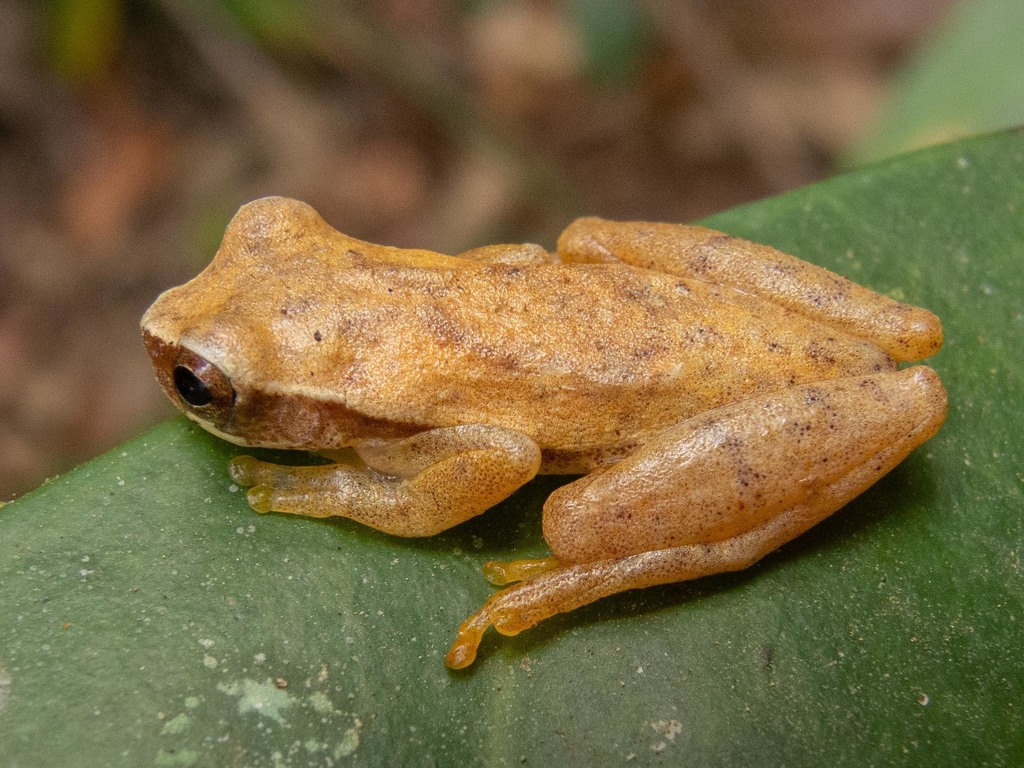
Bonito Tree Frog
Dendropsophus branneri
Dendropsophus branneri is a small hylid tree frog endemic to the Atlantic Forest region of Brazil. It feeds mainly on arthropods and is preyed upon by various invertebrates (e.g., giant aquatic bugs, spiders) and vertebrates (e.g., snakes, birds). Although currently classified by the IUCN Redlist as "least concern", D. branneri suffers rapid habitat loss due to residential development, agriculture, logging, and clearing for pastureland. Male D. branneri are noted for their fighting call, which differs significantly in frequency, duration, and pulses per call compared to their mate advertisement call. Males are also noted for their willingness to escalate physical altercations against other males, which includes kicking, pushing, and wrestling their opponent into non-dominant positions. Unlike most other frog species, D. branneri can breed in both temporary and permanent pools allowing it to inhabit a wide variety of habitats leading to its wide distribution.
From the article Dendropsophus branneri on Wikipedia (CC BY-SA), quoted section by section
Range & habitat
The Dendropsophus branneri are endemic to mountainous regions of the Brazilian Atlantic Forest, between Maranhão and Rio de Janeiro. They are typically found between the Rio Paraiba valley and High Muriaé River regions. They typically inhabit savannas, shrublands, grasslands, Restinga forests, and high-altitude swamps. Their long reproductive periods and strong adaptation abilities allow them to inhabit diverse ecosystems. D. branneri also live in vegetation surrounding temporary and permanent freshwater ponds. They have adapted to suit warm, dry climates to expand their ranges. Small ranges remain a threat to survival and can increase concern level on the IUCN Red List.
Wikipedia: “Habitat and distribution”
What it does
D. branneri utilize a "sit and wait" strategy in which they wait for food to enter proximity by chance, rather than actively foraging. A study of D. branneri living on coca plantations in southern Bahia, Brazil suggests a diet consisting largely of arthropods. Analysis of their stomach contents revealed three main prey orders: Diptera (14.96%), Araneae (11.02%), and larval lepidoptera (11.02%). Other prey found in the stomach contents include: blattaria, hemiptera, acari, hymenoptera, orthoptera. An average of 1.5 items were found per frog stomach. There was no significant correlation between frog body mass or snout-vent length and ingested volume of prey. Stomach content analysis of D. branneri exhibited significant plant content (13.39% of total volume). It is unclear whether this ingestion is intentional or an accidental consequence of arthropod hunting. D. branneri are the first species in which stomach flushing was used as a mechanism for studying the diet of frogs smaller than 14.4mm snout vent length (SVL). Whereas, the stomach content analysis of its closely related species, D. minutus, sampled in Serra Norte, Carajás, Brazil presented a slightly different prey composition. In D. minutus, Araneae was found to be the dominant prey-type. Larger frog species P. rohdei and P. burmeisteri tend to prey on larger invertebrates compared to D. …
Wikipedia: “Diet”
Listen
Looking for field recordings…
Where it lives
Recorded sightings
—
geo-referenced records in GBIF, from museums, herbaria and field observers.
Drag the globe to turn it. Dots are where records exist, not a range map; darker means more records.
In the stacks
Searching the stacks…
Every page naming Dendropsophus branneri in the Biodiversity Heritage Library →
This page is assembled live from iNaturalist, GBIF, Wikipedia, the Source Library and the Internet Archive. It is not yet part of the hand-edited codex. iNaturalist taxon 65338.