- Animals
- ›Chordates
- ›Vertebrates
- ›Birds
- ›Swifts and Hummingbirds
- ›Hummingbirds
- ›Bee Hummingbirds, Emeralds, Mountain-gems, and Allies
- ›Bee Hummingbirds and Allies
- ›Thaumastura
On eBird ↗
Peruvian Sheartail
Live sightings near you, the range map, bar charts of when it is seen, and Macaulay Library photos and recordings.
Peruvian Sheartail
Thaumastura cora
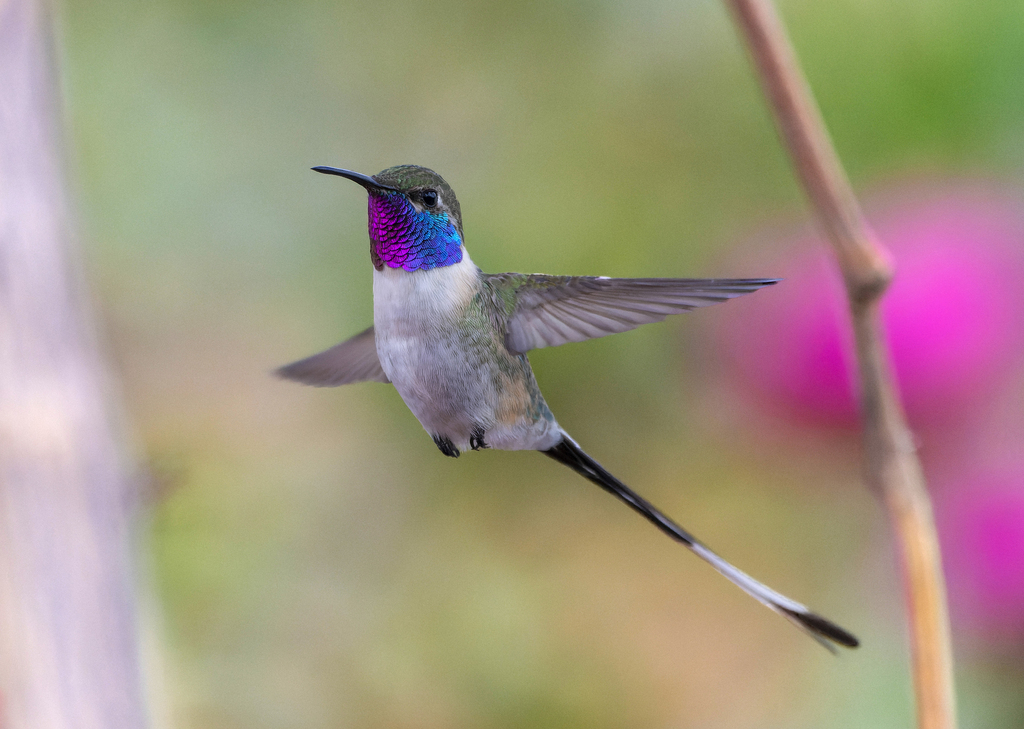
The Peruvian sheartail (Thaumastura cora) is a species of hummingbird in tribe Mellisugini of subfamily Trochilinae, the "bee hummingbirds". It is the only species placed in the genus Thaumastura. It is found in Chile, Ecuador, and Peru.
From the article Peruvian sheartail on Wikipedia (CC BY-SA), quoted section by section
Description
The male Peruvian sheartail is about 14 cm (5.5 in) long and weighs about 2.5 g (0.088 oz). The female about 7.5 cm (3.0 in) long and weighs about 2.6 g (0.092 oz). It is among the tiniest hummingbirds. Both sexes have a short, straight, black bill. Both sexes have metallic green upperparts, including the top of the face, that are darker towards the tail. The female's green has a faint beige tinge. Both sexes have an indistinct white spot behind the eye. Males have an iridescent magenta gorget that appears cyan or black at different angles; the female's throat is cream. The male's breast and belly are off-white to gray into which the green of the back gently merges. The female's breast and belly are similar but darker. The male Peruvian sheartail's most salient feature is its tail. The innermost pair of feathers are short, dark green on the outer vane and white on the inner. The next pair is very long with black outer vanes, white inner vanes, and black tips. The remaining three pairs are consecutively shorter, with black outer vanes, white inner vanes, and black tips outlined in white. The female's tail is short, with little difference in length among the feathers. The innermost pair have dark white bases followed by bronzy green outer webs and inner webs that transition from pale to almost black. …
Range & habitat
The Peruvian sheartail is found from far southwestern Ecuador through the entire length of western Peru and into northwestern Chile. Its presence in Ecuador is relatively recent; the first sighting was in the early 2000s and since then there are fewer than 10 eBird records. It is expanding its range in Chile, where it was first reported in 1971. The population in the Azapa Valley "is presently in the thousands", and it is also found further south. The Peruvian sheartail's native habitat is the arid coastal zone with sparse and scrubby vegetation. It is also readily found in farmland, gardens, and orchards. In elevation it ranges from sea level to about 2,800 m (9,200 ft) and possibly to above 3,300 m (10,800 ft). However, it is most common near sea level.
Wikipedia: “Distribution and habitat”
What it does
The Peruvian sheartail forages for nectar at a variety of flowering plants, both native and introduced such as Eucalyptus. It usually feeds by hovering but sometimes clings to the flower. It occasionally visits hummingbird feeders. During the breeding season males defend territories, but it is unclear whether these are for courtship, feeding, or both. In addition to feeding on nectar it captures small insects by hawking from a perch.
Wikipedia: “Feeding”
Listen
Looking for field recordings…
Where it lives
Recorded sightings
—
geo-referenced records in GBIF, from museums, herbaria and field observers.
Drag the globe to turn it. Dots are where records exist, not a range map; darker means more records.
In the stacks
Searching the stacks…
Every page naming Thaumastura cora in the Biodiversity Heritage Library →
This page is assembled live from iNaturalist, GBIF, Wikipedia, the Source Library and the Internet Archive. It is not yet part of the hand-edited codex. iNaturalist taxon 6516.