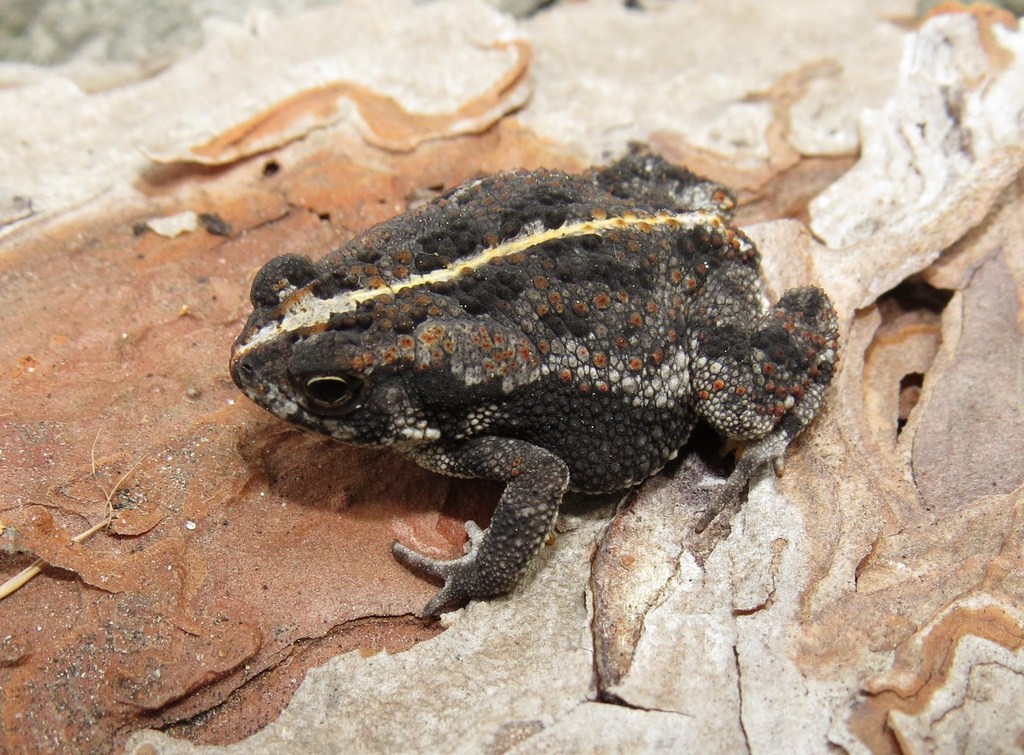
Oak Toad
Anaxyrus quercicus
The oak toad (Anaxyrus quercicus) is a species of toad in the family Bufonidae that is endemic to the coastal regions of southeastern United States. It is regarded as the smallest species of toad in North America, with a length of 19 to 33 mm (0.75 to 1.30 in).
From the article Oak toad on Wikipedia (CC BY-SA), quoted section by section
Description
The oak toad may be identified by its light mid-dorsal stripe, variable brown and black spots, and proportionally large parotoid glands. The female has a dark-spotted belly and the male has a clear white belly with a slightly distended, loose flap of skin beneath the mouth that expands into a vocal sac. As noted above, one of the most remarkable features of this species is its small adult size relative to other toads.
Range & habitat
The oak toad is native to the coastal regions of the southeastern United States, ranging from eastern Louisiana to southeast Virginia and south throughout Florida. It is found in a variety of habitats, including sandy pine flatwoods and oak scrub, open pine and pine-oak woods, pine or oak savanna with sandy soils, and maritime forests. Oak toads prefer open-canopied pine flatwoods with grassy ground cover. They are generally found in moist, grassy areas near pine or oak savannahs with sandy soil. They also are found in vernal pools and freshwater wetlands.
Wikipedia: “Habitat and distribution”
What it does
Oak toads are mostly diurnal and spend much of the time burrowed into the loose soil of their habitat. They may remain in burrows during the winter, often in hibernation. The breeding season extends from April to October, peaking early on. Breeding takes place in shallow pools that accumulate during heavy rains. Heavy, warm spring rains stimulate mating behavior. The male expands his distinctive elongated vocal sac to produce a chirping call. An average of 300 to 500 eggs are laid in short strands of three to eight eggs each, with each egg about a millimeter wide. The strands are attached to vegetation, usually submerged blades of grass 4 to 12 cm (1.6 to 4.7 in) beneath the surface. Energy investment in producing this quantity of eggs is significant, and many females are found dead during the mating season due to the rigors of the process. Fertilization takes place externally, with sperm being released in the vicinity of the eggs. As with other species of toad, the male oak toad has a Bidder's organ, which may become a functional ovary in the event of testicular malfunction.
Wikipedia: “Behavior”
Listen
Looking for field recordings…
Where it lives
Recorded sightings
—
geo-referenced records in GBIF, from museums, herbaria and field observers.
Drag the globe to turn it. Dots are where records exist, not a range map; darker means more records.
In the stacks
Searching the stacks…
Every page naming Anaxyrus quercicus in the Biodiversity Heritage Library →
This page is assembled live from iNaturalist, GBIF, Wikipedia, the Source Library and the Internet Archive. It is not yet part of the hand-edited codex. iNaturalist taxon 64985.