Canadian Toad
Anaxyrus hemiophrys
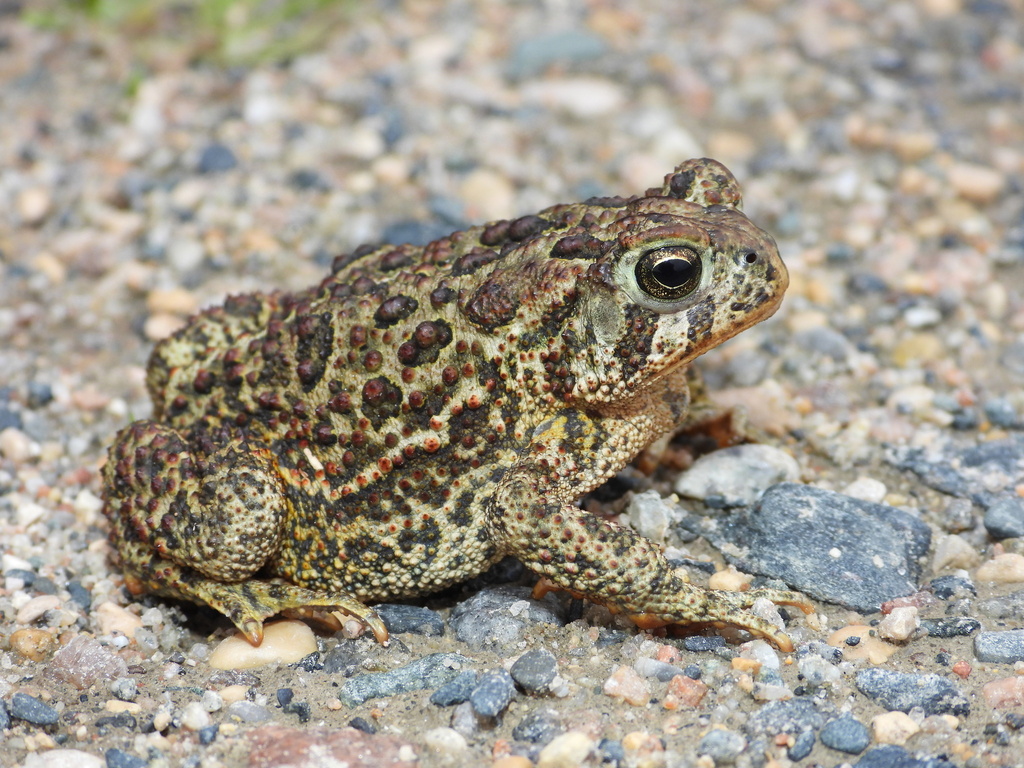
The Canadian toad (Anaxyrus hemiophrys), also known commonly as the Dakota toad, is a species of toad that ranges from the prairie regions of western Canada south to parts of the upper midwest of the United States. It belongs to the family Bufonidae, the "true" toads. Its specific name is derived from the Latin word hemiophrys, meaning eyebrow, which refers to its pronounced cranial crest between and behind the eyes. Anaxyrus hemiophrys displays the typical toad characteristics: it lacks a tail and teeth, it has a horizontal pupil, and its dry skin is thick and warty.
From the article Canadian toad on Wikipedia (CC BY-SA), quoted section by section
Description
The Canadian toad can grow to around 7.6 cm (3 in) in length. Fully grown adult males are usually 5.6 to 6.9 cm (2.2–2.7 in), while females are a little bigger between the ranges of 5.6 and 7.9 cm (2.2–3.1 in) and they weigh between 35 and 55 g. Their colouring is described by Cope (1886) as "brown, marked on the back with a median yellowish line, and two to three rows of brown spots of medium size on each side of it." Each spot has one to two tubercles in their centers which are redder in colour than the rest of the spots. He also identified two spots on the upper lip, one below the tympanum and a large spot that extends from below the parotid gland to near the front of the humerus. The parotid gland is narrow and secretes a toxin to protect it from predators. The toxins can cause irritation to the eyes and mouth and if it is ingested it can cause illness, but despite this toxin they are safe to handle. The coronal crests of Anaxyrus hemiophrys are well defined. The interorbital crests are narrow, relatively sharp-edged, non-porous and are widely separated. They run relatively parallel throughout most of their length, as far posterior as the level of the coronal crests. Posterior to that level they flare laterally to join the postorbital crests, delimiting the anterolateral edge of the postcoronal plane. Postcoronal plane is clearly defined and sloped posteroventrally. …
What it does
The tadpoles of Anaxyrus hemiophrys eat plant debris and other nutrients found in the waters in which they were spawned by way of suspension feeding. Juvenile Anaxyrus hemiophrys' dine mainly on small ground dwelling Coleoptera (beetles). The adult Canadian toad's diet is mainly insects, the most important being Coleoptera (beetles) and Hymenoptera (ants, bees, wasps, and sawflies). The small amount of non-insect food they consume is mainly small spiders.
Wikipedia: “Diet”
Listen
Looking for field recordings…
Where it lives
Recorded sightings
—
geo-referenced records in GBIF, from museums, herbaria and field observers.
Drag the globe to turn it. Dots are where records exist, not a range map; darker means more records.
In the stacks
Searching the stacks…
Every page naming Anaxyrus hemiophrys in the Biodiversity Heritage Library →
This page is assembled live from iNaturalist, GBIF, Wikipedia, the Source Library and the Internet Archive. It is not yet part of the hand-edited codex. iNaturalist taxon 64978.