- Animals
- ›Chordates
- ›Vertebrates
- ›Birds
- ›Swifts and Hummingbirds
- ›Hummingbirds
- ›Bee Hummingbirds, Emeralds, Mountain-gems, and Allies
- ›Emerald Hummingbirds and Allies
- ›Taphrospilus
On eBird ↗
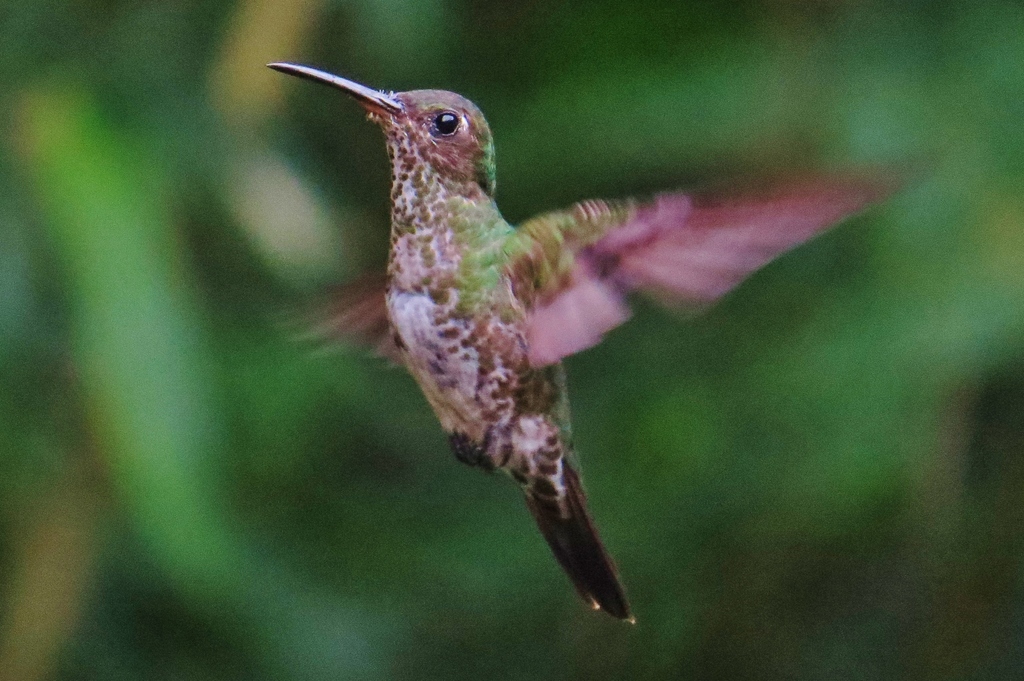
Many-spotted Hummingbird
Live sightings near you, the range map, bar charts of when it is seen, and Macaulay Library photos and recordings.
Many-spotted Hummingbird
Taphrospilus hypostictus
The many-spotted hummingbird (Taphrospilus hypostictus) is a species of hummingbird in the "emeralds", tribe Trochilini of subfamily Trochilinae. It is found in Bolivia, Colombia, Ecuador, Peru, and possibly Argentina.
From the article Many-spotted hummingbird on Wikipedia (CC BY-SA), quoted section by section
Description
The many-spotted hummingbird is 10.5 to 11.4 cm (4.1 to 4.5 in) long and weighs 6.7 to 9 g (0.24 to 0.32 oz). Both sexes have a slightly decurved black bill about 2.3 cm (0.91 in) long, and their plumage is very similar. Adults' upperparts are grass green to coppery bronze and the underparts white. The underparts except the central belly are thickly spotted with green, the female's somewhat less heavily. Their tail is blue-green with dusky gray tips to the feathers. Juveniles are the same with the addition of buffy fringes on the head feathers.
Range & habitat
The many-spotted hummingbird's primary range is the eastern slope of the Andes from Ecuador's Napo Province through eastern Peru into central Bolivia. It has also been documented in southern Colombia. The International Ornithological Committee places it Brazil and the Clements taxonomy in Argentina. However, the South American Classification Committee of the American Ornithological Society has no records from Brazil; undocumented sight records from Argentina lead the committee to list it as hypothetical in that country. The many-spotted hummingbird inhabits the interior and edges of humid foothill and subtropical forest, favoring small ravines. In elevation it mostly ranges between 400 and 1,500 m (1,300 and 4,900 ft) but has been found as high as 2,800 m (9,200 ft) in Peru. It is most numerous around 600 m (2,000 ft).
Wikipedia: “Distribution and habitat”
What it does
The many-spotted hummingbird forages for nectar at a variety of flowering trees, shrubs, vines, and terrestrial bromeliads. It usually does so alone, but at feeders will associate with other hummingbirds. In addition to nectar it feeds on small insects captured by hawking from a perch.
Wikipedia: “Feeding”
Listen
Looking for field recordings…
Where it lives
Recorded sightings
—
geo-referenced records in GBIF, from museums, herbaria and field observers.
Drag the globe to turn it. Dots are where records exist, not a range map; darker means more records.
In the stacks
Searching the stacks…
Every page naming Taphrospilus hypostictus in the Biodiversity Heritage Library →
This page is assembled live from iNaturalist, GBIF, Wikipedia, the Source Library and the Internet Archive. It is not yet part of the hand-edited codex. iNaturalist taxon 6496.