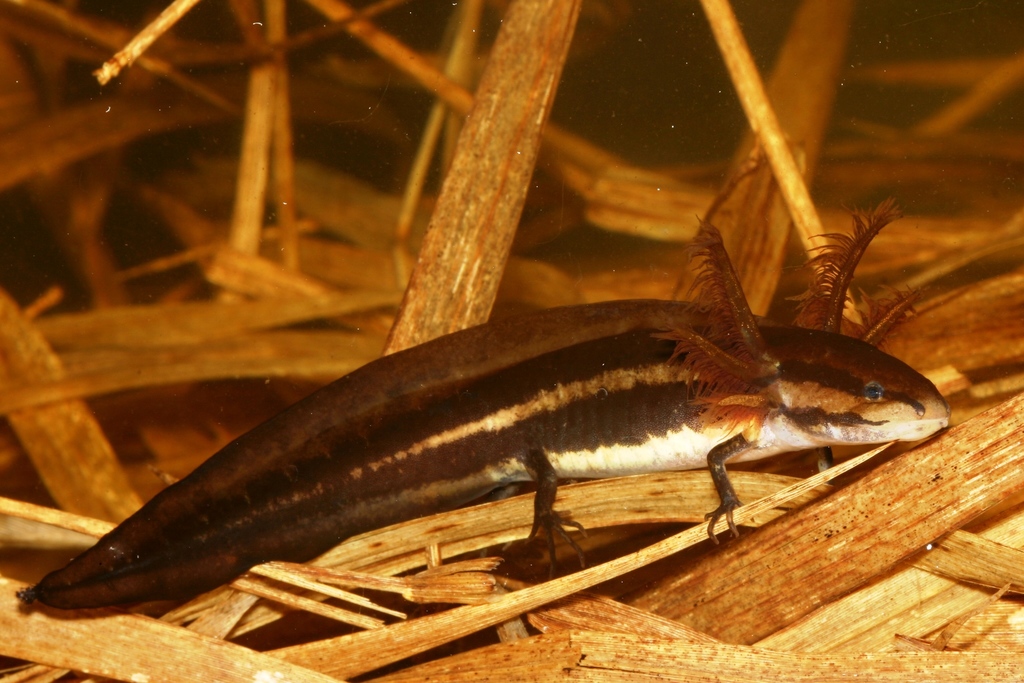
Reticulated Flatwoods Salamander
Ambystoma bishopi
The reticulated flatwoods salamander (Ambystoma bishopi) is a species of mole salamander, an amphibian in the family Ambystomatidae. The species is native to a small portion of the southeastern coastal plain of the United States in the western panhandle of Florida and extreme southwestern Georgia. The species once occurred in portions of southern Alabama but is now considered extirpated there. Its ecology and life history are nearly identical to its sister species, the frosted flatwoods salamander (A. cingulatum). A. bishopi inhabits seasonally wet pine flatwoods and pine savannas west of the Apalachicola River-Flint River system. The fire ecology of longleaf pine savannas is well-known, but there is less information on natural fire frequencies of wetland habitats in this region. Like the frosted flatwoods salamander, the reticulated flatwoods salamander breeds in ephemeral wetlands with extensive emergent vegetation, probably maintained by summer fires. Wetlands overgrown with woody shrubs are less likely to support breeding populations.
From the article Reticulated flatwoods salamander on Wikipedia (CC BY-SA), quoted section by section
Description
Ambystoma bishopi is a medium-sized species with a snout to vent length of 40 to 50 millimetres (1.6 to 2.0 in) and 14 to 16 costal grooves. The head is long with a tapered snout and there are vomerine teeth in the roof of the mouth. The forelimbs are stout and the tail is flattened towards the tip, being shorter than the head and body length combined. The skin is smooth and the dorsal surface is reticulated, with thin grey lines forming a net-like pattern on a brownish-black background. The ventral surface is dark with sparse white speckles. This salamander is similar in appearance to Ambystoma cingulatum but the latter has a more frosted dorsal pattern and larger white spots on the ventral surface.
Range & habitat
Ambystoma bishopi is a burrowing species of salamander and lives among the leaf litter beneath longleaf pine (Pinus palustris) and wiregrass (Aristida stricta) in the flatwoods coastal plain ecosystems of the Southeastern United States.
Wikipedia: “Distribution and habitat”
In human culture
The specific name, bishopi, is in honor of American herpetologist Sherman C. Bishop.
Wikipedia: “Etymology”
Listen
Looking for field recordings…
Where it lives
Recorded sightings
—
geo-referenced records in GBIF, from museums, herbaria and field observers.
Drag the globe to turn it. Dots are where records exist, not a range map; darker means more records.
In the stacks
Searching the stacks…
Every page naming Ambystoma bishopi in the Biodiversity Heritage Library →
This page is assembled live from iNaturalist, GBIF, Wikipedia, the Source Library and the Internet Archive. It is not yet part of the hand-edited codex. iNaturalist taxon 64881.