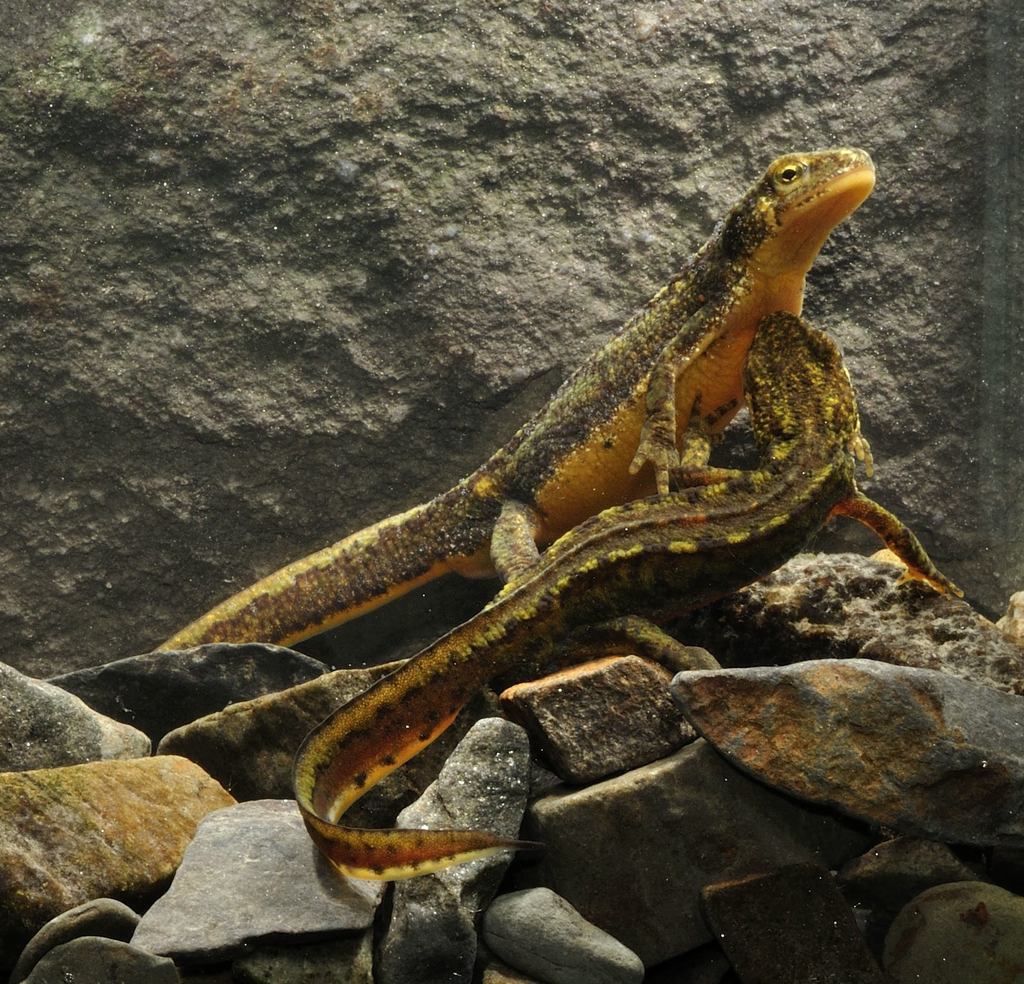
Carpathian Newt
Lissotriton montandoni
The Carpathian newt, or Montandon's newt, (Lissotriton montandoni) is a species of salamander in the family Salamandridae found in Czech Republic, Poland, Romania, Slovakia, and Ukraine.
The total length of adults of this species is around 10 cm. Its natural habitats are temperate forests, rivers, intermittent rivers, freshwater marshes, intermittent freshwater marshes, arable land, pastureland, rural gardens, and ponds. It is threatened by habitat loss.
From the article Carpathian newt on Wikipedia (CC BY-SA), quoted section by section
Description
The Carpathian newt grows to a total length of about 10 cm (4 in), females in general being larger than males. The skin is granulated in terrestrial individuals but smoother in more aquatic ones. There are three grooves on the head and the body is very square in cross section. The upper surface is yellowish-brown or olive-brown, copiously mottled with fine dark spots. The underparts are yellow or orange, often with small black spots at the sides. The lower part of the tail is white or orange with large black spots. In the breeding season, males have a slight crest on the tail and a filament on the tip, but only a slightly-raised ridge along the back.
Range & habitat
The Carpathian newt is native to the eastern part of the Carpathian Mountains and the eastern part of the Sudetes Mountains where it is found at altitudes of up to about 2,000 m (6,562 ft) above sea level. It has been introduced into the Bavarian Forest in Germany. Where their ranges overlap, it often hybridises with the smooth newt (Lissotriton vulgaris), the offspring being intermediate in appearance between the two species. The Carpathian newt prefers wet, shady woodland, both coniferous and broadleaf, glades, woodland edges and upland pastures. It is able to adapt to some extent to degraded habitats, and it breeds in permanent and temporary bodies of water.
Wikipedia: “Distribution and habitat”
What it does
The Carpathian newt often lives near the places where it breeds, hiding under fallen trees, rocks and loose bark. Breeding starts in the spring and the female lays up to 250 eggs during the year. The chosen sites are ponds, pools, ditches, water-filled wheel ruts, marshes and the edges of lakes. Dark, cold acid water is preferred but polluted water is sometimes used. The eggs hatch in one to four weeks according to temperature, and metamorphosis may occur at twelve weeks, but at higher altitudes, the tadpoles may overwinter. Sexual maturity is reached at about three years.
Wikipedia: “Behaviour”
Listen
Looking for field recordings…
Where it lives
Recorded sightings
—
geo-referenced records in GBIF, from museums, herbaria and field observers.
Drag the globe to turn it. Dots are where records exist, not a range map; darker means more records.
In the stacks
Searching the stacks…
Every page naming Lissotriton montandoni in the Biodiversity Heritage Library →
This page is assembled live from iNaturalist, GBIF, Wikipedia, the Source Library and the Internet Archive. It is not yet part of the hand-edited codex. iNaturalist taxon 64381.