- Animals
- ›Chordates
- ›Vertebrates
- ›Birds
- ›Swifts and Hummingbirds
- ›Hummingbirds
- ›Bee Hummingbirds, Emeralds, Mountain-gems, and Allies
- ›Bee Hummingbirds and Allies
- ›Selasphorus
On eBird ↗
Glow-throated Hummingbird
Live sightings near you, the range map, bar charts of when it is seen, and Macaulay Library photos and recordings.
Glow-throated Hummingbird
Selasphorus ardens
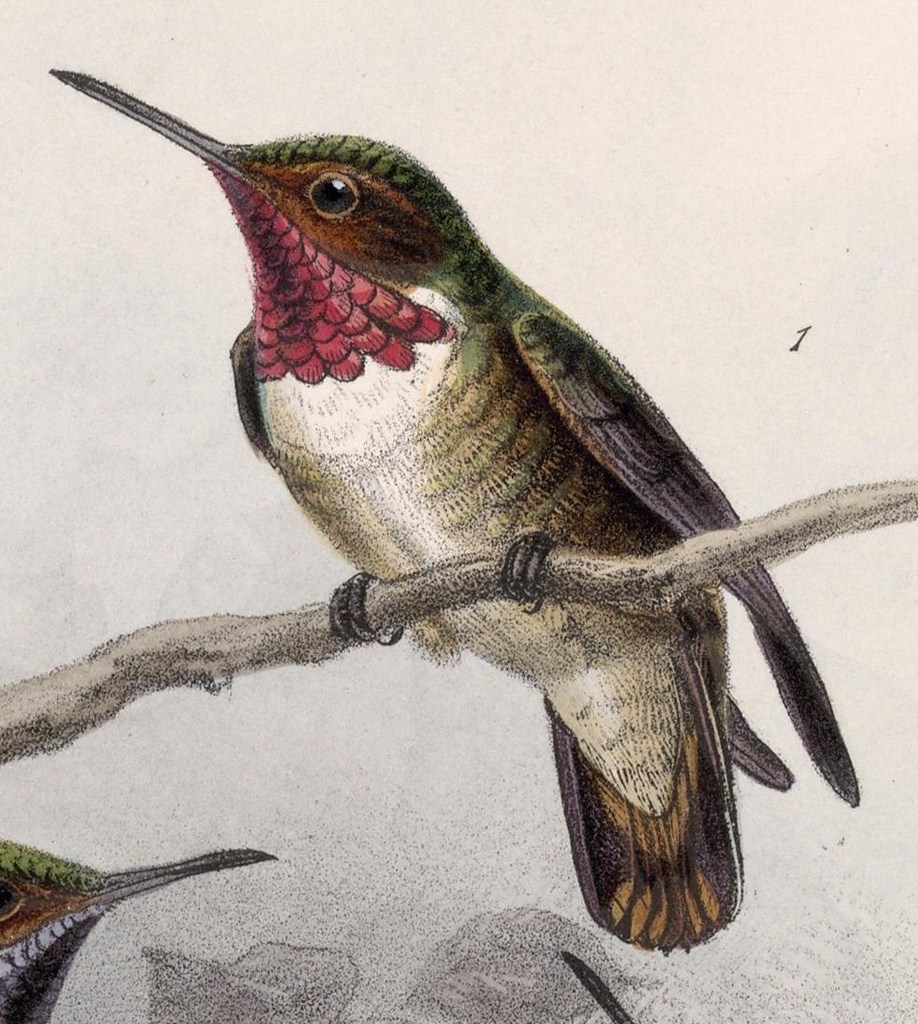
The glow-throated hummingbird (Selasphorus ardens) is an Endangered species of hummingbird in tribe Mellisugini of subfamily Trochilinae, the "bee hummingbirds". It is endemic to a small area of Panama.
From the article Glow-throated hummingbird on Wikipedia (CC BY-SA), quoted section by section
Description
The glow-throated hummingbird is about 7 cm (2.8 in) long. Both sexes have a short, straight, black bill. The adult male has bronzy green upperparts and the tail feathers are black with rufous edges. Its gorget is pinkish red with a white foreneck below it. The center of the breast and belly are also white and the rest of the underparts buffy to cinnamon with green spangles and buffy white undertail coverts. Adult females are also bronzy green above. Their central tail feathers are green; the rest have rufous bases, a black band near the end, and deep buffy tips. The throat is pale buff with grayish speckles and the rest of the underparts are like the male's. Immature birds resemble adult females but have rusty fringes on their head and nape feathers and more green on the tail.
Range & habitat
The glow-throated hummingbird is found only in west-central Panama's Chiriquí and Veraguas provinces. It was historically found more widely in Serranía de Tabasará but since the early 20th century is known only from Cerro Colorado and Cerro Flores in Chiriquí and Cerro Tute and the Santa Fé district in Veraguas. There are unsatisfactory sight records from the Azuero Peninsula, where its presence is considered hypothetical. It inhabits the edges and clearings of Talamancan montane forest at elevations between 750 and 1,800 m (2,500 and 5,900 ft).
Wikipedia: “Distribution and habitat”
What it does
Nothing is known about the foraging behavior or diet of the glow-throated hummingbird. Both are assumed to be similar to that of its close relative, the scintillant hummingbird (S. scintilla). That species, like most hummingbirds, feeds on nectar from flowers and on small insects.
Wikipedia: “Feeding”
Listen
Looking for field recordings…
Where it lives
Recorded sightings
—
geo-referenced records in GBIF, from museums, herbaria and field observers.
Drag the globe to turn it. Dots are where records exist, not a range map; darker means more records.
In the stacks
Searching the stacks…
Every page naming Selasphorus ardens in the Biodiversity Heritage Library →
This page is assembled live from iNaturalist, GBIF, Wikipedia, the Source Library and the Internet Archive. It is not yet part of the hand-edited codex. iNaturalist taxon 6368.