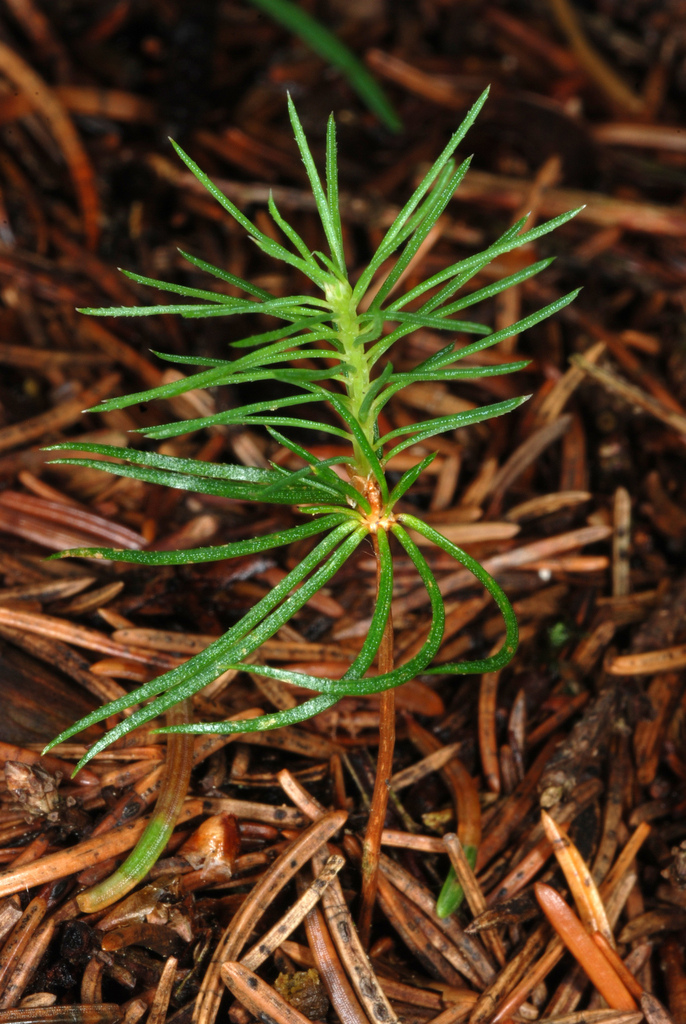
Norway spruce
Picea abies
Picea abies, the Norway spruce, is a species of spruce native to Northern, Central and Eastern Europe.
It has branchlets that typically hang downwards, and the longest cones of any spruce, 9–20 cm long. It is usually considered most closely related to the Siberian spruce (Picea obovata), which replaces it east of the Ural Mountains, and with which it hybridises freely; however this remains uncertain, with a study using nuclear DNA resolving Picea abies as sister to a large group of Asian spruces, with P. obovata being closer to these than to P. abies. The Norway spruce has a wide distribution, and is also widely planted for its wood, and is used as a Christmas tree in several countries around the world. It was the first gymnosperm to have its genome sequenced. The Latin specific epithet abies means "like Abies, Fir tree".
From the article Picea abies on Wikipedia (CC BY-SA), quoted section by section
Description
Norway spruce is a large, fast-growing evergreen coniferous tree growing 35–55 m (115–180 ft) tall and with a trunk diameter of 1 to 1.5 m. It can grow fast when young, up to 1 m per year for the first 25 years under good conditions, but becomes slower once over 20 m (65 ft) tall. The shoots are orange-brown and glabrous. The leaves are needle-like with blunt tips, 15–25 mm long, quadrangular in cross-section and dark green on all four sides with inconspicuous stomatal lines. The seed cones are 9–20 cm long (the longest of any spruce) and have bluntly to sharply triangular-pointed scale tips. They are green or reddish, maturing brown 5–7 months after pollination. The seeds are black, 4–5 mm long, with a pale brown 15 mm wing. The tallest measured Norway spruce is 62.26 m (204.3 ft) tall and grows near Ribnica na Pohorju, Slovenia.
Range & habitat
The Norway spruce grows throughout Europe from Norway in the northwest and Poland eastward, and also in the mountains of central Europe, southwest to the western end of the Alps, and southeast in the Carpathians and Balkans to the extreme north of Greece. The northern limit is in the arctic, just north of 70° N in Norway. Its eastern limit in Russia is hard to define owing to extensive hybridisation and intergradation with the Siberian spruce but is usually given as the Ural Mountains. However trees showing some Siberian spruce characters extend as far west as much of northern Finland, with a few records in northeast Norway. The hybrid is known as Picea × fennica (or P. abies subsp. fennica, if the two taxa are considered subspecies), and can be distinguished by a tendency to have hairy shoots and cones with smoothly rounded scales. Norway spruce cone scales are used as food by the caterpillars of the tortrix moth Cydia illutana, whereas Cydia duplicana feeds on the bark around injuries or canker.
Wikipedia: “Range and ecology”
At the table
The Norway spruce is one of the most widely planted spruces, both in and outside of its native range, and one of the most economically important coniferous species in Europe. It is used as an ornamental tree in parks and gardens. It is also widely planted for use as a Christmas tree. Every year the Norwegian capital city, Oslo, provides the cities of London (the Trafalgar Square Christmas tree), Edinburgh and Washington, D.C. with a Norway spruce, which is placed in the central square of each city, mainly in gratitude for the aid these countries gave during the Second World War. In North America Norway spruce is widely planted, specifically in the Northeastern, Pacific Coast, and Rocky Mountain states, as well as in southeastern Canada. It is naturalised in some parts of North America. Naturalised populations occur from Connecticut to Michigan, and probably elsewhere. Norway spruces prefer cool-summer areas and they will grow up to USDA Growing Zone 7, except along the west coast where summers are cool enough even in parts of USDA Growing Zone 10 (Sunset Climate Zones 14-17). Seed production begins when the tree is in its fourth decade and total lifespan is up to 300 years in its natural range in Europe. Introduced Norway spruces in the British Isles and North America have a much shorter life expectancy. …
Wikipedia: “Cultivation and uses”
Where it lives
Recorded sightings
—
geo-referenced records in GBIF, from museums, herbaria and field observers.
Drag the globe to turn it. Dots are where records exist, not a range map; darker means more records.
In the stacks
Searching the stacks…
Every page naming Picea abies in the Biodiversity Heritage Library →
This page is assembled live from iNaturalist, GBIF, Wikipedia, the Source Library and the Internet Archive. It is not yet part of the hand-edited codex. iNaturalist taxon 63567.