- Fungi Including Lichens
- ›Basidiomycete Fungi
- ›Higher Basidiomycetes
- ›Mushrooms, Bracket Fungi, Puffballs, and Allies
- ›Agaricomycetidae
- ›boletes and allies
- ›Hygrophoropsidaceae
- ›Hygrophoropsis
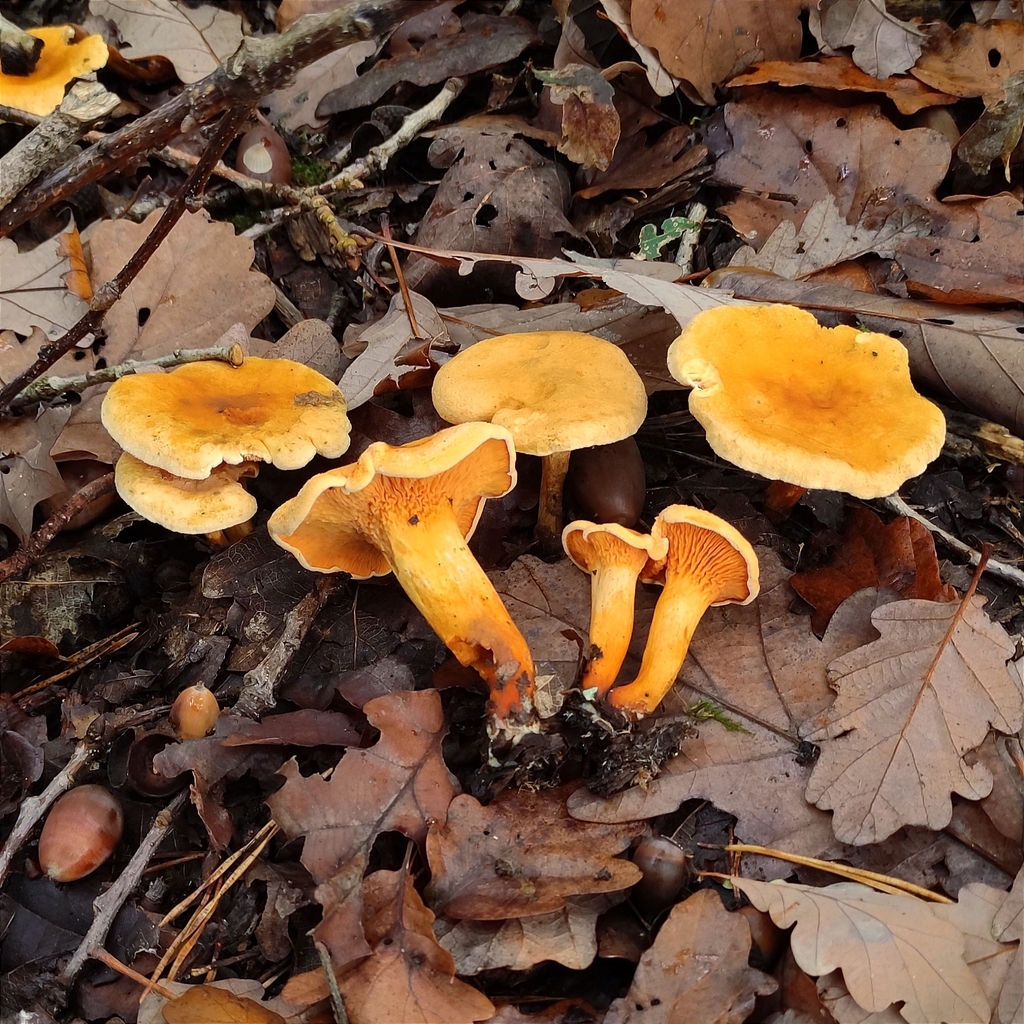
False Chanterelle
Hygrophoropsis aurantiaca
Hygrophoropsis aurantiaca, commonly known as the false chanterelle, is a species of fungus in the family Hygrophoropsidaceae.
Austrian naturalist Franz Xaver von Wulfen described the false chanterelle in 1781, noting both its resemblance with the true chanterelles and people's propensity to confuse them. The false chanterelle was then placed in the genus Clitocybe, but it was later observed that its forked gills and dextrinoid spores indicated a relationship to Paxillus. Genetic analysis has confirmed that it belongs to the order Boletales and is more closely related to boletes.
From the article Hygrophoropsis aurantiaca on Wikipedia (CC BY-SA), quoted section by section
Description
The species has a golden-orange cap ranging from 2–10 cm (3⁄4–4 in) in diameter, initially convex but becoming funnel-shaped as the mushroom matures. The cap margin, which remains rolled in a little, becomes wavy or lobed in age. The cap surface is covered with a fine down. The decurrent gill-like structures are narrow and forked, which is a distinctive and distinguishing feature. They are generally a more intense shade of orange than the cap. Along the stipe, the gills may be slightly crimped. The orange stipe is 1.5–8 cm (5⁄8–3+1⁄8 in) tall and 0.5–1 cm (1⁄4–3⁄8 in) thick, and lacks a ring. It often has a darker, brownish, base. The ability to form sclerotia (compact masses of hardened fungal mycelium) has been documented for H. aurantiaca in laboratory studies. These structures contain glycogen and protein that may be used as food reserves during spore germination. The soft, thin flesh ranges from white to yellowish to golden-orange. It has an odour and taste described variously as indistinct, or unpleasant and earthy. The spore print is white to cream. The oval spores are 5.5–7 by 4–4.5 micrometres (μm), with walls that tend to thicken in age. The spores are cyanophilous, meaning they will readily stain dark blue in methyl blue solution. Staining with Melzer's reagent often produces a dextrinoid (reddish-brown) colour reaction. …
Range & habitat
Hygrophoropsis aurantiaca is a widely distributed species. In Europe and North America, it is found in both hardwood and conifer forests, as well as heathland, in summer and autumn. In North America, it can be found from July–October to the east and September–January on the West Coast. It can be found in Central and South America, and Mexico, where it is common in coniferous forests. It has also been recorded in northern Asia, Australia and New Zealand. Populations in California represent a complex of undescribed species that are collectively referred to as Hygrophoropsis aurantiaca sensu lato. It fruits from the ground or from decaying wood, on burned areas in forests, and is often found near fallen trees and tree stumps. The fungus can also grow on woodchips used in gardening and landscaping, and so it also appears on roadsides and other locations where this material is used. Fruit bodies occur singly to scattered, or in clusters, and can be very abundant. Generally considered a dry weather mushroom, it can be plentiful when other mushrooms are scarce.
Wikipedia: “Distribution and habitat”
What it does
A saprophytic fungus, H. aurantiaca obtains nutrients from forest litter and decomposing wood, causing a brown rot on the wood upon which it grows. H. aurantiaca secretes large amounts of oxalic acid, a reducing agent and relatively strong acid. This stimulates weathering of the humus layer of forest soil, and influences the solubility and turnover of nutrients (particularly phosphorus and nitrogen), which in turn affects their availability for use by forest trees.
Wikipedia: “Ecology”
At the table
The false chanterelle is considered poisonous and may cause serious digestive problems. Among other toxins, it contains high levels of the sugar alcohol arabitol. The mushroom was sometimes described as edible (though not tasty) until 1999. Fries described it as venenatus, meaning "poisonous", in 1821. Considering the species potentially edible, David Arora speculated that it may have been confused with similar-looking but definitely poisonous species of Omphalotus. Italian mycologist Nicola Sitta has reported that the one attributed case of poisoning he knew of could be attributed to an idiosyncratic reaction as only one of three people eating it got symptoms and concludes that it is harmless. It is eaten in Spain and France, and can legally be sold in France and Belgium. It is not recommended in Italy due to its similarity to poisonous species. It is eaten, though not highly regarded, by the Zapotec people of Ixtlán de Juárez in Oaxaca. The Tepehuán people of northwestern Mexico also occasionally eat the mushroom, which they refer to in their native language as guin'xacan ("delightful") or kia's gio' ("iguana lard"); there, it is commonly prepared by roasting over charcoal, or boiling and garnishing with cheese.
Wikipedia: “Edibility”
Where it lives
Recorded sightings
—
geo-referenced records in GBIF, from museums, herbaria and field observers.
Drag the globe to turn it. Dots are where records exist, not a range map; darker means more records.
In the stacks
Searching the stacks…
Every page naming Hygrophoropsis aurantiaca in the Biodiversity Heritage Library →
This page is assembled live from iNaturalist, GBIF, Wikipedia, the Source Library and the Internet Archive. It is not yet part of the hand-edited codex. iNaturalist taxon 63538.