- Fungi Including Lichens
- ›Basidiomycete Fungi
- ›Higher Basidiomycetes
- ›Mushrooms, Bracket Fungi, Puffballs, and Allies
- ›Agaricomycetidae
- ›Common Gilled Mushrooms and Allies
- ›Marasmiineae
- ›Mycenaceae
- ›Mycena
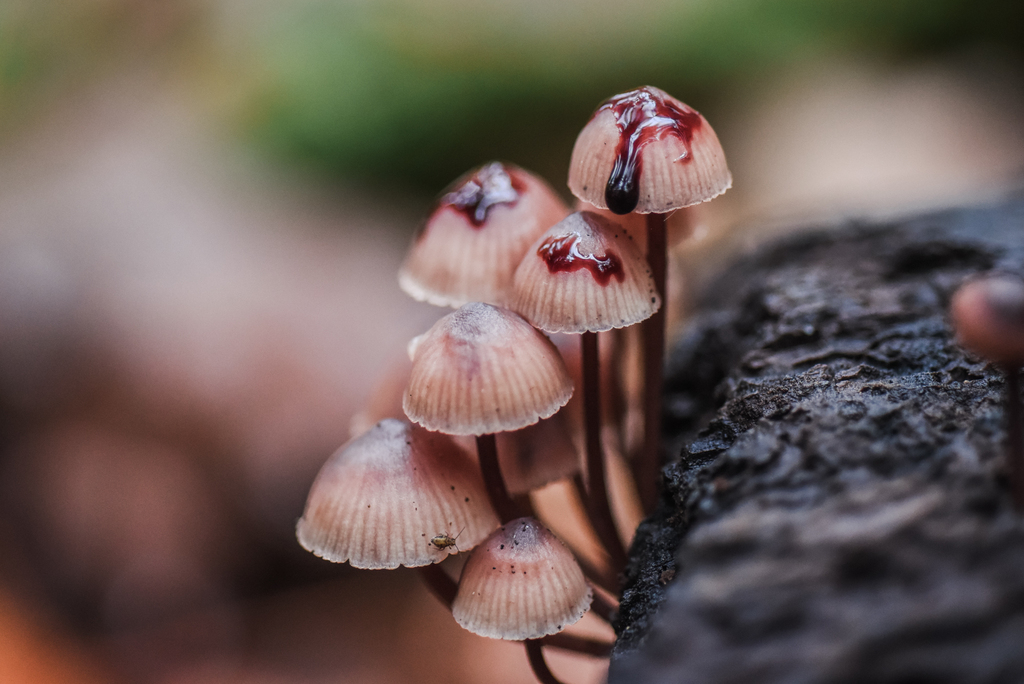
Bleeding Fairy Helmet
Mycena haematopus
Mycena haematopus, commonly known as the bleeding fairy helmet, the burgundydrop bonnet, or the bleeding Mycena, is a species of fungus in the family Mycenaceae, of the order Agaricales. First described scientifically in 1799, it is classified in the section Lactipedes of the genus Mycena, along with other species that produce a milky or colored latex.
The fruit bodies of M. haematopus have caps that are up to 4 cm (1+5⁄8 in) wide, whitish gills, and a thin, fragile reddish-brown stem with thick coarse hairs at the base. They are characterized by their reddish color, the scalloped cap edges, and the dark red latex they "bleed" when cut or broken. Both the fruit bodies and the mycelia are strongly bioluminescent.
From the article Mycena haematopus on Wikipedia (CC BY-SA), quoted section by section
Description
The fruit bodies of Mycena haematopus are the reproductive structures produced by cellular threads or hyphae which grow in rotting wood. The shape of the cap of the fruit body will vary depending on its maturity. Young caps, or "buttons", are ovoid (egg-shaped) to conical; later they are campanulate (bell-shaped), and as the fruit body matures, the margins (cap edge) lift upward so that the cap becomes somewhat flat with an umbo (a central nipple-shaped bump). The fully grown cap can reach up to 4 cm (1+5⁄8 in) in diameter. The surface of the cap initially appears dry and covered with what appears to be a very fine whitish powder, but it soon becomes polished and moist. Mature caps appear somewhat translucent, and develop radial grooves mirroring the position of the gills underneath. The color of the cap is reddish- or pinkish-brown, often tinged with violet, and paler towards the edge. The margin is wavy like the edge of a scallop and may appear ragged because of lingering remnants of the partial veil. The gills have an adnate attachment to the stem, meaning they are more or less directly attached to it. They are initially whitish or "grayish vinaceous" in color, and can develop reddish-brown stains. Between 20 and 30 gills reach from the cap edge to the stem, resulting in a gill spacing that is described as "close to subdistant"—gaps are visible between adjacent gills. …
Range & habitat
In North America, M. haematopus is distributed from Alaska southward. According to Mycena specialist Alexander H. Smith, it is "the commonest and the most easily recognized one in the genus". The species is common in Europe and has also been collected from Japan, and Mérida, Venezuela (as the variety M. haematopus var. marginata). In the Netherlands, M. haematopus is one of many mushrooms that can regularly be found fruiting on ancient timber wharves. The fruit bodies can be found year-round in mild weather. The mushroom obtains nutrients from decomposing organic matter (saprobic) and the fruit bodies can typically be found growing on stumps and well-decayed logs, usually in groups that are joined together by a common base. The decomposition of woody debris on the forest floor is the result of the combined activity of a community of fungal species. In the sequential succession of mushrooms species, M. haematopus is a "late colonizer" fungus: its fruit bodies appear after the wood has first been decayed by white rot species. The initial stage of wood decay by white rot fungi involves the breakdown of "acid-unhydrolyzable residue" and holocellulose (a mixture of cellulose and hemicellulose). Mycena haematopus can be parasitized by Spinellus fusiger, another fungal species which gives the mushroom a strikingly hairy appearance.
Wikipedia: “Distribution, habitat and ecology”
At the table
Although some sources claim that M. haematopus is edible, it is disregarded due to being insubstantial. Other sources consider the species inedible, or recommend avoiding consumption due to the potential toxicity of related taxa.
Wikipedia: “Edibility”
Where it lives
Recorded sightings
—
geo-referenced records in GBIF, from museums, herbaria and field observers.
Drag the globe to turn it. Dots are where records exist, not a range map; darker means more records.
In the stacks
Searching the stacks…
Every page naming Mycena haematopus in the Biodiversity Heritage Library →
This page is assembled live from iNaturalist, GBIF, Wikipedia, the Source Library and the Internet Archive. It is not yet part of the hand-edited codex. iNaturalist taxon 63460.