- Fungi Including Lichens
- ›Basidiomycete Fungi
- ›Higher Basidiomycetes
- ›Mushrooms, Bracket Fungi, Puffballs, and Allies
- ›Agaricomycetidae
- ›Common Gilled Mushrooms and Allies
- ›Phyllotopsidineae
- ›Phyllotopsidaceae
- ›Tricholomopsis
- ›Tricholomopsis
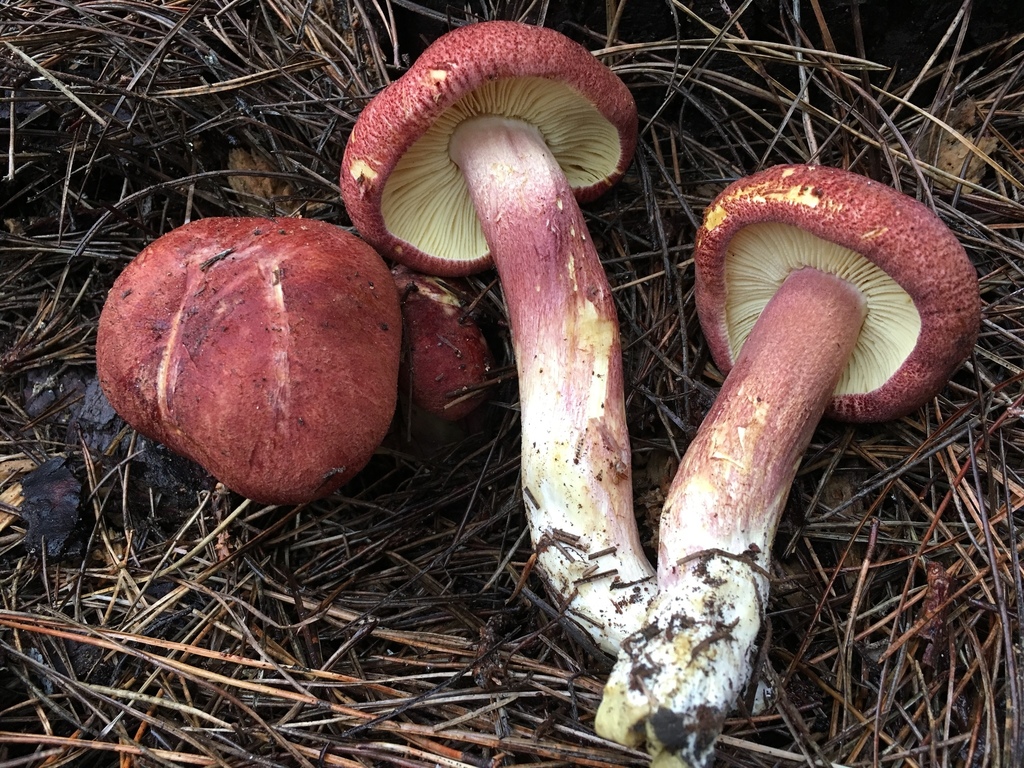
Plums-and-Custard
Tricholomopsis rutilans
Tricholomopsis rutilans, known by the unusual but apt common name of Plums and Custard or, less commonly Red-haired agaric, is a species of gilled mushroom found across Europe and North America.
From the article Tricholomopsis rutilans on Wikipedia (CC BY-SA), quoted section by section
Description
The common name stems from the plum-red scaled cap and custard-yellow gills. The cap is convex, becoming bell-shaped then flattening with age. It is up to 12 centimetres (4+1⁄2 in) wide with an incurved margin, densely covered with red to purplish red hairs; with maturity the hairs bunch into small scales and the yellowish color beneath shows through. A KOH test produces red on cap surface. The gills are adnate, yellow, and close with many short gills. The stem is 5–11 cm (2–4+1⁄4 in) tall, 8–25 mm (3⁄8–1 in) thick with a red scaly base fading to yellow towards the gills. In age it may be entirely yellow. The flesh is yellow to cream-coloured and spore print creamy white. The spores are cream colored, 5–7 x 3–5 μm, almost globe shaped to broadly ellipsoid, smooth, and clear like glass in KOH. The basidia have 4 protrusions, the cheilocystidia 50–70+ x 20–25 μm; shaped like a ball on a stick to sack shaped or swollen-irregular, smooth, thin-walled, clear in KOH. Pleurocystidia scattered, 30-35 x 5–7 μm, flask shaped to almost cylindrical, smooth, clear in KOH.
Similar species. A related species, Tricholomopsis decora, is also found in conifer woods but is golden in colour, much less common and found at higher altitudes. T. flammula is smaller and has a yellower stem. Megacollybia fallax is similar but with a gray-brown cap. …
Range & habitat
Tricholomopsis rutilans can be found growing on tree stumps and logs (especially those of spruce) in coniferous woodlands throughout the northern hemisphere, in places as diverse as Ireland, Bulgaria, Ukraine and northwest Russia, in late summer and autumn (June until November). It has also been found, probably accidentally introduced, in Australia, Aotearoa New Zealand and Costa Rica on introduced pine trees. It is saprobic on the well-decayed wood of conifers, also occasionally reported in woodchips, sawdust, and lignin-rich soil. It grows alone, scattered or gregariously, and is widely distributed in North America.
Wikipedia: “Distribution and habitat”
At the table
Many older texts list T. rutilans as apparently able to be eaten after boiling, though not recommended. A couple of more recent books list it as of poor quality, reportedly due to a taste of rotting wood.
Wikipedia: “Edibility”
Where it lives
Recorded sightings
—
geo-referenced records in GBIF, from museums, herbaria and field observers.
Drag the globe to turn it. Dots are where records exist, not a range map; darker means more records.
In the stacks
Searching the stacks…
Every page naming Tricholomopsis rutilans in the Biodiversity Heritage Library →
This page is assembled live from iNaturalist, GBIF, Wikipedia, the Source Library and the Internet Archive. It is not yet part of the hand-edited codex. iNaturalist taxon 63387.