- Animals
- ›Chordates
- ›Vertebrates
- ›Birds
- ›Swifts and Hummingbirds
- ›Hummingbirds
- ›Bee Hummingbirds, Emeralds, Mountain-gems, and Allies
- ›Bee Hummingbirds and Allies
- ›Eulidia
On eBird ↗
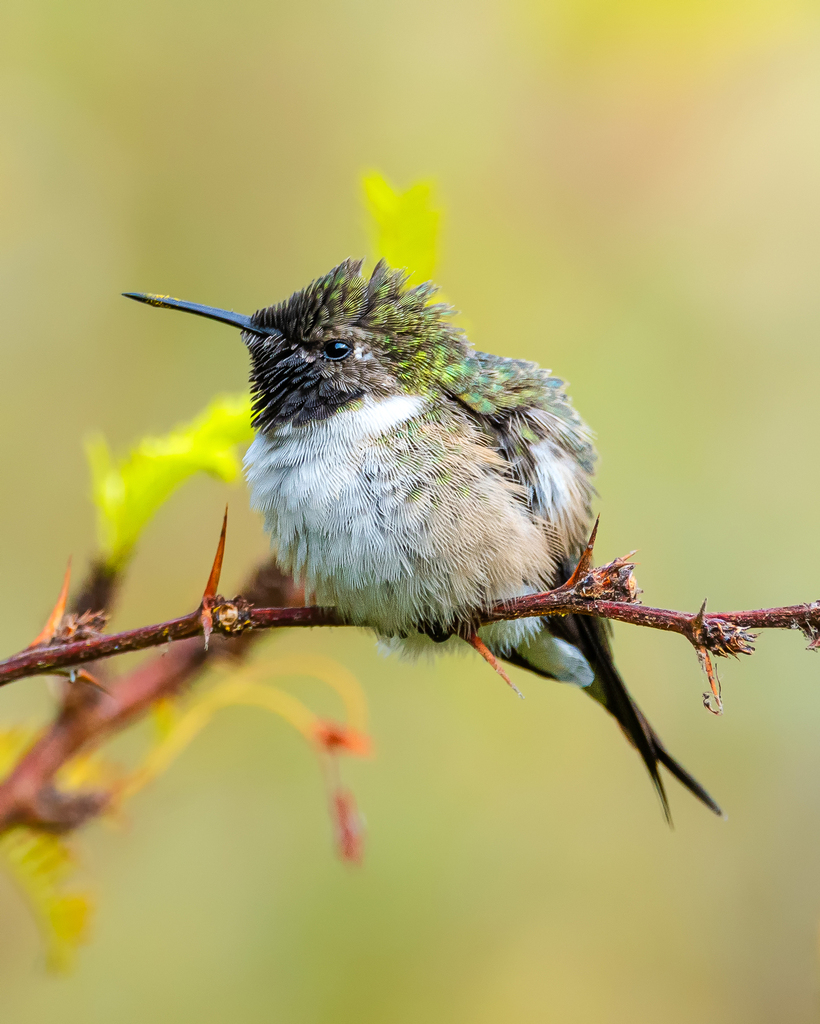
Chilean Woodstar
Live sightings near you, the range map, bar charts of when it is seen, and Macaulay Library photos and recordings.
Chilean Woodstar
Eulidia yarrellii
The Chilean woodstar (Eulidia yarrellii) is a small bird in the hummingbird family, Trochilidae. It is restricted to northernmost Chile with reports from southern Peru. Its natural habitats are dry shrubland and rural gardens. It is threatened by habitat loss and is classed as a critically endangered species. It is usually classified in its own genus Eulidia, but is sometimes placed with the purple-collared woodstar in the genus Myrtis. In 2013, it was classed as endangered,...
From the article Chilean woodstar on Wikipedia (CC BY-SA), quoted section by section
Description
The Chilean woodstar is 7.5 to 8.0 cm (3.0 to 3.1 in) long and weighs 2.3 to 2.6 g (0.081 to 0.092 oz). It is the smallest bird in Chile. Both sexes have a short black bill. The adult male is iridescent olive green above and white below. Its gorget is reddish-purple and blue, but often appears blackish. The central tail feathers are very short and green; the outer ones are longer, blackish brown, and curve inward. Females are also olive green above but are mostly very pale buff below, darkest on the belly and thighs. Their tail is short and slightly graduated with green central feathers; the outer ones are black with buff bases and wide white tips. Immature males are similar to the female, but have a mottled throat and may have elongated outer tail feathers. The Peruvian sheartail (Thaumastura cora), which shares the Chilean woodstar's range and outnumbers it there, is very similar to the Chilean woodstar. However, the male sheartail has two elongated white feathers in its tail, while the female tends to have a whiter belly and a more buff throat than the woodstar. In contrast to the sheartail, the woodstar usually flies with its tail cocked and seldom pumps its tail.
Range & habitat
The Chilean woodstar is now (2022) known only from the Lluta, Azapa, and Vitor valleys of far northern Chile's Arica and Parinacota Region. There is an historical record further south in Antofagasta Province. There are also undocumented sight records in Peru in the Tacna Region and possibly Moquegua Region; the South American Classification Committee of the American Ornithological Society considers the species "hypothetical" in that country. The Chilean woodstar inhabits scrub, thickets, and gardens along river valleys of the arid Arica area. In elevation it generally ranges between 200 and 750 m (660 and 2,500 ft). It is most common below 400 m (1,300 ft) but there is a small population at around 1,800 m (5,900 ft) in the Vitor Valley and there are single records as high as 3,000 m (9,800 ft).
Wikipedia: “Distribution and habitat”
What it does
The Chilean woodstar feeds on nectar from a variety of native and introduced flowers, shubs, cacti, and trees. Native plants include Inga feulles, Geoffroea decorticans, and Schinus molle. Examples of introduced nectar sources are Lantana, Hibiscus and Citrus species. It tends to forage alone, but there are historical records of large numbers feeding at flowering trees. In addition to nectar, the woodstar feeds on small insects such as Hymenoptera, Homoptera and Coleoptera that it catches on the wing.
Wikipedia: “Feeding”
Listen
Looking for field recordings…
Where it lives
Recorded sightings
—
geo-referenced records in GBIF, from museums, herbaria and field observers.
Drag the globe to turn it. Dots are where records exist, not a range map; darker means more records.
In the stacks
Searching the stacks…
Every page naming Eulidia yarrellii in the Biodiversity Heritage Library →
This page is assembled live from iNaturalist, GBIF, Wikipedia, the Source Library and the Internet Archive. It is not yet part of the hand-edited codex. iNaturalist taxon 6337.