- Animals
- ›Chordates
- ›Vertebrates
- ›Birds
- ›Swifts and Hummingbirds
- ›Hummingbirds
- ›Bee Hummingbirds, Emeralds, Mountain-gems, and Allies
- ›Bee Hummingbirds and Allies
- ›Calliphlox
On eBird ↗
Amethyst Woodstar
Live sightings near you, the range map, bar charts of when it is seen, and Macaulay Library photos and recordings.
Amethyst Woodstar
Calliphlox amethystina
The amethyst woodstar (Calliphlox amethystina) is a species of hummingbird in the family Trochilidae. It is found in most of central, and eastern South America proper, in Argentina, Bolivia, Brazil, Colombia, Ecuador, French Guiana, Guyana, Suriname-(the Guianas), Paraguay, Peru, and Venezuela. The bird's range surrounds the Amazon countries into the Andes foothills and higher elevations of upstream river systems, but is not along the Amazon River proper in the central Amazon Basin, or the central upper
From the article Amethyst woodstar on Wikipedia (CC BY-SA), quoted section by section
Description
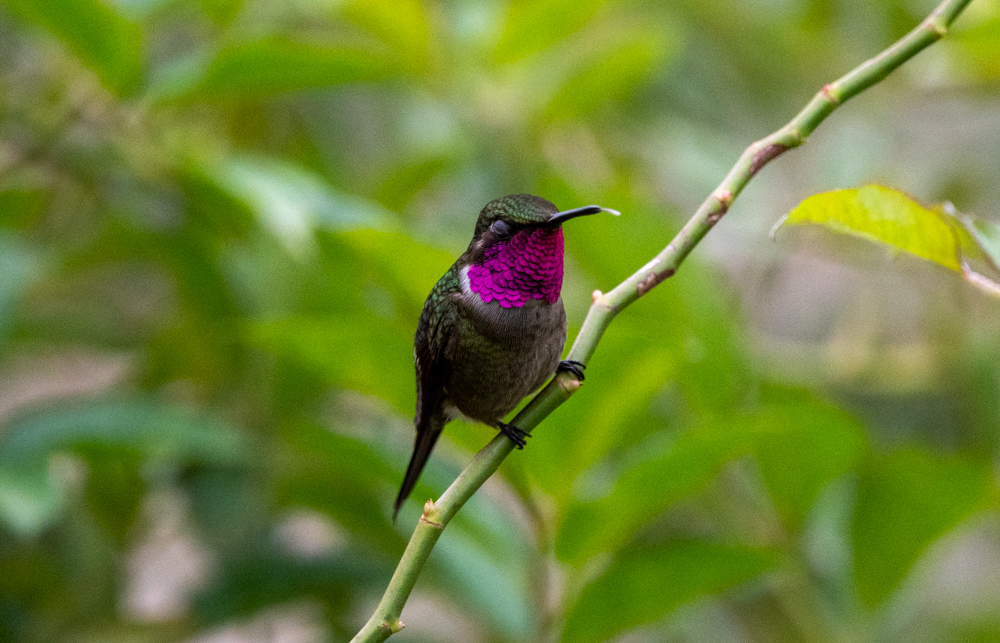
The amethyst woodstar is 6 to 8.4 cm (2.4 to 3.3 in) long and weighs 3.2 to 2.5 g (0.11 to 0.088 oz). Both sexes have a medium length, straight, black bill. They have dark bronzy green upperparts with a large white spot on either side of the rump. Males have a small white spot behind the eye while females have a thin white stripe. Males in breeding plumage have an iridescent amethyst gorget with a whitish band below it. The rest of the underparts are greenish with brownish lower flanks. Its deeply forked tail is purplish black with green tips to the feathers. Males in non-breeding (eclipse) plumage have a pale throat with some iridescent disks. Females have whitish underparts with a few green spangles on the throat and rufous flanks and undertail coverts. The tail is short and dull green with a black band near the end and pale tips to the feathers.
Range & habitat
The amethyst woodstar is found from eastern Colombia through Venezuela and the Guianas into most of Brazil except the main Amazon basin as far south as extreme northeastern Argentina, and from there west and north into Paraguay and through Bolivia, Peru, and Ecuador slightly into southern Colombia. It inhabits a wide variety of semi-open to open landscapes including the borders of humid forest, clearings within forest, savanna, and scrubby woodland. It shuns the interior of closed forest. In elevation it ranges from sea level to 1,500 m (4,900 ft).
Wikipedia: “Distribution and habitat”
What it does
The amethyst woodstar forages in low bushes and small trees, collecting nectar from a very wide variety of flowering plants. It is known to feed at plants of more than 30 genera. In addition to nectar, it also feeds on insects captured by hawking from a perch. It is dominated by most other hummingbirds.
Wikipedia: “Feeding”
Listen
Looking for field recordings…
Where it lives
Recorded sightings
—
geo-referenced records in GBIF, from museums, herbaria and field observers.
Drag the globe to turn it. Dots are where records exist, not a range map; darker means more records.
In the stacks
Searching the stacks…
Every page naming Calliphlox amethystina in the Biodiversity Heritage Library →
This page is assembled live from iNaturalist, GBIF, Wikipedia, the Source Library and the Internet Archive. It is not yet part of the hand-edited codex. iNaturalist taxon 6331.