- Animals
- ›Chordates
- ›Vertebrates
- ›Mammals
- ›Therians
- ›Placental Mammals
- ›Ungulates, Carnivorans, and Allies
- ›Shrews, Moles, Hedgehogs, and Allies
- ›Shrews, Moles, and Hedgehogs
- ›Shrews
- ›Red-toothed Shrews
- ›Short-tailed and Small-eared Shrews
- ›Blarina
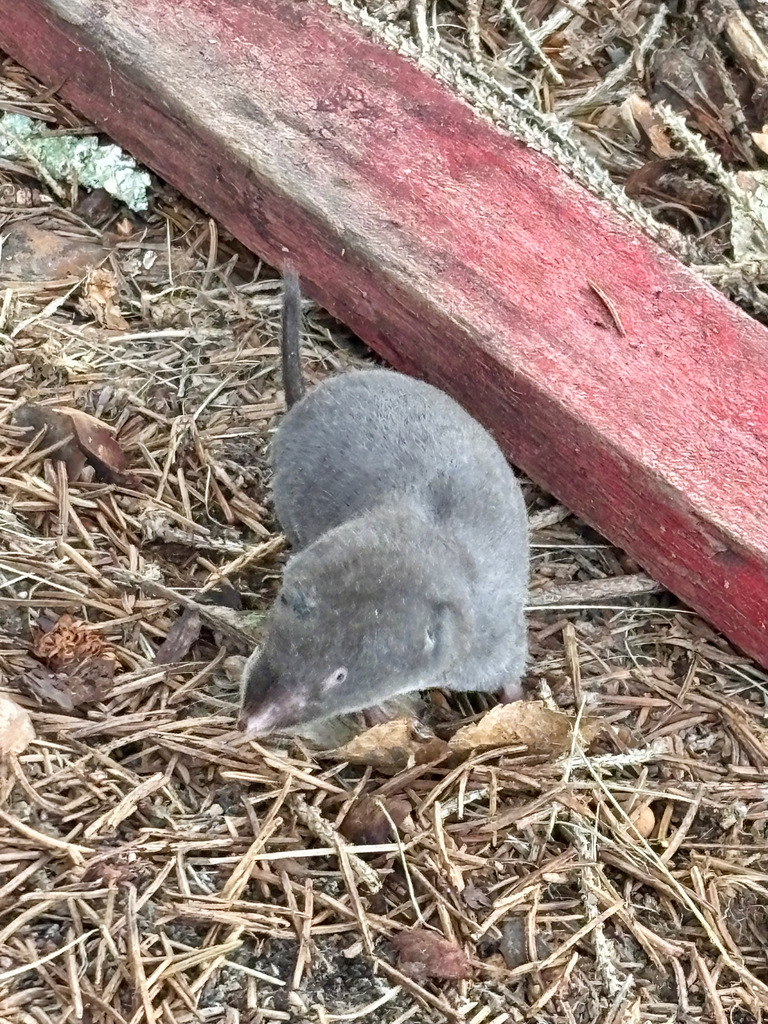
Northern Short-tailed Shrew
Blarina brevicauda
The northern short-tailed shrew (Blarina brevicauda) is the largest shrew in the genus Blarina, and occurs in the northeastern region of North America. It is a semifossorial, highly active, and voracious insectivore and is present in a variety of habitats like broadleaved and pine forests among shrubs and hedges as well as grassy river banks. It is notable in that it is one of the few venomous mammals. The specific epithet, brevicauda, is a combination of the Latin brevis and cauda, meaning "short tail".
From the article Northern short-tailed shrew on Wikipedia (CC BY-SA), quoted section by section
Description
This shrew has a total length of 108 to 140 mm (4.3 to 5.5 in), of which 18 to 32 mm (0.71 to 1.26 in) is tail; and weighs 15 to 30 g (0.53 to 1.06 oz). The species exhibits slight sexual dimorphism in size, with the male being slightly larger than the female. The dorsal fur is thick and velvety, and can be black, brownish black, or silvery gray, with the ventral fur being a bit lighter and grayer. The shrew molts from a summer coat which is shorter and paler than the winter pelage in October and November, and back again sometime in February through July. The tail is quite short, amounting to less than 25% of the total length. The dental formula is I 3-3/1-1, C 1-1/1-1, P 3-3/1-1, M 3-3/3-3 = 16/16 = 32. Three well-developed scent glands are present, one on each side of the animal and one ventral; the scent may be used for marking territories, though the shrew's sense of smell is thought to be poor.
Range & habitat
This shrew is found throughout central and eastern North America, from southern Saskatchewan to Atlantic Canada and south to northern Arkansas and Georgia. It is probably the most common shrew in the Great Lakes region. Population densities usually range from five to 30 shrews per hectare (two to 12 per acre), but rarely exceed 200/ha (80/ac). The typical home range of a shrew is 2.5 ha, and may overlap slightly with the ranges of other shrews.
Wikipedia: “Range”
What it does
This shrew consumes up to three times its weight in food each day. It eats small quantities of subterranean fungi and seeds, though it is mostly carnivorous. It prefers insects (such as beetles), earthworms, voles, snails, and other shrews for the bulk of its diet, though salamanders, frogs, snakes, birds, and mice are also eaten. This shrew consumes vertebrates more often than other shrews do. The shrew mostly forages within a few hours after sunset, though it is also active during cloudy days. High evaporative water loss requires the shrew to have access to a source of water, though it does obtain water from its food, as well. The shrew often hoards food, especially in the fall and winter, or during a time of prey abundance; one study found it caches 87% of the prey it catches, while 9% is eaten immediately and 4% is left where it was killed.
Toxin. The saliva of the northern short-tailed shrew contains a kallikrein-like protease, used to paralyze and subdue its prey. The toxin is strong enough to kill small animals, up to sizes somewhat larger than the shrew itself, and results in painful bites to humans who attempt to handle the shrew. The venomous saliva is secreted from submaxillary glands, through a duct which opens at the base of the lower incisors, where the saliva flows along the groove formed by the two incisors, and into the prey. …
Wikipedia: “Diet”
Listen
Looking for field recordings…
Where it lives
Recorded sightings
—
geo-referenced records in GBIF, from museums, herbaria and field observers.
Drag the globe to turn it. Dots are where records exist, not a range map; darker means more records.
In the stacks
Searching the stacks…
Every page naming Blarina brevicauda in the Biodiversity Heritage Library →
This page is assembled live from iNaturalist, GBIF, Wikipedia, the Source Library and the Internet Archive. It is not yet part of the hand-edited codex. iNaturalist taxon 63113.