- Animals
- ›Chordates
- ›Vertebrates
- ›Birds
- ›Swifts and Hummingbirds
- ›Hummingbirds
- ›Brilliants, Coquettes, and Allies
- ›Coquettes and Allies
- ›Ramphomicron
On eBird ↗
Purple-backed Thornbill
Live sightings near you, the range map, bar charts of when it is seen, and Macaulay Library photos and recordings.
Purple-backed Thornbill
Ramphomicron microrhynchum
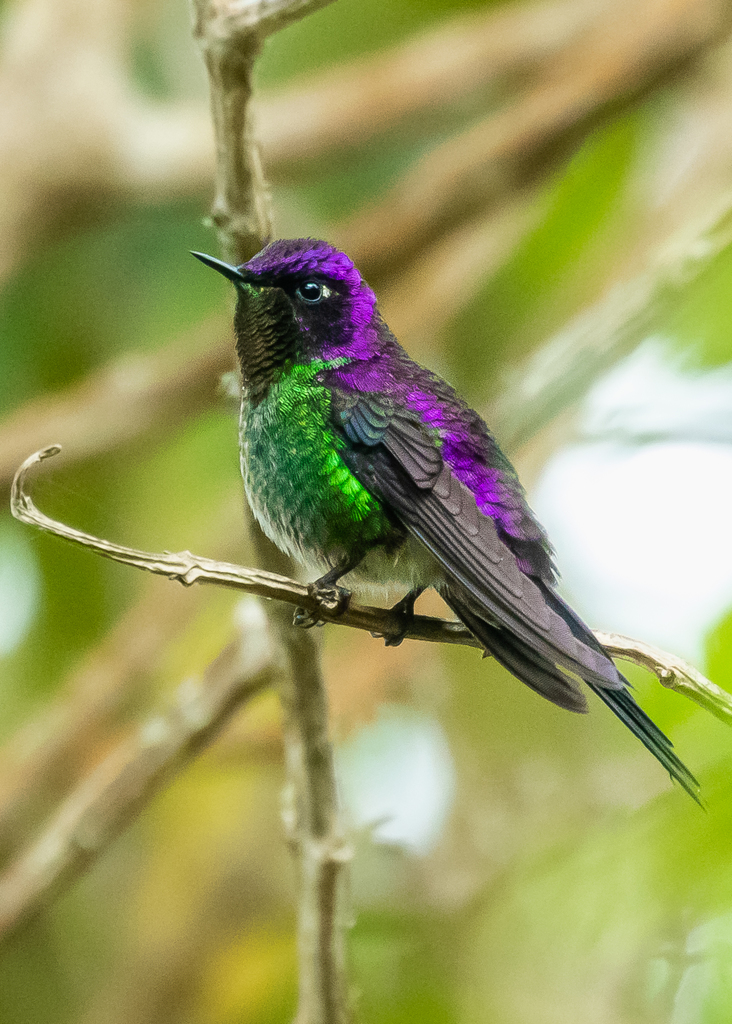
The purple-backed thornbill (Ramphomicron microrhynchum) is a species of hummingbird in the family Trochilidae. It is found in Bolivia, Colombia, Ecuador, Peru, and Venezuela. Its natural habitat is subtropical or tropical moist montane forests.
From the article Purple-backed thornbill on Wikipedia (CC BY-SA), quoted section by section
Description
The purple-backed thornbill is 8 to 9 cm (3.1 to 3.5 in) long and weighs about 3.5 g (0.12 oz). Both sexes have a black bill, the shortest of any hummingbird. Males of the nominate subspecies have metallic violet-purple upperparts with a white spot behind the eye. Their gorget is iridescent golden green, the underparts bronzy green, and the undertail coverts coppery with tawny fringes. The tail is moderately long, forked, and dark purple. Nominate females have shining green upperparts, and like the male, a white spot behind the eye. Their underparts are white with green dots except on the belly. The tail is shorter than the male's and less forked, bronzy purple, and the outer pair of feathers have white tips. Males of subspecies R. m. andicola have a green-bordered golden gorget and more rufous undertail coverts. R. m. albiventre is very similar to the nominate, but with lighter margins on the male's undertail coverts and smaller spots on the female's underparts. Males of R. m. bolivianum have metallic violet upperparts, dark green underparts, and grayish white undertail coverts.
Range & habitat
The subspecies of purple-backed thornbill are found thus:
R. m. andicola, Andes of western Venezuela, especially Mérida state R. m. microrhynchum, Andes of Colombia, Ecuador, and Cajamarca in northwestern Peru R. m. albiventre, Andes' eastern slope in Peru from Huánuco south to Apurímac and Cuzco R. m. bolivianum, Andes of Cochabamba Department in central Bolivia The purple-backed thornbill inhabits the edges of humid montane forest, Polylepis forest, páramo, and the transitions between them. R. m. bolivianum also occurs well below the treeline in shrubby areas. In elevation the species ranges from 1,700 to 3,600 m (5,600 to 11,800 ft).
Wikipedia: “Distribution and habitat”
What it does
The purple-backed thornbill forages for nectar from mid-level to the canopy, primarily by trap-lining. It has often been observed "robbing" nectar from holes in flowers made by Diglossa flowerpiercers. It has been recorded taking nectar from a wide variety of flowering plants, shrubs, and trees. In addition it feeds on insects caught on the wing and gleaned from flowers.
Wikipedia: “Feeding”
Listen
Looking for field recordings…
Where it lives
Recorded sightings
—
geo-referenced records in GBIF, from museums, herbaria and field observers.
Drag the globe to turn it. Dots are where records exist, not a range map; darker means more records.
In the stacks
Searching the stacks…
Every page naming Ramphomicron microrhynchum in the Biodiversity Heritage Library →
This page is assembled live from iNaturalist, GBIF, Wikipedia, the Source Library and the Internet Archive. It is not yet part of the hand-edited codex. iNaturalist taxon 6297.