- Animals
- ›Chordates
- ›Vertebrates
- ›Reptiles
- ›Snakes and Lizards
- ›Lizards
- ›Iguanas and Allies
- ›Iguanas, Anoles, and Allies
- ›Collared Lizards
- ›Gambelia
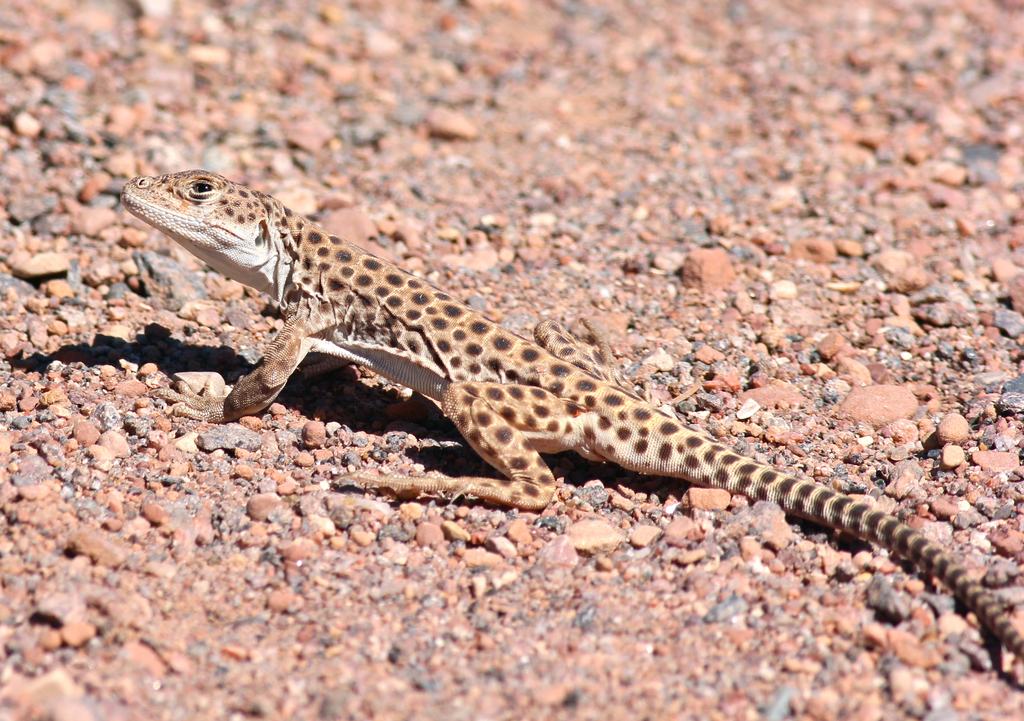
Long-nosed Leopard Lizard
Gambelia wislizenii
The long-nosed leopard lizard (Gambelia wislizenii) is a species of relatively large North American lizard in the family Crotaphytidae. Gambelia wislizenii ranges in snout-to-vent length (SVL) from 8.3 to 14.6 cm (3+1⁄4 to 5+3⁄4 in). It has a large head, a long nose, and a long round tail that can be longer than its body. It is closely related to the blunt-nosed leopard lizard (Gambelia sila), which closely resembles the long-nosed leopard lizard in body proportions, but has a conspicuously blunt snout. The species G. wislizenii, once considered part of the genus Crotaphytus, is under moderate pressure because of habitat destruction but is categorized as "least concern".
From the article Long-nosed leopard lizard on Wikipedia (CC BY-SA), quoted section by section
Description
Gambelia wislizenii has granular dorsal scales that can be white, cream, or gray with irregular brown or dark gray spots along its body and head. Sometimes they have dark bars across their back. The tail also has dark bars across it. Juveniles have more highly contrasted markings compared to adults, often with rusty coloring on the back or bright red spots, and yellow on the thighs and under the tail. The male and female are different in appearance. The female is about 15 cm (5.8 in) snout-vent length, and the male is smaller, measuring about 12 cm (4.8 in) SVL. Both sexes are capable of marked color changes. In its dark phase the lizard's spots are nearly hidden and light crossbars become quite obvious on both the body and the tail. In the light phase the opposite is true with the dominant color consisting of gray, pinkish, brown or yellowish brown hues. During the mating season females develop reddish orange spots and bars on their sides and underneath the tail when gravid. Males develop pink or rusty wash on the throat, chest, and sometimes the body, during the breeding season.
Range & habitat
The long-nosed leopard lizard prefers to inhabit arid and semiarid plains growth, like bunch grass, alkali bush, sagebrush, creosote bush, and other scattered low plants. The ground can be hardpan, sand, or even gravel with rocks that may often be used as basking sites. G. wislizenii prefers flat areas with open space for running, avoiding densely vegetated areas. It is found from near sea level to around 6,000 feet (1,800 m). Its range includes the western part of the United States from Oregon to Idaho in the north, south to northern Mexico in Baja California, Sonora, Coahuila, and Zacatecas and Casa Grande, Arizona. In San Diego County, it occurs east of the Peninsula Ranges within the Lower Colorado Desert. It is found in desert flats and lower foothills with little vegetation.
Wikipedia: “Distribution and habitat”
What it does
The long-nosed leopard lizard is often seen on small rocks along the roadside, preferring direct sunlight when basking. It is diurnal and has the potential to be active all day when the weather is mild to warm. The daily activity cycle starts relatively early (05:30–08:30, variation depends on location), and after a period of basking, long-nosed leopard lizards begin active hunting and feeding. When in danger, it uses a defense mechanism known as "freeze" behavior, which means it runs underneath a bush, flattens its body against the ground and is motionless until the threat is gone. If the case is extreme enough, such as capture, it is capable of caudal autotomy, or tail separation. Its speed and agility are major contributors to its predatory success as well as its ability to evade predators. When running at rapid speeds it runs with forelimbs raised.
Wikipedia: “Behaviors”
In human culture
The specific name or epithet, wislizenii, is in honor of the German-American surgeon and naturalist Frederick Adolph Wislizenus, who caught the first specimen near Santa Fe, New Mexico.
Wikipedia: “Etymology”
Where it lives
Recorded sightings
—
geo-referenced records in GBIF, from museums, herbaria and field observers.
Drag the globe to turn it. Dots are where records exist, not a range map; darker means more records.
In the stacks
Searching the stacks…
Every page naming Gambelia wislizenii in the Biodiversity Heritage Library →
This page is assembled live from iNaturalist, GBIF, Wikipedia, the Source Library and the Internet Archive. It is not yet part of the hand-edited codex. iNaturalist taxon 62797.