- Animals
- ›Chordates
- ›Vertebrates
- ›Birds
- ›Hawks, Eagles, Kites, and Allies
- ›Hawks, Eagles, and Kites
- ›Buteonine Hawks, Kites, and allies
- ›Leucopternis
On eBird ↗
Semiplumbeous Hawk
Live sightings near you, the range map, bar charts of when it is seen, and Macaulay Library photos and recordings.
Semiplumbeous Hawk
Leucopternis semiplumbeus
The semiplumbeous hawk (Leucopternis semiplumbeus) is a species of bird of prey in the family Accipitridae. It is found in Colombia, Costa Rica, Ecuador, Honduras, and Panama. Its natural habitat is subtropical or tropical moist lowland forests.
From the article Semiplumbeous hawk on Wikipedia (CC BY-SA), quoted section by section
Description
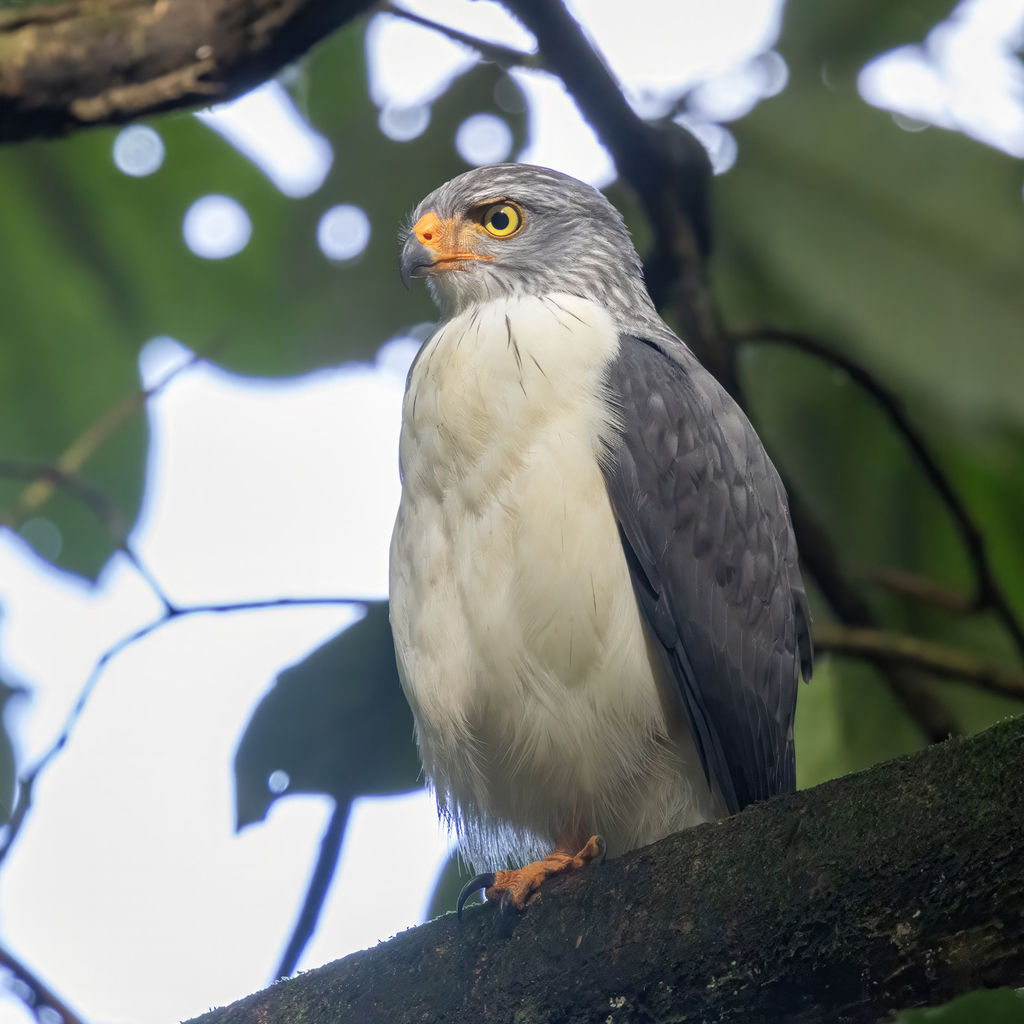
The semiplumbeous hawk is a small bird, averaging about 12–13 inches (30–33 cm) in length (approximately the size of a kestrel or merlin). It is dark gray above with white underparts and a white throat. The semiplumbeous hawk is easily identifiable due to its striking orange cere and black face mask. It has bright yellow eyes and its legs and feet are orange to orange-red in color.
Wikipedia: “Morphology”
Range & habitat
Semiplumbeous hawks can be found in the eastern part of Honduras and eastern Nicaragua, as well as in the southern areas of western Colombia (east to Magdalena Valley) and northwest Ecuador (Esmeraldas and northwest Pichincha). There have been several recent reports of semiplumbeous hawks being seen and heard in the Allpahuayo-Mishana National Reserve in northern Peru, which may refer to either this species or a closely related new species. Semiplumbeous hawks are typically found in humid forests located in tropical and lower subtropical zones. It can be observed in various locations such as forest edges, in and around forest fragments, and in tall second-growth areas throughout Colombia. Although it can be found from sea level up to 1000 m, it is usually present in elevations below 500 m. It has been reported up to 1600 m in altitude in one instance.
Wikipedia: “Habitat and distribution”
What it does
Semiplumbeous hawks are rarely seen in flight. Instead, these hawks typically perch silently on a high branch, waiting for prey. This sit-and-wait strategy of feeding is similar to the feeding behavior of other Leucopternis species. The semiplumbeous hawk often follows swarms of army ants in order to capture antbirds, which, along with other small songbirds, make up a large portion of its diet. It might also feed on bats, lizards and snakes. During the breeding season, this species is known to be quite vocal and produces a series of loud, piercing upslurred whistles that sound like "kwee...wee...wee...wee...wee." Outside of breeding season, it tends to be more silent, but may occasionally produce a high-pitched, thin upslurred whistle that is repeated at intervals.
Wikipedia: “Behavior, hunting, and diet”
Listen
Looking for field recordings…
Where it lives
Recorded sightings
—
geo-referenced records in GBIF, from museums, herbaria and field observers.
Drag the globe to turn it. Dots are where records exist, not a range map; darker means more records.
In the stacks
Searching the stacks…
Every page naming Leucopternis semiplumbeus in the Biodiversity Heritage Library →
This page is assembled live from iNaturalist, GBIF, Wikipedia, the Source Library and the Internet Archive. It is not yet part of the hand-edited codex. iNaturalist taxon 62532.