- Animals
- ›Chordates
- ›Vertebrates
- ›Ray-finned Fishes
- ›Spiny-rayed fishes
- ›Cichlids and Allies
- ›Cichlids
- ›South and Central American Cichlids
- ›Amatitlania
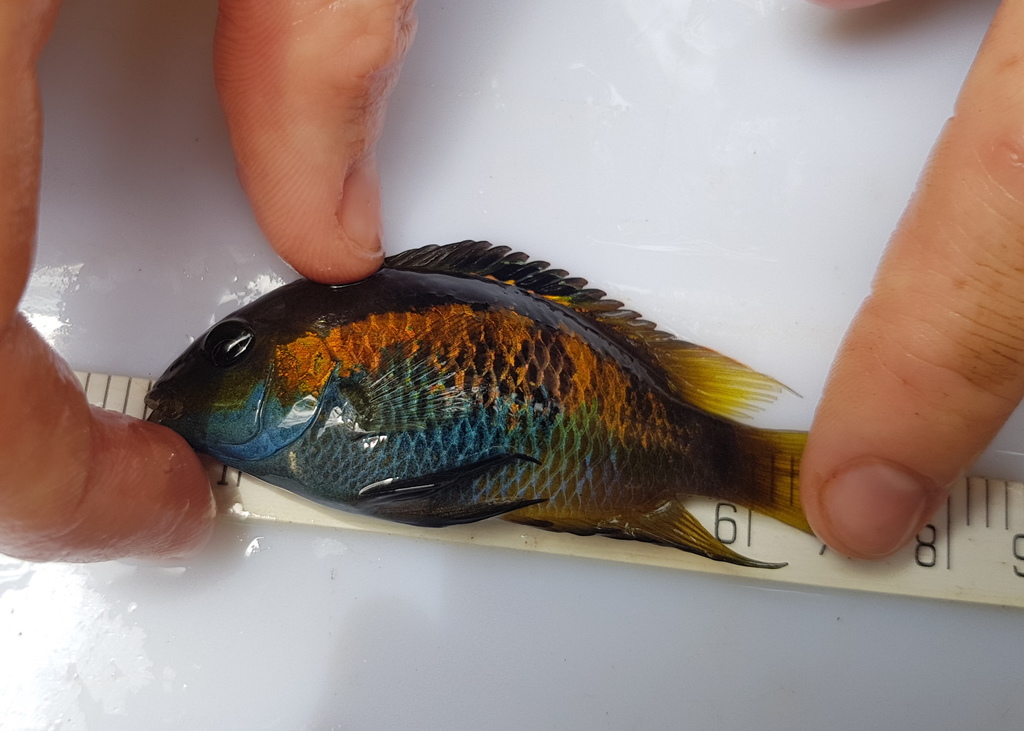
Seven-striped Cichlid
Amatitlania septemfasciata
Amatitlania septemfasciata (sometimes called the Seven-stripe Cichlid or Cutter's Cichlid) is a fish species in the cichlid family. It is found on the Atlantic slope of Costa Rica, between the San Juan River drainage and the Banano River. Several currently recognized cichlid species within the genus Amatitlania were formerly considered varieties of Amatitlania septumfasciata, including Amatitlania myrnae, the Topaz Cichlid, and Amatitlania cutteri (which also sometimes uses the common name "Cutter's Cichlid").
Prior to being placed in the genus Amatitlania, it had been considered a member of the genus Archocentrus. Within Amatitlania, Amatitlania septemfasciata is placed in the subgenus Bussingius, along with the T-bar Cichlid and several other species. However, a 2008 study led by Oldřich Říčan has suggested that all the related species A. septemfasciatus, should be moved into the genus Hypsophrys.
From the article Amatitlania septemfasciata on Wikipedia (CC BY-SA), quoted section by section
In human culture
Amatitlania septemfasciata grows to between 4 and 5 inches (10 and 13 cm). Males are typically larger than females. Both sexes generally have six vertical bars along each side. Females have a black spot or ocellus on the dorsal fin, which is generally surrounded by metallic coloration. It lives in rivers on the Atlantic slope of Costa Rica. It can be found in rivers of all velocities, including slow moving and fast moving rivers. The bottom of the rivers it lives in are generally covered by rocks and leaf litter. In its natural habitat, the pH is generally between 6.6 and 7.6 and the water temperature is between 21 and 27 degrees Celsius (70 to 81 degrees Fahrenheit). Its ability to protrude its jaw 3.5% standard length limits its diet to about 1% evasive prey. Amatitlania septemfasciata is an egg layer and a cave spawner. In breeds in crevices in the rocks at the bottom of the river. Spawnings typically result in 200 to 250 fry. The conservation status of Amatitlania septemfasciata has not been evaluated by the International Union for Conservation of Nature (IUCN).
Wikipedia: “Natural history”
Where it lives
Recorded sightings
—
geo-referenced records in GBIF, from museums, herbaria and field observers.
Drag the globe to turn it. Dots are where records exist, not a range map; darker means more records.
In the stacks
Searching the stacks…
Every page naming Amatitlania septemfasciata in the Biodiversity Heritage Library →
This page is assembled live from iNaturalist, GBIF, Wikipedia, the Source Library and the Internet Archive. It is not yet part of the hand-edited codex. iNaturalist taxon 623713.