- Animals
- ›Chordates
- ›Vertebrates
- ›Birds
- ›Swifts and Hummingbirds
- ›Hummingbirds
- ›Brilliants, Coquettes, and Allies
- ›Brilliants and Allies
- ›Coeligena
On eBird ↗
Collared Inca
Live sightings near you, the range map, bar charts of when it is seen, and Macaulay Library photos and recordings.
Collared Inca
Coeligena torquata
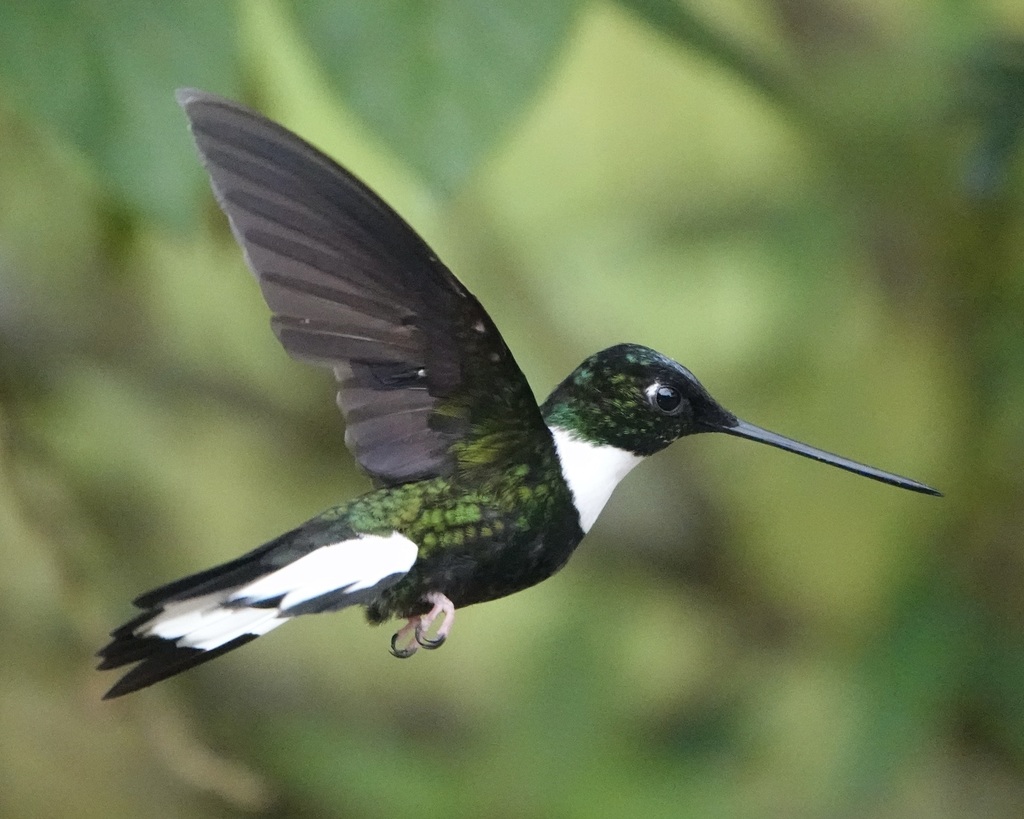
The collared inca (Coeligena torquata) is a species of hummingbird found in humid Andean forests from western Venezuela through Colombia and Ecuador to Peru. It is very distinctive in having a white chest-patch and white on the tail. Like other hummingbirds it takes energy from flower nectar (especially from bromeliads), while the plant benefits from the symbiotic relationship by being pollinated. Its protein source is small arthropods such as insects. It is normally solitary and can be found at varying heights above the ground, often in the open.
From the article Collared inca on Wikipedia (CC BY-SA), quoted section by section
Description
10–14 centimetres (3.9–5.5 in) in length, with a rather long (3–3.5 centimetres (1.2–1.4 in)), straight, black beak. Under most lighting conditions Coeligena torquata torquata appears black except for a very large and distinctive white chest-patch. However, in ideal lighting other features can be discerned: a shimmering metallic violet forehead patch in males, white thighs, fleshy-dusky feet, shimmering green throat in males, dull and containing some white in females, and some dark green mixed in with the black of the body. The tail of both sexes is black except for white on the basal half of the outer four rectrices, and part of the underside. The female is slightly lighter green overall than the male and has a slightly smaller chest-patch Vocalizations are infrequent. Quiet, low-pitched, reedy whistle "tu-tee." Longer series of "pip... pip..." Very quiet spitting sound when foraging.
Range & habitat
Humid subtropical and temperate forest regions, including cloud forests on both slopes of the Andes from Venezuela to Bolivia between 1,800 metres (5,900 ft) and 3,000 metres (9,800 ft), usually above 2,100 metres (6,900 ft) in Ecuador. It typically forages below half the height of the canopy, and can most often be found around thickets near the forest edge. It is fairly common throughout most of its range. No reasons for concern have been claimed.
Wikipedia: “Distribution and habitat”
What it does
Like other hummingbirds, the collared inca obtains most of its energy from nectar, which it drinks while it in turn pollinates the flower, and feeds on insects and other small insect-like arthropods as a source of protein. It seems to prefer epiphytes. It is a solitary trap-liner, meaning that it forages alone by flying a routine route between several flowers.
Wikipedia: “Diet”
Listen
Looking for field recordings…
Where it lives
Recorded sightings
—
geo-referenced records in GBIF, from museums, herbaria and field observers.
Drag the globe to turn it. Dots are where records exist, not a range map; darker means more records.
In the stacks
Searching the stacks…
Every page naming Coeligena torquata in the Biodiversity Heritage Library →
This page is assembled live from iNaturalist, GBIF, Wikipedia, the Source Library and the Internet Archive. It is not yet part of the hand-edited codex. iNaturalist taxon 6214.