- Animals
- ›Chordates
- ›Vertebrates
- ›Birds
- ›Swifts and Hummingbirds
- ›Hummingbirds
- ›Brilliants, Coquettes, and Allies
- ›Coquettes and Allies
- ›Heliangelus
On eBird ↗
Royal Sunangel
Live sightings near you, the range map, bar charts of when it is seen, and Macaulay Library photos and recordings.
Royal Sunangel
Heliangelus regalis
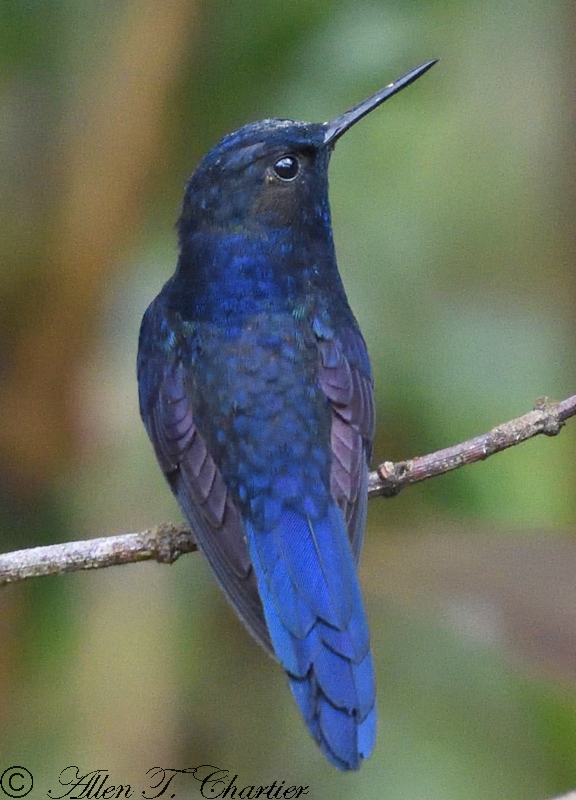
The royal sunangel (Heliangelus regalis) is a species of hummingbird. It is endemic to subtropical elfin forests and shrubs in the Andes of northern Peru and adjacent south-eastern Ecuador. It is endangered due to habitat loss. It is strongly sexually dichromatic, and while females resemble other female sunangels, males are unique with their iridescent dark blue plumage.
From the article Royal sunangel on Wikipedia (CC BY-SA), quoted section by section
Description
The royal sunangel is 10 to 12 cm (3.9 to 4.7 in) long and weighs 3.4 to 4.5 g (0.12 to 0.16 oz). Its black bill is short and straight. Both subspecies are strongly sexually dichromatic. The adult males are unique among genus Heliangelus: Their bodies are entirely dark blue. The nominate's plumage is slightly shiny, with significant iridescence only on its forecrown (just above the bill). H. r. johnsoni is intensely iridescent all over and especially so on the crown, throat, and upper breast. The male nominate's tail is dark metallic violet-purple and that of johnsoni is metallic indigo. Both males' tails are deeply forked. Adult females of the two subspecies are similar to those of the rest of genus Heliangelus and differ only slightly between them. They are dark green above and rich cinnamon with bronzy green discs below. A buffy breastband separates the throat and chest. Their tails are not as deeply forked as those of the males. The nominate female's tail is blue-black and that of johnsoni is metallic indigo like that of the male. Juveniles are like the females but with gray spots instead of green on the throat. The amount of blue in males increases with age and typically the gorget is the first area to achieve it.
Range & habitat
The nominate subspecies of royal sunangel is mostly found in the Cordillera del Cóndor of Peru's Cajamarca and Amazonas departments, and also on the east slope of the Andes in Peru's departments of San Martín and Loreto. It was first documented in extreme southeastern Ecuador's Zamora-Chinchipe Province in 2008. H. r. johnsoni is found only in the Cordillera Azul of northern Peru. The royal sunangel inhabits a few specialized landscapes. It is most numerous in "elfin scrub", a rather dry grassland habitat with mossy stunted forest and small bushes that forms the transition between dry savannah and humid elfin forest. It is also found in steep wooded ravines, and in Ecuador is most numerous on sandstone ridges with páramo-like vegetation but also in medium-elevation forest. The species is most abundant between 1,500 and 2,200 m (4,900 and 7,200 ft) of elevation. It has been documented as low as 1,250 m (4,100 ft) and there are sight records between 550 and 700 m (1,800 and 2,300 ft) in Peru.
Wikipedia: “Distribution and habitat”
What it does
The royal sunangel feeds on nectar and insects. Several flowering plants, shrubs, and small trees have been identified as nectar sources. Males are highly territorial at flowering bushes. Both sexes often feed by perching on a flower rather than hovering, and they have been observed "robbing" nectar from holes pierced by other birds. They capture insects by hawking from a perch and by gleaning from vegetation.
Wikipedia: “Feeding”
Listen
Looking for field recordings…
Where it lives
Recorded sightings
—
geo-referenced records in GBIF, from museums, herbaria and field observers.
Drag the globe to turn it. Dots are where records exist, not a range map; darker means more records.
In the stacks
Searching the stacks…
Every page naming Heliangelus regalis in the Biodiversity Heritage Library →
This page is assembled live from iNaturalist, GBIF, Wikipedia, the Source Library and the Internet Archive. It is not yet part of the hand-edited codex. iNaturalist taxon 6200.