- Animals
- ›Chordates
- ›Vertebrates
- ›Birds
- ›Swifts and Hummingbirds
- ›Hummingbirds
- ›Bee Hummingbirds, Emeralds, Mountain-gems, and Allies
- ›Bee Hummingbirds and Allies
- ›Chaetocercus
On eBird ↗
Rufous-shafted Woodstar
Live sightings near you, the range map, bar charts of when it is seen, and Macaulay Library photos and recordings.
Rufous-shafted Woodstar
Chaetocercus jourdanii
The rufous-shafted woodstar (Chaetocercus jourdanii) is a species of hummingbird in the Trochilidae family. It is found in Venezuela, Trinidad and Tobago and far northeastern Colombia. Its natural habitats are subtropical or tropical moist montane forests and heavily degraded former forest.
From the article Rufous-shafted woodstar on Wikipedia (CC BY-SA), quoted section by section
Description
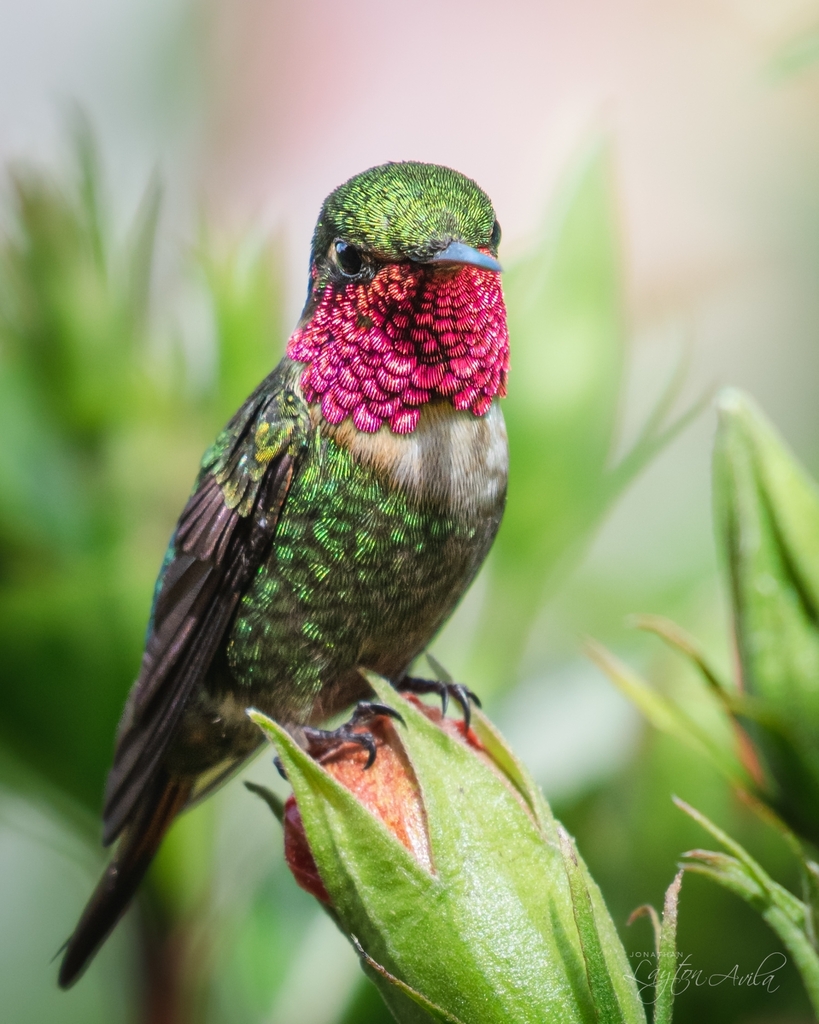
The rufous-shafted woodstar is 6 to 8 cm (2.4 to 3.1 in) long. Both sexes of all subspecies have a straight black bill and white patches on their flank behind the wing. Males of the subspecies differ only in the color of their gorget: violet in the nominate, rosy crimson in C. j. rosae, and a less purple rosy in C. j. andinus. Females do not differ across the subspecies. Males have bottle green upperparts, a white breast, and a green belly. Their tail is deeply forked; the feathers are black with orange shafts. Females are bronzy green above and rufous below. The tail has two rounded "lobes"; the central feathers are green and the others cinnamon with a dark bar near the end. The male rufous-shafted woodstar sings "a rising 3–4-note 'tssit, tssit, tssit, tssit'" from a treetop perch. As of July 2020, Cornell Lab of Ornithology's Macaulay Library has very few recordings of the species and xeno-canto has none.
Range & habitat
The nominate subspecies of rufous-shafted woodstar is found in northeastern Venezuela's Sucre and Monagas states and, according to some taxonomies, in Trinidad as well. However, the South American Classification Committee of the American Ornithological Society lists it as resident in Venezuela but only a vagrant to Trinidad. Subspecies C. j. rosae is found in northern Venezuela between the states of Falcón and Miranda. C. j. andinus is found in the Sierra de Perijá that straddles the border between Colombia and Venezuela, the eastern Andes of Colombia, and the Andes of Venezuela between Táchira and Lara states. The rufous-shafted woodstar inhabits semi-open and open landscapes such as scrublands, the edge of montane forest, and coffee plantations; it occasionally visits the lower parts of the páramo. In elevation it ranges between 900 and 3,000 m (3,000 and 9,800 ft), though there is some question about the accuracy of records higher than 2,500 m (8,200 ft). At least in Venezuela, the rufous-shafted woodstar is known to move between higher elevations in the dry season and lower ones in the rainy season.
Wikipedia: “Distribution and habitat”
What it does
The rufous-shafted woodstar forages at all levels of the vegetation, but more often between the middle and upper strata. It takes nectar from a variety of flowering plants and trees such as Inga. It also eats small arthropods. It does not defend feeding territories, and because of its small size and slow bumblebee-like flight it is sometimes able to feed in the territories of other hummingbirds.
Wikipedia: “Food and feeding”
Listen
Looking for field recordings…
Where it lives
Recorded sightings
—
geo-referenced records in GBIF, from museums, herbaria and field observers.
Drag the globe to turn it. Dots are where records exist, not a range map; darker means more records.
In the stacks
Searching the stacks…
Every page naming Chaetocercus jourdanii in the Biodiversity Heritage Library →
This page is assembled live from iNaturalist, GBIF, Wikipedia, the Source Library and the Internet Archive. It is not yet part of the hand-edited codex. iNaturalist taxon 6177.