- Animals
- ›Chordates
- ›Vertebrates
- ›Birds
- ›Swifts and Hummingbirds
- ›Hummingbirds
- ›Brilliants, Coquettes, and Allies
- ›Coquettes and Allies
- ›Adelomyia
On eBird ↗
Speckled Hummingbird
Live sightings near you, the range map, bar charts of when it is seen, and Macaulay Library photos and recordings.
Speckled Hummingbird
Adelomyia melanogenys
The speckled hummingbird (Adelomyia melanogenys) is a species of hummingbird. It is the only member of the genus Adelomyia. It inhabits Neotropical montane cloud forests at elevations of 1,000–2,500 meters and is confined to the Andes of Argentina, Bolivia, Peru, Ecuador, Colombia and Venezuela; as well as to some isolated montane forests in western Ecuador and Venezuela. In Ecuador, it ranges across both the eastern and western slopes of the Andes and occupies a broad altitudinal range from subtropical forests (1400 m) to cloud forests (3000 m). In addition, one isolated population inhabits the Chongón Colonche cordillera in the coastal evergreen montane forest (600 m) located ca. 130 km away from the Andes.
From the article Speckled hummingbird on Wikipedia (CC BY-SA), quoted section by section
Description
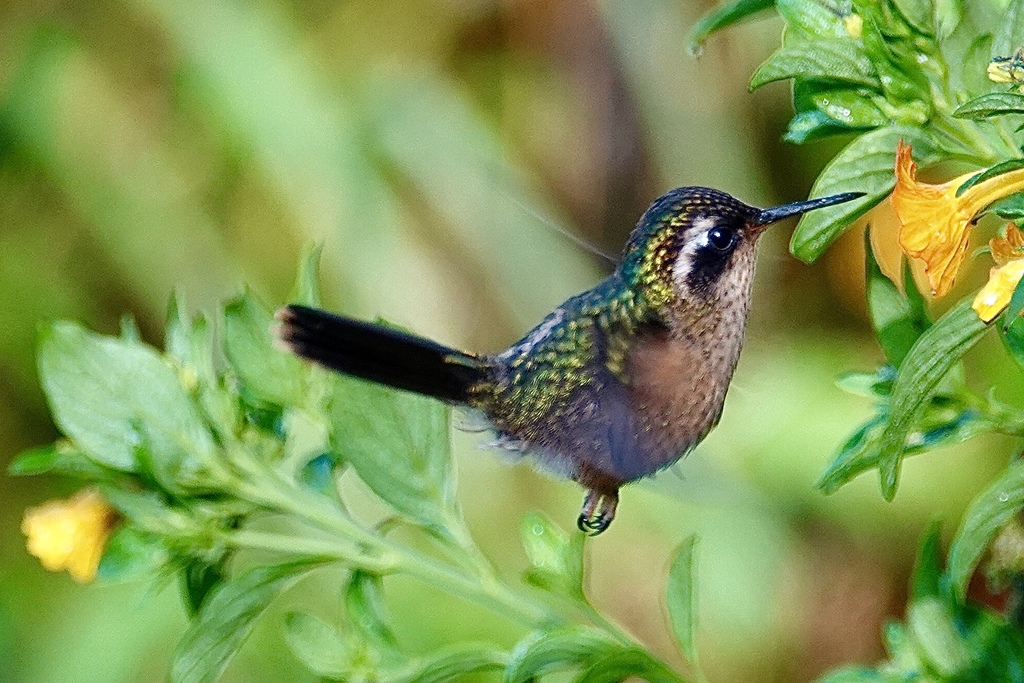
The speckled hummingbird is a monomorphic species, making females and males indistinguishable. Adults measure approximately 8 cm, or 3 inches, in length (from bill to tip of tail). The upper plumage is a glossy green/bronze. The underside is pale, with green and bronze specks. It has a black cheek patch below its eye with a white stripe above.
What it does
The speckled hummingbird is a solitary species. They neither live nor migrate in flocks and there is no pair bond for this species, making them a mainly sedentary species. Nevertheless, individuals may disperse to lower altitudes as the breeding periods finish.
Breeding. Males do not participate in any part of nest building or brooding of the young, and disengage with female partners after copulation. Though, both males and females may be promiscuous, having multiple partners. Female speckled hummingbirds incubate and feed nestlings. A clutch consists of two white eggs; measurements consist of 12.4 mm × 8.7 mm and 12.6 mm × 8.6 mm. The incubation period lasts approximately 17–20 days. The species broods for shorter durations than most hummingbirds during incubation. Speckled hummingbirds often travel several kilometers to avoid competition, making visits to the nest less frequent. After the young hatch, the adult continues brooding hatchlings for 7–8 days. After brooding and until the young have fledged, the adult will no longer enter the nest and instead perch nearby, potentially watching for predators. This behavior is curious, as perching outside a nest may alert predators of its location. Nests can be found all year round, and consist of a bulky cup shaped of moss and cobweb, lined with plant fibre. …
Wikipedia: “Behavior”
Listen
Looking for field recordings…
Where it lives
Recorded sightings
—
geo-referenced records in GBIF, from museums, herbaria and field observers.
Drag the globe to turn it. Dots are where records exist, not a range map; darker means more records.
In the stacks
Searching the stacks…
Every page naming Adelomyia melanogenys in the Biodiversity Heritage Library →
This page is assembled live from iNaturalist, GBIF, Wikipedia, the Source Library and the Internet Archive. It is not yet part of the hand-edited codex. iNaturalist taxon 6166.