- Animals
- ›Chordates
- ›Vertebrates
- ›Birds
- ›Swifts and Hummingbirds
- ›Hummingbirds
- ›Bee Hummingbirds, Emeralds, Mountain-gems, and Allies
- ›Emerald Hummingbirds and Allies
- ›Leucippus
On eBird ↗
Buffy Hummingbird
Live sightings near you, the range map, bar charts of when it is seen, and Macaulay Library photos and recordings.
Buffy Hummingbird
Leucippus fallax
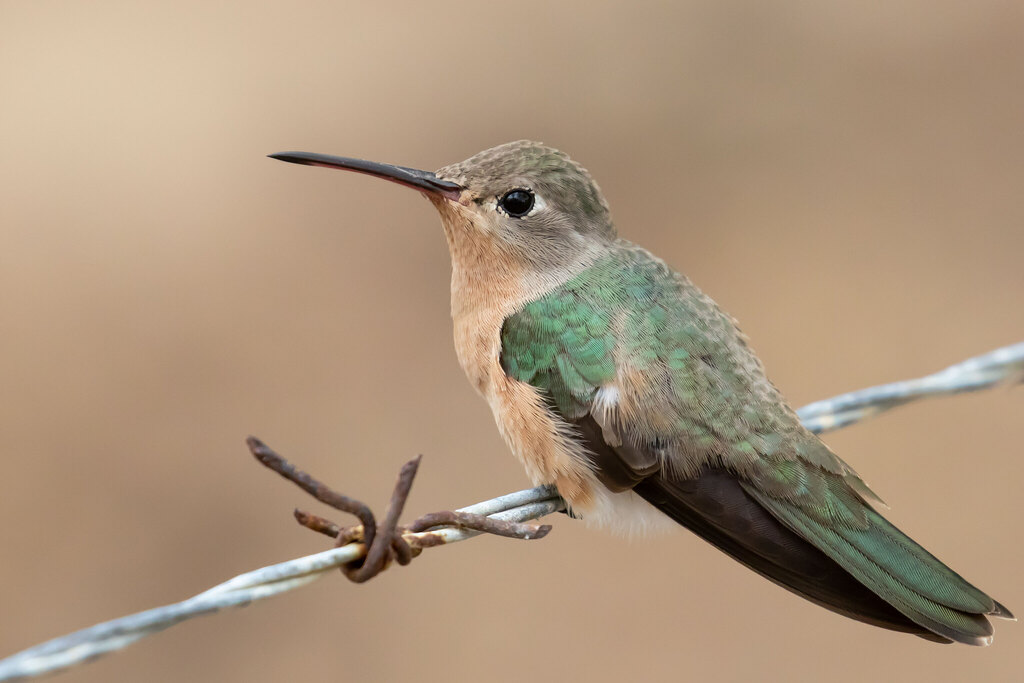
The buffy hummingbird (Leucippus fallax) is a species of bird in the hummingbird family Trochilidae. It is the only species placed in the genus Leucippus. This bird lives in dry forest and scrubland in northern South America where it feeds on insects and the nectar, flesh, and juice of cactus fruits.
From the article Buffy hummingbird on Wikipedia (CC BY-SA), quoted section by section
Description
The male and female buffy hummingbird are similar in appearance but the female tends to be less brightly coloured, and there is considerable variation in shade between individuals. The back and upper parts of the bird are a dull green, the underparts pale cinnamon-buff and the belly and undertail coverts white. The tail is dull green with a transverse grey bar and a rounded end. There is a white spot behind the eye and the beak is slender and straight. The upper mandible is black and the lower one pale with a black tip. The bird ranges from 8.5 to 9 cm (3.3 to 3.5 in) in length.
Range & habitat
The buffy hummingbird is found in Colombia, French Guiana, and Venezuela. Its natural habitats are desert shrubland, thorny shrubs in arid areas and mangrove areas at elevations of up to 500 metres (1,600 ft). It forages at medium heights and near the ground. It tends to feed near the canopy of the forests that it inhabits.
Wikipedia: “Distribution and habitat”
What it does
Hummingbirds are specialist feeders on nectar and the buffy hummingbird consumes the nectar of such plants as Agave and Hibiscus and various species of cacti. The hummingbird will protect the flower patches that it feeds from. This hummingbird is unusual in that it also consumes the exposed flesh and the juice of the fruits of cacti in the genus Armatocereus. This hummingbird also plays an important role in the pollination of flowers of Melocactus, carrying the pollen on its plumage as it moves from flower to flower sipping nectar. In addition to plant matter, the bird consumes insects, which it catches in flight.
Wikipedia: “Feeding”
Listen
Looking for field recordings…
Where it lives
Recorded sightings
—
geo-referenced records in GBIF, from museums, herbaria and field observers.
Drag the globe to turn it. Dots are where records exist, not a range map; darker means more records.
In the stacks
Searching the stacks…
Every page naming Leucippus fallax in the Biodiversity Heritage Library →
This page is assembled live from iNaturalist, GBIF, Wikipedia, the Source Library and the Internet Archive. It is not yet part of the hand-edited codex. iNaturalist taxon 6158.