- Animals
- ›Chordates
- ›Vertebrates
- ›Ray-finned Fishes
- ›Carps, Characins, Catfishes and Allies
- ›Characins
- ›Characoidei
- ›Iguana Tetras
- ›Bryconops
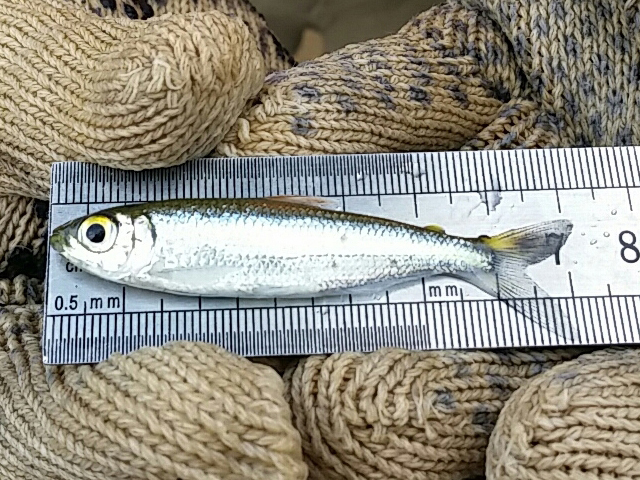
Bryconops alburnoides
Bryconops alburnoides is a small species of freshwater ray-finned fish belonging to the family Iguanodectidae. This fish is found in the rivers of South America. It has a slender body, with a yellowish dorsal fin and yellow-tinged back scales that fade into silver on its belly. It is largely an insectivore that picks land-dwelling insects from the riverbanks, though it eats much more whenever rain washes prey into the water.
From the article Bryconops alburnoides on Wikipedia (CC BY-SA), quoted section by section
Description
Bryconops alburnoides reaches 15 cm (5.9 inches) at a maximum in standard length (tail fin not included), with a generally elongated body. The genus Bryconops as a whole has been described as slender-bodied and "smelt-like", similar to sister genus Piabucus; B. alburnoides is no exception. B. alburnoides is one of the larger members of the genus by a considerable margin. The lateral line has 50 to 62 scales. B. alburnoides has a yellowish dorsal fin, which is a feature that can be used to distinguish it from other members of the genus that look similar. The upper and lower margins of the caudal fin are also tinted yellow. A congener, Bryconops gracilis, has frequently been misidentified as B. alburnoides, thanks to a yellowish dorsal fin and a similar number of lateral-line scales. However, B. alburnoides has three rows of premaxillary teeth, while B. gracilis only has two, making for a definitive way to tell the two apart.
Range & habitat
Like the rest of the genus Bryconops, B. alburnoides is found solely in South American freshwater habitats. It is local to the Amazon and Orinoco river basins, as well as flood-plain lakes in the lower Orinoco region. Bryconops alburnoides is an insectivore, demonstrating a marked preference for terrestrial insects. Its consumption increases opportunistically with windy and rainy weather, which sweeps more prey into its aquatic habitat. This is in line with other members of the genus, all of which have a diet that consists at least partially of insects.
== References ==
Wikipedia: “Habitat and ecology”
In human culture
Many members of the genus Bryconops draw comparisons to other taxa, but B. alburnoides in particular bears a resemblance to members of the cyprinid genus Alburnus. This, in fact, is the origin of its specific epithet; the suffix "–oides" means "with the form of" or "resembling", hence alburnoides. The genus name Bryconops in itself is a reference to another taxon - Brycon is a genus of characins that also lives in South America. Therefore, B. alburnoides' full scientific name means "resembling Brycon and Alburnus". The name Brycon originates in Greek, and comes from the word "bryko", which means "to bite" or "to eat". This is in reference to the notable set of teeth that all members of the genus are equipped with. The name alburnoides is also used for the genus Alburnoides, consisting of cyprinid fishes that inhabit Europe and Asia. Outside of similar nomenclature, Alburnoides is entirely unrelated to B. alburnoides.
Wikipedia: “Etymology”
Where it lives
Recorded sightings
—
geo-referenced records in GBIF, from museums, herbaria and field observers.
Drag the globe to turn it. Dots are where records exist, not a range map; darker means more records.
In the stacks
Searching the stacks…
Every page naming Bryconops alburnoides in the Biodiversity Heritage Library →
This page is assembled live from iNaturalist, GBIF, Wikipedia, the Source Library and the Internet Archive. It is not yet part of the hand-edited codex. iNaturalist taxon 615533.