- Animals
- ›Chordates
- ›Vertebrates
- ›Ray-finned Fishes
- ›Spiny-rayed fishes
- ›Gobies, cardinalfishes and allies
- ›Gobies and allies
- ›Gobies
- ›Sea Gobies
- ›Elacatinus
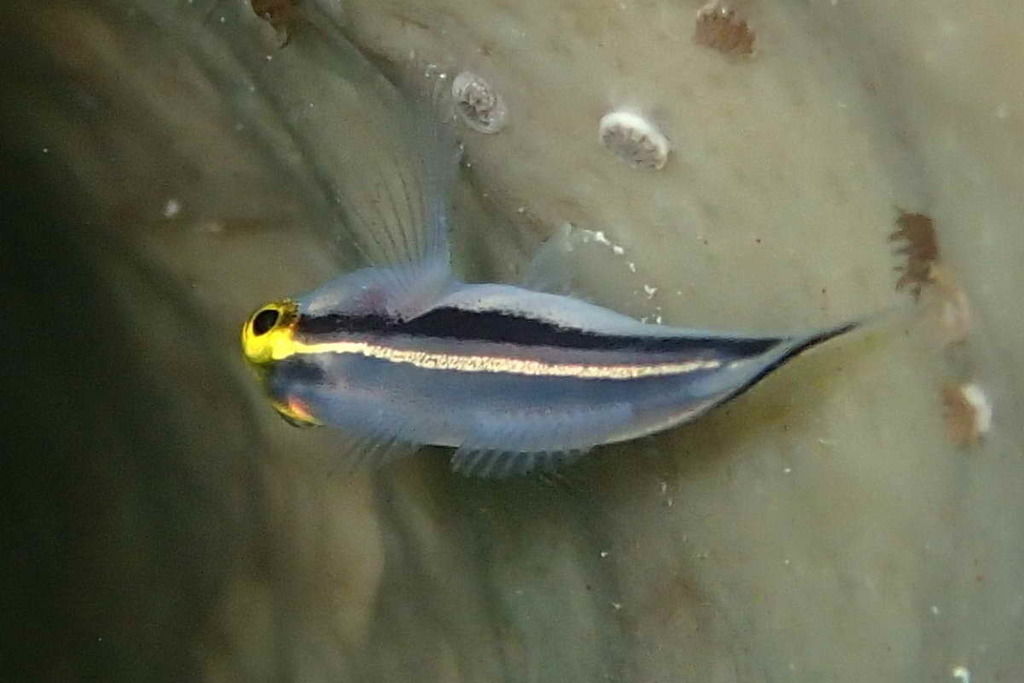
Belize Sponge Goby
Elacatinus colini
Elacatinus colini, the Belize sponge goby, is a species of goby native to the Western Central Atlantic Ocean, near Belize and Honduras. Its specific name honours Patrick L. Colin, of the Coral Reef Research Foundation, Palau, who made a comparative study of the genus Elacatinus for his doctoral thesis.
From the article Elacatinus colini on Wikipedia (CC BY-SA), quoted section by section
Description
Elacatinus colini was originally thought to be a color variant of E. xanthiprora from Florida but was recently classified as its own species due to the presence of a bright white, not yellow, stripe along its body. E. colini are typically around 3 cm in length (3.2 cm SL for males, 3.4 cm SL for females), and can be easily identified by the white strip running from its anterior to posterior end. On the E. colini's head, the lateral stripe is relatively small – about the same width as its pupil. However, on its body, the lateral stripe widens to about the same width as its eye. E. colini typically have 8 dorsal spines, 10-12 dorsal soft rays, 1 anal spine, 10–11 anal soft rays, and 17-19 pectoral rays. They lack scales and are covered with a thick adherent mucus. The bodies of E. colini are bluish-greenish gray above their lateral stripe, with the dorsal part of their head, iris, and lips exhibiting a bright yellow color and the ventral part of their body being white. Their fins are a translucent gray color.
Wikipedia: “Appearance”
Range & habitat
Elacatinus colini live in marine systems in symbiotic relationships with various species of sponges, using them as shelter. They have been found to live in Carrie Bow Cay in Belize and Utila Island in Honduras. They live in shallow sponge, between 2–17 metres (6 ft 7 in – 55 ft 9 in) deep but it is possible that they live deeper as well. E. colini inhabit tropical areas, 17ºN - 16ºN, 88ºW - 89ºW. According to Tassell, E. colini can occupy an area of about 11,184 km2.
Wikipedia: “Habitat”
What it does
In a study performed by Majoris, Francisco, Atema and Buston, it was shown that E. colini larvae survived in higher numbers when fed wild-caught plankton as opposed to Rotifers (microscopic aquatic animals) and Artemia (a genus of aquatic crustaceans). The study also showed that the standard length of E. colini was higher when fed a diet of plankton as opposed to Artemia or rotifer. Researchers postulated this could be because larvae may not have developed the ability to digest Artemia and Rotifer, because Artemia could have changed water quality and thus affected the ability of the E. colini larvae to survive, or because the Artemia could have depleted the oxygen levels in the water and consequently lowered the survival rate of E. colini. However, this last hypothesis is the least likely because the research tanks were well oxygenated.
Wikipedia: “Diet”
In human culture
Its specific name honours Patrick L. Colin, of the Coral Reef Research Foundation, Palau, who made a comparative study of the genus Elacatinus for his doctoral thesis.
Wikipedia: “Etymology”
Where it lives
Recorded sightings
—
geo-referenced records in GBIF, from museums, herbaria and field observers.
Drag the globe to turn it. Dots are where records exist, not a range map; darker means more records.
In the stacks
Searching the stacks…
Every page naming Elacatinus colini in the Biodiversity Heritage Library →
This page is assembled live from iNaturalist, GBIF, Wikipedia, the Source Library and the Internet Archive. It is not yet part of the hand-edited codex. iNaturalist taxon 614474.