- Fungi Including Lichens
- ›Basidiomycete Fungi
- ›Higher Basidiomycetes
- ›Mushrooms, Bracket Fungi, Puffballs, and Allies
- ›Agaricomycetidae
- ›Common Gilled Mushrooms and Allies
- ›Agaricineae
- ›Field Mushrooms and Allies
- ›Agariceae
- ›Agaricus
- ›Pseudochitonia
- ›Bivelares
- ›Hortenses
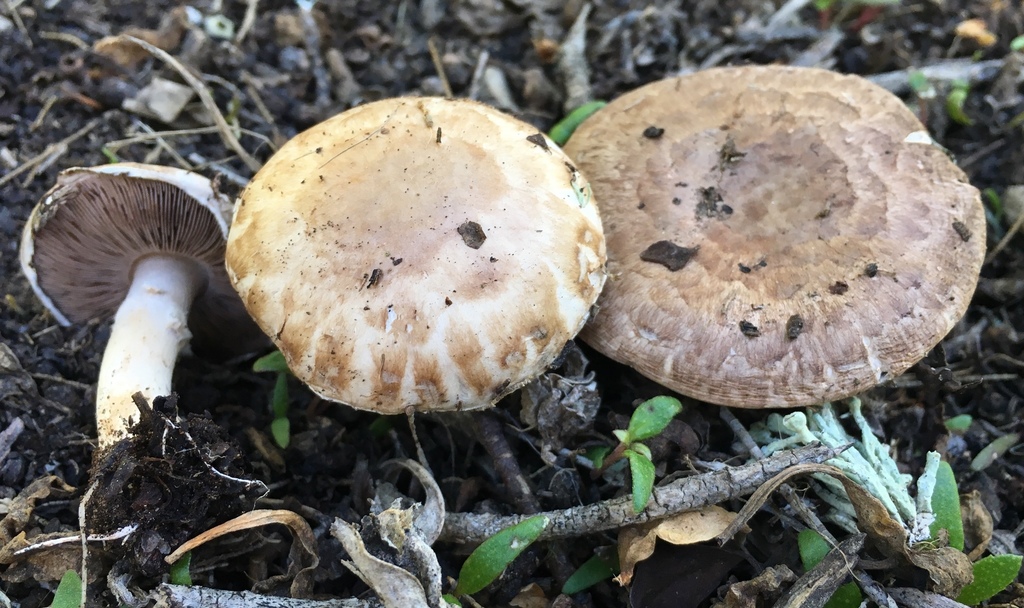
White Button Mushroom
Agaricus bisporus
Agaricus bisporus, the cultivated mushroom, is a basidiomycete mushroom native to grasslands in Eurasia and North America. It is cultivated in more than 70 countries and is one of the most commonly and widely consumed mushrooms in the world. It has two color states while immature – white and brown – both of which have various names, with additional names for the mature state, such as chestnut, portobello, portabellini, button, cremini, and champignon de Paris (see Names below).
Some poisonous lookalikes in the wild, such as Entoloma sinuatum, may appear similar. Amanita phalloides, or death cap, which is extremely toxic, has also been mistaken for A. bisporus. Often grows in rich soil and compost.
From the article Agaricus bisporus on Wikipedia (CC BY-SA), quoted section by section
Description
The pileus or cap of the original wild species is a pale grey-brown, with broad, flat scales on a paler background and fading toward the margins. It is first hemispherical before flattening out with maturity, typically measuring 5–10 centimetres (2–4 inches) in diameter. The narrow, crowded gills are free and initially pink, then red-brown, and finally a dark brown with a whitish edge from the cheilocystidia. The cylindrical stipe is up to 6 cm (2+1⁄2 in) tall by 1–2 cm (1⁄2–3⁄4 in) wide and bears a thick and narrow ring, which may be streaked on the upper side. The firm flesh is white, although it stains a pale pinkish-red on bruising. The spore print is dark brown. The spores are oval to round and measure approximately 4.5–5.5 μm × 5–7.5 μm, and the basidia usually two-spored, although two four-spored varieties have been described from the Mojave Desert and the Mediterranean, with predominantly heterothallic and homothallic lifestyles, respectively.
Similar species. The common mushroom could be confused with young specimens of a group of lethal mushrooms in the Amanita genus referred to as destroying angels, but the latter may be distinguished by their volva or cup at the base of the mushroom and pure white gills (as opposed to pinkish or brown of A. bisporus). A more common and less dangerous mistake is to confuse Agaricus bisporus with A. …
Range & habitat
This mushroom is widespread worldwide, fruiting from autumn to winter, especially in association with cypress, rich soil, compost, and manure.
Wikipedia: “Distribution and habitat”
At the table
A. bisporus mushrooms are 92% water, 3% carbohydrates, 3% protein, and contain negligible fat. In a reference amount of 100 g (3.5 oz), raw white mushrooms provide 93 kilojoules (22 kilocalories) of food energy and are an excellent source (20% or more of the Daily Value, DV) of the B vitamins riboflavin, niacin, and pantothenic acid. Fresh mushrooms are also a good source (10–19% DV) of the dietary minerals phosphorus and potassium. While fresh A. bisporus only contains 0.2 micrograms (8 IU) of vitamin D per 100 g, the ergocalciferol (D2) content increases substantially to 11.2 micrograms (446 IU) after exposure to UV light.
Wikipedia: “Nutrition”
In human culture
The earliest scientific description of the commercial cultivation of A. bisporus was made by French botanist Joseph Pitton de Tournefort in 1707. French agriculturist Olivier de Serres noted that transplanting mushroom mycelia would lead to the propagation of more mushrooms. Originally, cultivation was unreliable as mushroom growers would watch for good flushes of mushrooms in fields before digging up the mycelium and replanting them in beds of composted manure or inoculating 'bricks' of compressed litter, loam, and manure. Spawn collected this way contained pathogens, and crops would be infected or not grow. In 1893, sterilized, or pure culture, spawn was discovered and produced by the Pasteur Institute in Paris for cultivation on composted horse manure.
Modern commercial varieties of the common agaricus mushroom were originally light brown. The white mushroom was discovered in 1925 growing among a bed of brown mushrooms at the Keystone Mushroom Farm in Coatesville, Pennsylvania. Louis Ferdinand Lambert, the farm's owner and a mycologist by training, brought the white mushroom back to his laboratory. As with the reception of white bread, it was seen as a more attractive food item and became grown and distributed. Similar to the commercial development history of the navel orange and Red Delicious apple, cultures were grown from the mutant individuals. …
Wikipedia: “History”
Where it lives
Recorded sightings
—
geo-referenced records in GBIF, from museums, herbaria and field observers.
Drag the globe to turn it. Dots are where records exist, not a range map; darker means more records.
In the stacks
Searching the stacks…
Every page naming Agaricus bisporus in the Biodiversity Heritage Library →
This page is assembled live from iNaturalist, GBIF, Wikipedia, the Source Library and the Internet Archive. It is not yet part of the hand-edited codex. iNaturalist taxon 61395.