- Animals
- ›Arthropods
- ›Crustaceans
- ›Typical Crustaceans
- ›Malacostracans
- ›Decapods, Isopods, and allies
- ›Decapods and Krill
- ›Decapods
- ›Crabs, Lobsters, Shrimps, and Allies
- ›Spiny and Slipper Lobsters
- ›Spiny Lobsters
- ›Panulirus
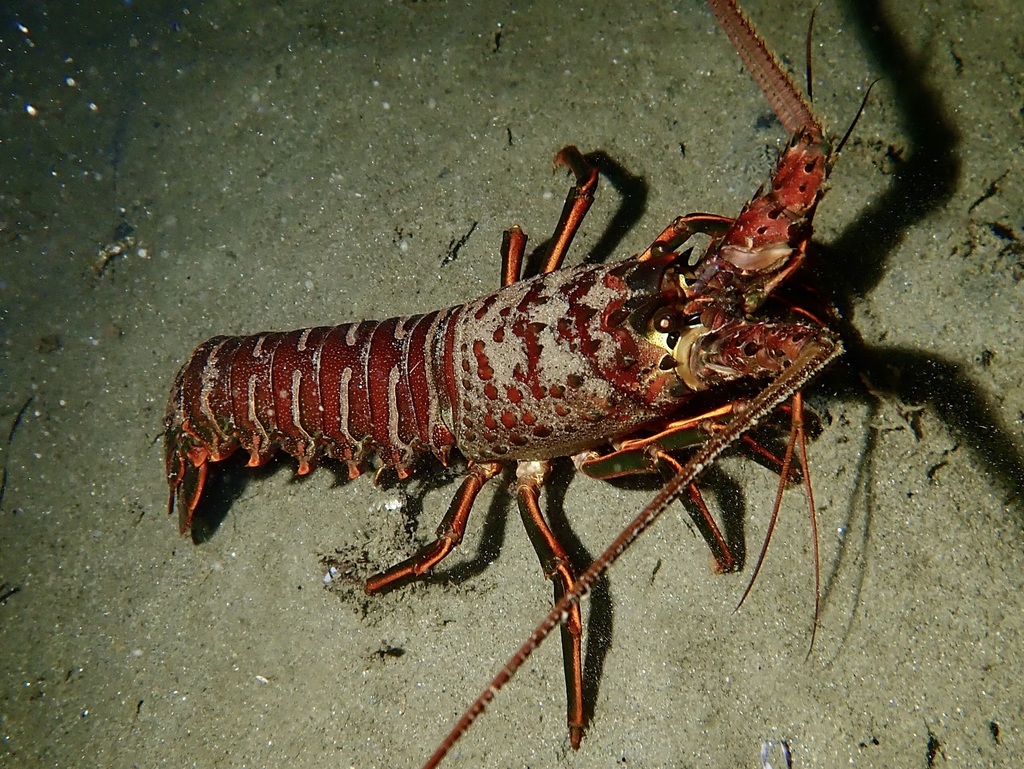
California Spiny Lobster
Panulirus interruptus
The California spiny lobster (Panulirus interruptus) is a species of spiny lobster found in the eastern Pacific Ocean from Monterey Bay, California, to the Gulf of Tehuantepec, Mexico. It typically grows to a length of 30 cm (12 in) and is a reddish-brown color with stripes along its legs, and has a pair of enlarged antennae but no claws. The interrupted grooves across the tail are characteristic for the species.
Females can carry up to 680,000 eggs, which hatch after 10 weeks into flat phyllosoma larvae. These larvae feed on plankton before their metamorphosis into the juvenile state. Adults are nocturnal and migratory, living among rocks at depths of up to 65 m (213 ft), and feeding on sea urchins, clams, mussels and worms. The spiny lobster is eaten by various fish, octopuses and sea otters, but can defend itself with a loud noise produced by its antennae. The California spiny lobster is the subject of both commercial and recreational fishery in both Mexico and the United States, with sport fishermen using hoop nets and commercial fishermen using lobster traps. It is also considered a keystone species because of their control of urchin species which would otherwise damage kelp forests.
From the article California spiny lobster on Wikipedia (CC BY-SA), quoted section by section
Description
In common with all spiny lobsters, the California spiny lobster has two large, spiny antennae, but no large claws on its legs. The California spiny lobster is one of the largest spiny lobster species, and grows up to 60 centimeters (24 in) long, but does not usually exceed 30 cm (12 in). Males can weigh up to 7.4 kilograms (16 lb)., with the record being a 16 lbs., 1 oz. male caught off Catalina island in 1968. The upper side of the animal is brownish red, without the paler bands or spots seen in some other spiny lobsters. The legs are a similar color, but with one or more lighter streaks running along their length. California spiny lobsters in particular have very brightly colored eye-spots.
Wikipedia: “Appearance”
Range & habitat
The California spiny lobster is found in parts of the Gulf of California, and along the Pacific coast of the length of the Baja California peninsula, extending as far north as San Luis Obispo Bay, California. There are occasional records from Monterey Bay, but the water there is too cold for the California spiny lobster to breed, and it is thought that any adult found in Central California arrived as a larva during El Niño years. California spiny lobsters live on rocky substrates, at depths of up to 65 meters (213 ft). Although adults can be found in shallow water, including tide pools, they are more frequent in deeper waters. Juveniles generally inhabit rocky habitats at a depth of 0–4 m (0–13 ft) with dense plant cover, especially the surf grass Phyllospadix torreyi.
Wikipedia: “Distribution”
What it does
California spiny lobsters are nocturnal, hiding in crevices during the day, with only the tips of their long antennae showing as a means of avoiding predators. In these crevices, they can either be found alone or with 2 to 15 lobsters. The lobsters that are in the crevices tend to retreat further back into the burrow and brace their bodies against the rocky walls instead of chaotically or synchronously swimming out and away from predators. Towards dawn, the spiny lobsters form aggregations, which they maintain until dusk. At night, they emerge and feed on sea urchins, clams, mussels and worms. This activity is important in limiting sea urchin populations, and, subsequently, maintaining healthy seabed communities. Spiny lobsters show a gregarious approach to feeding because they are able to recruit other members of their species to feeding sites. They can recruit by using chemical and olfactory cues and social behavior. However, this is not always a positive trait as fishermen can take advantage of this and use other lobsters to attract more to their traps.
Wikipedia: “Feeding behavior”
Where it lives
Recorded sightings
—
geo-referenced records in GBIF, from museums, herbaria and field observers.
Drag the globe to turn it. Dots are where records exist, not a range map; darker means more records.
In the stacks
Searching the stacks…
Every page naming Panulirus interruptus in the Biodiversity Heritage Library →
This page is assembled live from iNaturalist, GBIF, Wikipedia, the Source Library and the Internet Archive. It is not yet part of the hand-edited codex. iNaturalist taxon 61371.