- Animals
- ›Chordates
- ›Vertebrates
- ›Birds
- ›Swifts and Hummingbirds
- ›Hummingbirds
- ›Bee Hummingbirds, Emeralds, Mountain-gems, and Allies
- ›Emerald Hummingbirds and Allies
- ›Chlorostilbon
On eBird ↗
Coppery Emerald
Live sightings near you, the range map, bar charts of when it is seen, and Macaulay Library photos and recordings.
Coppery Emerald
Chlorostilbon russatus
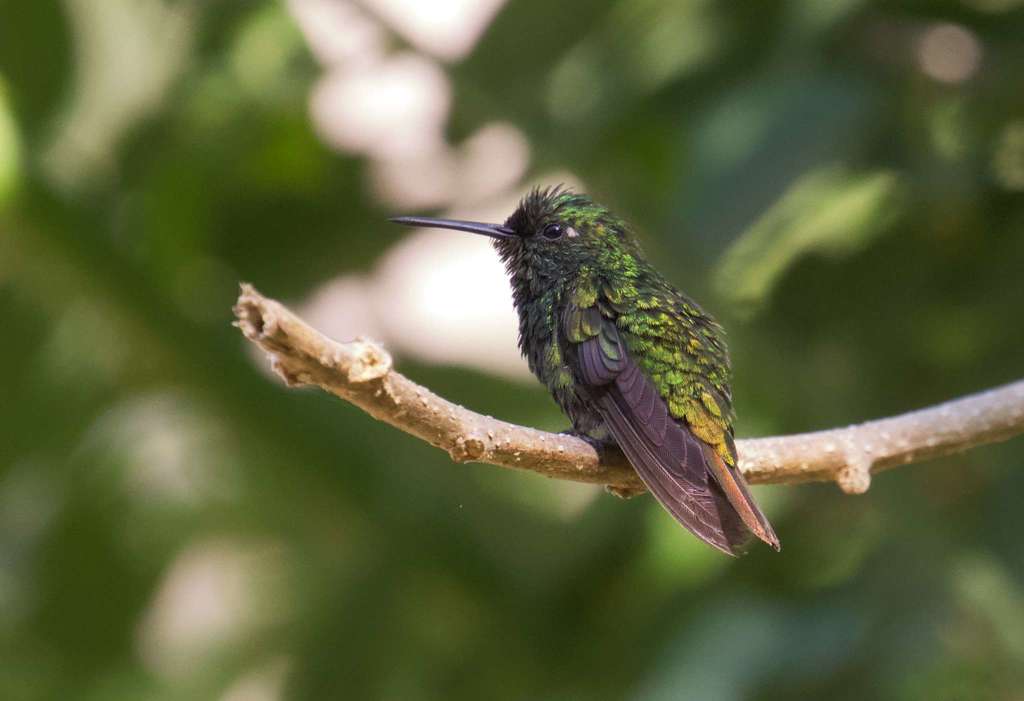
The coppery emerald (Chlorostilbon russatus) is a species of hummingbird in the "emeralds", tribe Trochilini of subfamily Trochilinae. It is found in Colombia and Venezuela.
From the article Coppery emerald on Wikipedia (CC BY-SA), quoted section by section
Description
The male coppery emerald is 8 to 8.5 cm (3.1 to 3.3 in) long and females 7 to 7.5 cm (2.8 to 3.0 in). The species weighs between 3.2 and 3.6 g (0.11 and 0.13 oz). Both sexes have a short, straight, black bill. The male's forehead, crown, and upperparts are shining golden green. Its uppertail coverts are coppery green, and its slightly forked tail is golden coppery. Its underparts are glittering golden green. The female's forehead, crown, upperparts, flanks, and uppertail coverts are coppery green and its underparts are smoky gray. Its tail is also slightly forked; its feathers are greenish coppery and the outer four pairs of feathers have a coppery purple band near the end and pale tips. Immature coppery emeralds are similar to adult females with buffy fringes on the feathers of the head.
Range & habitat
The coppery emerald is found in Colombia's lower Magdalena River valley and Santa Marta department (including the Sierra Nevada de Santa Marta) and also Serranía del Perijá that straddles the northern Colombia/western Venezuela border. It inhabits semi-open and open landscapes such as scrublands, forest edges, and cultivated areas. The coppery emerald's elevation (flight height) ranges from sea-level to 2,600 m (8,500 ft). It is usually between 500 and 1,700 m (1,600 and 5,600 ft).
Wikipedia: “Distribution and habitat”
What it does
The coppery emerald forages for nectar by trap-lining, visiting a circuit of a variety of flowering plants, especially Leguminaceae, Rubiaceae, Heliconiaceae, and Gesneriaceae. It generally forages between 4 and 12 m (13 and 39 ft) above the ground. It captures small insects by hawking from a perch and sometimes by gleaning from vegetation.
Wikipedia: “Feeding”
Listen
Looking for field recordings…
Where it lives
Recorded sightings
—
geo-referenced records in GBIF, from museums, herbaria and field observers.
Drag the globe to turn it. Dots are where records exist, not a range map; darker means more records.
In the stacks
Searching the stacks…
Every page naming Chlorostilbon russatus in the Biodiversity Heritage Library →
This page is assembled live from iNaturalist, GBIF, Wikipedia, the Source Library and the Internet Archive. It is not yet part of the hand-edited codex. iNaturalist taxon 6114.