- Animals
- ›Chordates
- ›Vertebrates
- ›Ray-finned Fishes
- ›Spiny-rayed fishes
- ›Anglerfishes
- ›Pelagic Anglerfishes
- ›Prickly Seadevils
- ›Centrophryne
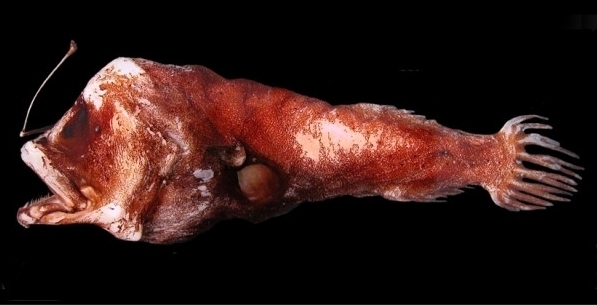
Centrophryne spinulosa
The horned lantern fish or prickly seadevil (Centrophryne spinulosa), is a species of marine ray-finned fish and the only species in the monotypic family Centrophrynidae. This species has a circumglobal distribution and is distinguished from other deep-sea anglerfishes by several characteristics, including four pectoral radials, an anterior spine on the subopercular bone, and a short hyoid (chin) barbel in both sexes.
From the article Horned lantern fish on Wikipedia (CC BY-SA), quoted section by section
Description
The female horned lantern fish measures up to 23 cm (9.1 in) in length and is long and slender, with a large head and jaws of equal length. The jaws are filled with slender, recurved, depressible teeth of mixed large and small sizes. There is a large oval pit in front of each eye in specimens larger than 42 mm. The eye itself lies beneath the skin and appears through a translucent patch. The fish is reddish brown to black in color; its skin is covered with numerous close-set spines. The illicium ("fishing rod") and esca (lure) are attached to the snout. The esca has a fan-shaped appendage in front and another short appendage on the back; the tip is white with scattered large melanophores. There is a small hyoid barbel, although it is vestigial in adult females. The males are much smaller and dark brown in color, measuring up to 1.6 cm (0.63 in) long and lacking the illicium and esca. The known specimens are all immature, though already with large olfactory organs and well-developed denticular plates on the tip of the snout bearing 3-4 curved teeth each. Their hyoid barbel distinguishes them from the males of all other deep-sea anglerfish. The two known larvae measure 4.2 mm and 7.5 mm long and have short, stout bodies with moderately inflated skin.
Range & habitat
The horned lantern fish occurs in the Pacific Ocean from Baja California south to the Marquesas Islands and the Gulf of California. Specimens have also been captured in other locations, including New Guinea, the South China Sea, Venezuela, and the Mozambique Channel, suggesting a wide oceanic distribution in tropical and subtropical waters. Specimens were caught at depths from 650 to over 2000 m (2130–6560 ft), while larvae have been recovered close to the surface to a depth of 35 m (115 ft).
Wikipedia: “Distribution”
In human culture
Centrophryne is a combination of the word kentron, meaning "thorn" or "spine", and phryne, a suffix commonly used in the names of anglerfish genera. Its use may date as far back as Aristotle and Cicero, who referred to anglerfishes as "fishing-frogs" and "sea-frogs", respectively, possibly because of their resemblance to frogs and toads. The first part of the name refers to the prickly skin of females. The specific name spinulosa means "bearing minute spinules", also a reference to the spined (prickly) skin of females.
Wikipedia: “Etymology”
Where it lives
Recorded sightings
—
geo-referenced records in GBIF, from museums, herbaria and field observers.
Drag the globe to turn it. Dots are where records exist, not a range map; darker means more records.
In the stacks
Searching the stacks…
Every page naming Centrophryne spinulosa in the Biodiversity Heritage Library →
This page is assembled live from iNaturalist, GBIF, Wikipedia, the Source Library and the Internet Archive. It is not yet part of the hand-edited codex. iNaturalist taxon 609971.