- Fungi Including Lichens
- ›Ascomycete Fungi
- ›Sac Fungi and Lichens
- ›Common Lichens
- ›Shield Lichens, Sunburst Lichens, Rosette Lichens, and Allies
- ›shield lichens, rim lichens, and allies
- ›shield lichens and allies
- ›typical shield lichens
- ›Xanthoparmelia
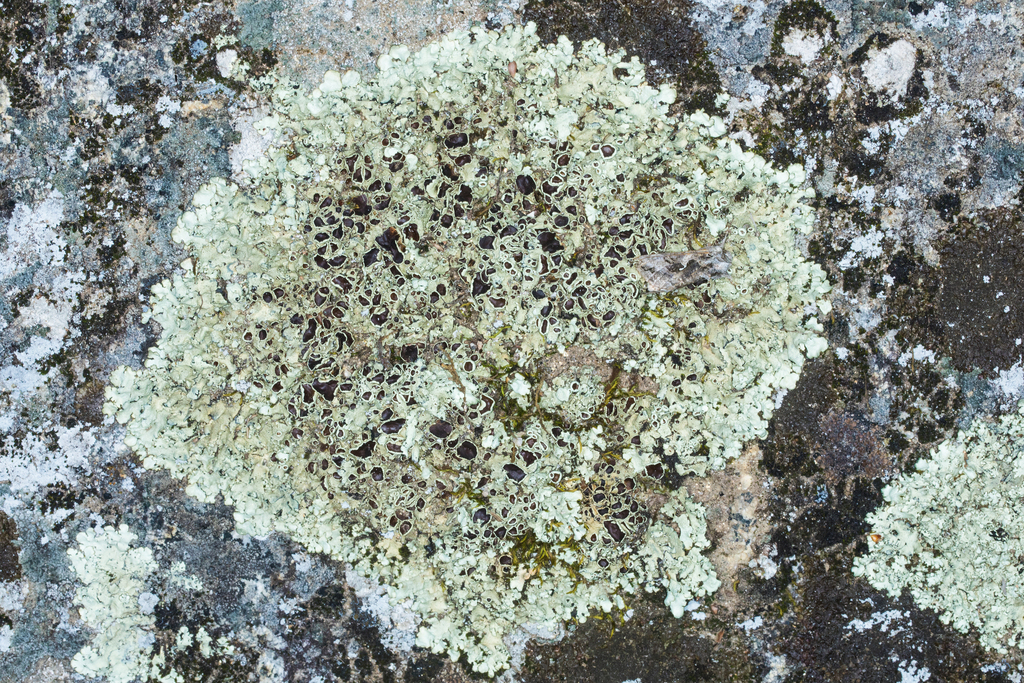
Tight Rock-shield
Xanthoparmelia lineola
Xanthoparmelia lineola, commonly known as the tight rock-shield, is a foliose lichen species in the genus Xanthoparmelia. It is a common species with a temperate distribution. Found in North America and South Africa, it grows on rocks.
From the article Xanthoparmelia lineola on Wikipedia (CC BY-SA), quoted section by section
Description
Xanthoparmelia lineola has a thallus that is tightly attached (adnate) on its rock substrate. Yellowish green in colour, it grows to 3–10 cm (1.2–3.9 in) in diameter. The lobes are irregular in shape and measure 0.8–2 mm wide. Isidia and soredia are not present on the thallus. The medulla is white with a flat lower surface. The rhizines are pale, unbranched, and measure 0.2–0.4 mm long. The lichen has well-developed apothecia (2–5 in diameter) that sit on rudimentary stalks. The ascospores are 6–7 by 9–12 um. Xanthoparmelia lineola contains the compounds salazinic, consalazinic, constipatic, protoconstipatic, and usnic acids.
Similar species. Xanthoparmelia lineola is one of several morphologically similar species that contain salazinic acid and form a continuum based on the degree of agnation to the substrate. X. coloradoensis is loosely attached, X. wyomingica is even more loosely attached, while X. chlorochroa at maturity is not attached to a substrate (a vagrant lichen).
Range & habitat
Xanthoparmelia lineola is known from northern North America and South Africa. Populations from Australia previously considered X. lineola have been since characterized with DNA analysis and assigned to a new species, X. knudsenii. It has a widespread distribution in western North America. In a study of Xanthoparmelia lichens in Arizona, Thomas Nash observed that this species seemed to develop best at elevations of 1,500–2,100 metres (4,900–6,900 ft), where individuals grew to cover half or more of the exposed rock face beneath ponderosa pines. It is common on north-facing rocks in the Arizona desert. The lichen can also be found growing in dry habitats on tree bases covered with wind-blown dust. Five morphologically similar chemotypes of Xanthoparmelia lineola are known from North America: X. subdecipiens, X. cumberlandia, X. oleosa, and X. novomexicana.
Wikipedia: “Habitat and distribution”
Where it lives
Recorded sightings
—
geo-referenced records in GBIF, from museums, herbaria and field observers.
Drag the globe to turn it. Dots are where records exist, not a range map; darker means more records.
In the stacks
Searching the stacks…
Every page naming Xanthoparmelia lineola in the Biodiversity Heritage Library →
This page is assembled live from iNaturalist, GBIF, Wikipedia, the Source Library and the Internet Archive. It is not yet part of the hand-edited codex. iNaturalist taxon 60725.