- Animals
- ›Chordates
- ›Vertebrates
- ›Ray-finned Fishes
- ›Spiny-rayed fishes
- ›Cichlids and Allies
- ›Cichlids
- ›South and Central American Cichlids
- ›Geophagus
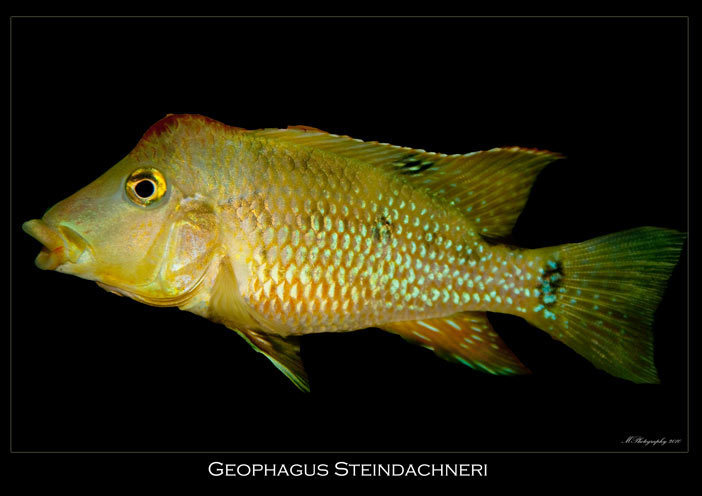
Redhump Eartheater
Geophagus steindachneri
The redhump eartheater (Geophagus steindachneri) is a species of eartheater cichlid from freshwater habitats in northwestern South America.
From the article Redhump eartheater on Wikipedia (CC BY-SA), quoted section by section
Range & habitat
The redhump eartheater is native to river drainages in northern and western Colombia (Magdalena, Cauca and Sinú basins), and northwestern Venezuela (El Limón River). It lives in water that is slightly acidic to neutral (6.5 to 7.0 pH) and typically about 24 to 26 °C (75 to 79 °F). It is stenohaline, found only in mainland freshwater environments.
Wikipedia: “Distribution”
What it does
Redhump eartheaters are immediate maternal mouthbrooders. These fish grow relatively quickly, and can be sexed as subadults. Sexual dimorphism is clear - males have a large, red nuptial hump on their heads and grow larger than the females. Mature males develop an iridescence on the scales on their sides and very large humps. Males will display to females by opening their mouths and flaring their gills. Nonreceptive females may be driven from the spawning area. Spawning takes place on a smooth rock or clean sand bed. The female lays one or two eggs, then the male fertilizes them. The female immediately takes the fertilized eggs into her mouth and proceeds to lay more eggs. This continues until spawning is completed. The female carries the eggs until they are free-swimming and have absorbed their yolk sacs, about 2–3 weeks. She eats little to no food during this period. Eventually, she releases them and allows them to search for food, taking them back into her mouth when she feels threatened. The brooding female often signals to her fry when danger is present, and shuts her fry out of her mouth when encouraging then to forage.
Wikipedia: “Reproduction”
At the table
Wild redhump eartheaters take substrate material into their mouths and sift out inedible bits of sand or gravel, while consuming detritus and small organisms.
Wikipedia: “Food”
In human culture
The cichlid is named in honor of Austrian ichthyologist Franz Steindachner (1834–1919).
Wikipedia: “Etymology”
Where it lives
Recorded sightings
—
geo-referenced records in GBIF, from museums, herbaria and field observers.
Drag the globe to turn it. Dots are where records exist, not a range map; darker means more records.
In the stacks
Searching the stacks…
Every page naming Geophagus steindachneri in the Biodiversity Heritage Library →
This page is assembled live from iNaturalist, GBIF, Wikipedia, the Source Library and the Internet Archive. It is not yet part of the hand-edited codex. iNaturalist taxon 605366.