- Animals
- ›Arthropods
- ›Chelicerates
- ›Arachnids
- ›Mites and Ticks
- ›Parasitiformes
- ›Ticks
- ›Hardbacked Ticks
- ›Rhipicephalus
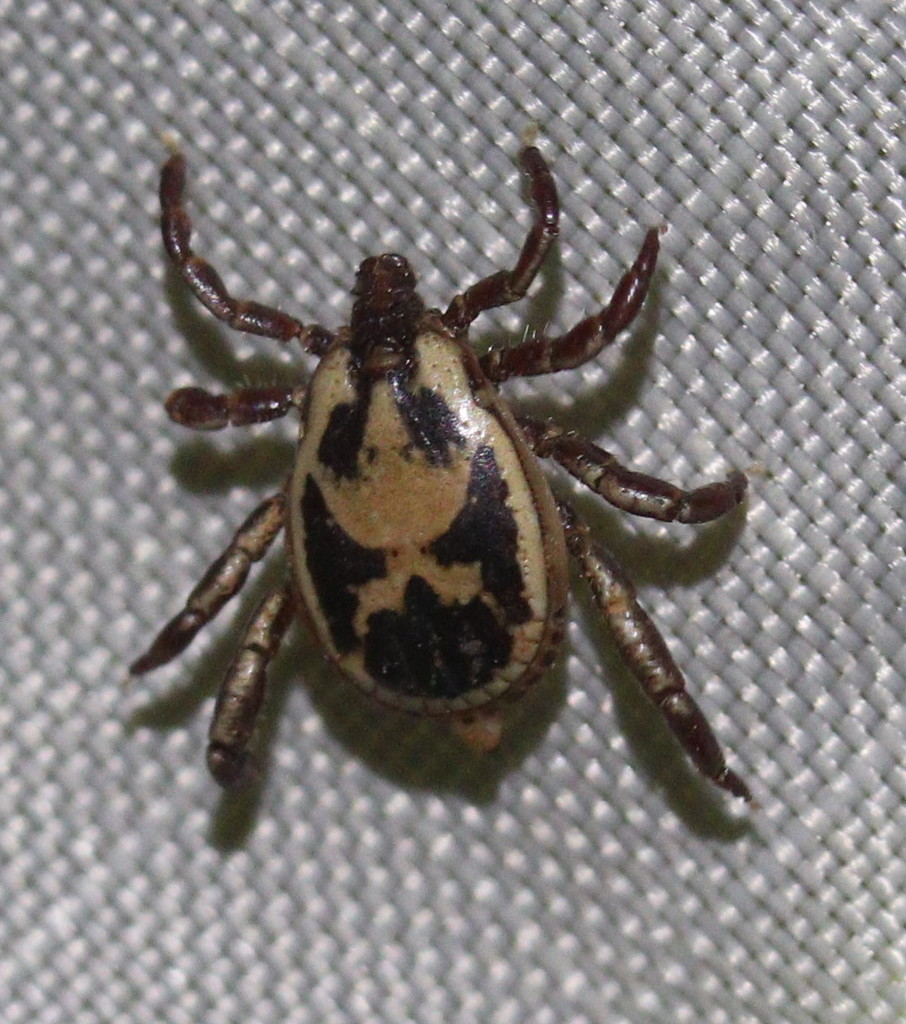
Zebra Tick
Rhipicephalus pulchellus
Rhipicephalus pulchellus (zebra tick or yellow back tick) is a species of hard tick. It is a very common tick in the Horn of Africa, with a habitat of the Rift Valley and eastward. It hosts upon a wide variety of species, including livestock, wild mammals, and humans, and can be a vector for various pathogens. The adult male has a distinctive black and ivory ornamentation on its scutum.
From the article Rhipicephalus pulchellus on Wikipedia (CC BY-SA), quoted section by section
Range & habitat
This tick inhabits the Afrotropical biogeographic realm. It has been reported in the Palearctic, namely in the Giza Governorate, Egypt, but some researchers are hesitant about listing the Palearctic in its distribution based on just that report. Adult ticks looking for hosts inhabit scrub and long-grass areas. It occurs in the Horn of Africa, particularly in the Rift Valley and eastward. It lives between elevations of 500 and 2,000 m (1,600 and 6,600 ft) in semiarid bushlands and plains with an annual rainfall of 100–800 mm (3.9–31.5 in). One study predicted that its habitat range will increase throughout 2100 due to climate change. It is most active during the rainy season.
Population. It was the most common tick in one study conducted in Haller Park, Kenya. In the early 1900s, it was very common in Kenya's Athi Plains, and also found near Nairobi, Kiambu, and Ruiru, and is the predominant tick collected from grass in the Kilimani area of Nairobi in a 1935 study. One long-term study conducted in Laikipia, Kenya involved people walking for 400 m (1,300 ft) and counting the number of ticks found on their clothing; the average number of R. pulchellus adults peaked at three.
As introduced species. R. …
Wikipedia: “Habitat and distribution”
Where it lives
Recorded sightings
—
geo-referenced records in GBIF, from museums, herbaria and field observers.
Drag the globe to turn it. Dots are where records exist, not a range map; darker means more records.
In the stacks
Searching the stacks…
Every page naming Rhipicephalus pulchellus in the Biodiversity Heritage Library →
This page is assembled live from iNaturalist, GBIF, Wikipedia, the Source Library and the Internet Archive. It is not yet part of the hand-edited codex. iNaturalist taxon 604850.