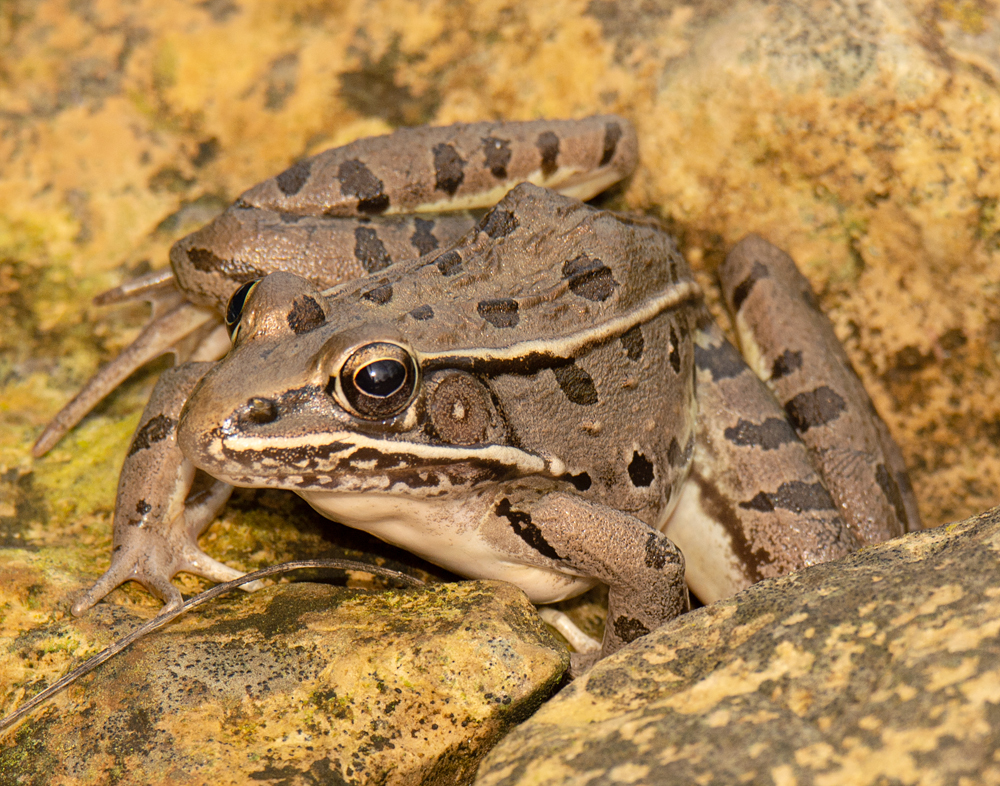
Southern Leopard Frog
Lithobates sphenocephalus
Lithobates sphenocephalus or Rana sphenocephala, commonly known as the southern leopard frog, is a medium-sized anuran in the family Ranidae (the true frogs). The southern leopard frog is one of the 36 species currently or formerly classified in the Rana genus found in North America. It is native to eastern North America from Kansas to New Jersey to Florida. It is also an introduced species in some areas.
From the article Southern leopard frog on Wikipedia (CC BY-SA), quoted section by section
Description
This frog is up to 13 cm (5.1 in) long. Males at sexual maturity average 52.9 mm (2.08 in) snout to vent length and females average 63.8 mm (2.51 in) SVL. It is green or brown in color with a yellowish ridge along each side of the back. Rounded dark spots occur on the back and sides; a light spot is seen on each tympanum. The male has larger fore limbs than the female. The breeding male's vocal sacs are spherical when inflated. The call is described as a "ratchet-like trill", "chuckling croak", or a "squeaky balloon-like sound". The larva is mottled, and the eyes are positioned on the top of the head. It grows to 7.6 cm (3.0 in) in length before maturing. The female lays an egg mass that is "baseball-sized" when close to hatching time, and contains up to 1,500 eggs. Some larva, eggs and embryos may be exposed to pesticides during their development causing significant mortality and developmental deformity. It is possible to confuse this species for the similarly shaped and colored pickerel Frog (Lithobates palustris). However, pickerel frogs dark spots along their back are more rectangular, uniform, and form rows. The spot in the center of their tympanum, if present, is a dark green/brown rather than a stark white. Southern Leopard Frogs may also be confused with the Atlantic Coast Leopard Frog (Lithobates kauffeldi) in the northern portion of its range. …
Range & habitat
This frog is widespread across eastern North America, especially the Southeast US. It is the most common frog in Florida and several other regions. It is an introduced species in The Bahamas, in Arizona and at two locations in California. Southern leopard frogs are believed to have been introduced to the Prado Flood Control Basin via a shipment of aquatic fauna to the Chino Gun Club in 1929 or 1930; they are now common in areas of the basin undergoing urbanization. Loss of forests is a concern as it is among the leading cause of population decline. A second established population of the species in California is now suspected, following the March 2016 discovery of two females in the San Joaquin River just northwest of Fresno on the border between Madera and Fresno Counties. A third species has recently discovered in southern New York, northern New Jersey, and western Connecticut.
Wikipedia: “Range”
What it does
This frog lives in many types of shallow freshwater habitat and sometimes in slightly brackish water. They usually look for wetter environments that have herbaceous plant cover and low canopy. It is usually found close to water, but it can stay on dry land for long periods of time. During warmer months, it moves away from the water for most of the time, It is mostly nocturnal, but it can be active during the day and the night, especially during rainfall. It breeds in the winter and spring, and sometimes in the fall. While there is a relationship between month and breeding activity, mean daily precipitation is the main factor that determines breeding activity. They have been observed depositing eggs communally in cold weather but independently in warm weather. Breeding can occur throughout the year in southern states but typically occurs in early spring Mating takes place from February to December with a peak from April to August. with both sexes having their lowest fat storage during late-winter-spring, indicative of the commencement of breeding. The southern populations breed the longest. They can breed in a variety of aquatic habitats ranging from ephemeral to permanent. The egg mass is connected to aquatic vegetation. It typically nests communally in cooler weather, and individually in warmer weather. …
Wikipedia: “Ecology and behavior”
Listen
Looking for field recordings…
Where it lives
Recorded sightings
—
geo-referenced records in GBIF, from museums, herbaria and field observers.
Drag the globe to turn it. Dots are where records exist, not a range map; darker means more records.
In the stacks
Searching the stacks…
Every page naming Lithobates sphenocephalus in the Biodiversity Heritage Library →
This page is assembled live from iNaturalist, GBIF, Wikipedia, the Source Library and the Internet Archive. It is not yet part of the hand-edited codex. iNaturalist taxon 60341.