- Animals
- ›Chordates
- ›Vertebrates
- ›Cartilaginous Fishes
- ›Sharks and Rays
- ›Sharks
- ›Squalean Sharks
- ›Squaliform Sharks
- ›Sleeper Sharks
- ›Centroscymnus
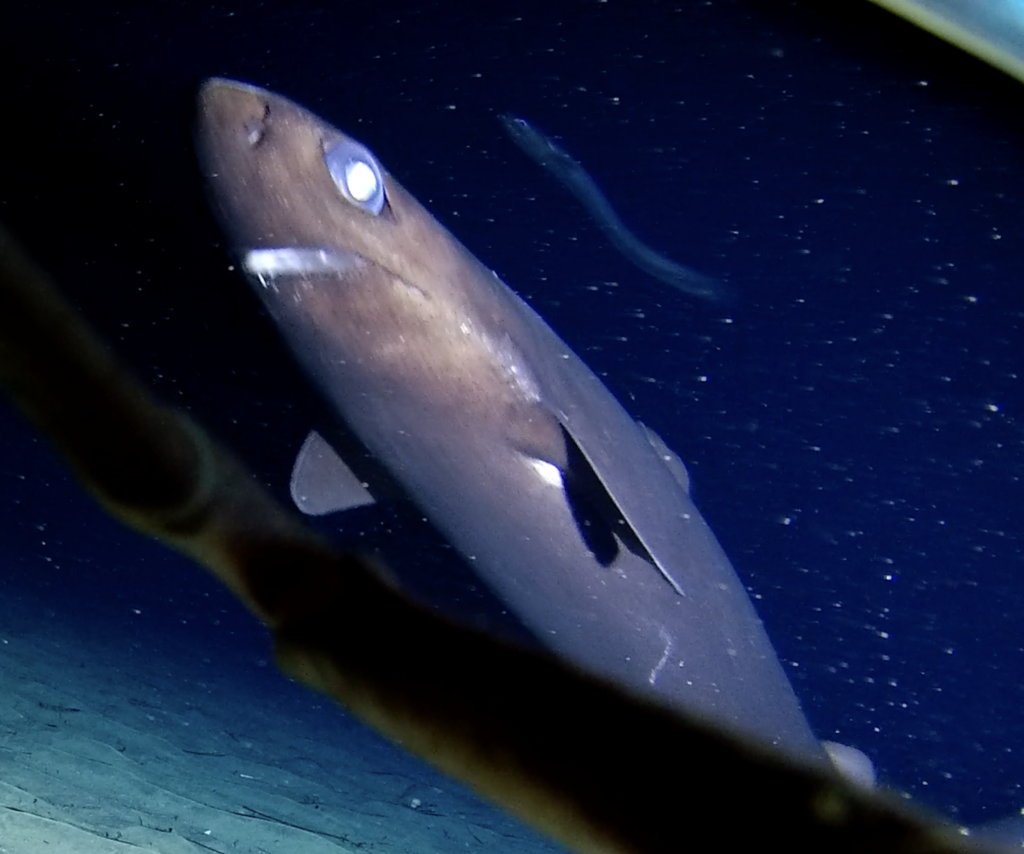
Portuguese Dogfish
Centroscymnus coelolepis
The Portuguese dogfish (Centroscymnus coelolepis) or Portuguese shark, is a species of sleeper shark of the family Somniosidae. This globally distributed species has been reported down to a depth of 3,675 m (12,057 ft), making it the deepest-living shark known. It inhabits lower continental slopes and abyssal plains, usually staying near the bottom. Stocky and dark brown in color, the Portuguese dogfish can be distinguished from similar-looking species (such as the kitefin shark, Dalatias licha) by the small spines in front of its dorsal fins. Its dermal denticles are also unusual, resembling the scales of a bony fish. This species typically reaches 0.9–1 m (3.0–3.3 ft) in length; sharks in the Mediterranean Sea are much smaller and have distinct depth and food preferences.
Relatively common, the Portuguese dogfish is an active hunter capable of tackling fast, large prey. It feeds mainly on cephalopods and fishes, though it also consumes invertebrates and cetacean carrion. This shark has acute vision optimized for detecting the bioluminescence of its prey, as sunlight does not reach the depths at which it lives. The Portuguese dogfish is aplacental viviparous, with the young provisioned by yolk and perhaps uterine fluid. The females give birth to up to 29 young after a gestation period of over one year. Valued for its liver oil and to a lesser extent meat, Portuguese dogfish are important to deepwater commercial fisheries operating off Portugal, the British Isles, Japan, and Australia.
From the article Portuguese dogfish on Wikipedia (CC BY-SA), quoted section by section
Description
The Portuguese dogfish typically reaches a length of 0.9 m (3.0 ft) for males and 1.0 m (3.3 ft) for females, though specimens up to 1.2 m (3.9 ft) long have been recorded. Sharks in the Mediterranean are smaller, growing no more than 65 cm (26 in) long. This species has a flattened, broadly rounded snout that is shorter than the mouth is wide. The nostrils are preceded by short flaps of skin. The eyes are large and oval in shape, positioned laterally on the head and equipped with a reflective tapetum lucidum that produces a yellow-green "eye shine". The mouth is wide and slightly arched, with moderately thick, smooth lips and short furrows at the corners extending onto both jaws. The upper teeth are slender and upright with a single cusp, numbering 43–68 rows. The lower teeth have a short, strongly angled cusp and number 29–41 rows; their bases interlock to form a continuous cutting surface. The five pairs of gill slits are short and nearly vertical. The body of the Portuguese dogfish is thick and cylindrical except for the flattened belly. The two dorsal fins are small and of similar size and shape, each bearing a tiny grooved spine in front. The first dorsal fin originates well behind the pectoral fins, while the second dorsal originates over the middle of the pelvic fin bases. The pectoral fins are medium-sized with a rounded margin. There is no anal fin. …
Range & habitat
One of the widest-ranging deepwater sharks, the Portuguese dogfish is patchily distributed around the world. In the western Atlantic, it occurs from the Grand Banks of Newfoundland to the U.S. state of Delaware. In the eastern Atlantic, it is found from Iceland to Sierra Leone, including the western Mediterranean Sea, the Azores and Madeira, as well as from southern Namibia to western South Africa. In the Indian Ocean, this species has been caught off the Seychelles. In the Pacific, this shark occurs off Japan, New Zealand, and Australia from Cape Hawke, New South Wales, to Beachport, South Australia, including Tasmania. The deepest-living shark known, the Portuguese dogfish has been reported at depths of 150 m (490 ft) to 3,675 m (12,057 ft) from the lower continental slope to the abyssal plain, and is most common between 400 m (1,300 ft) and 2,000 m (6,600 ft). This species is found deeper in the Mediterranean, seldom occurring above a depth of 1,500 m (4,900 ft) and being most common at 2,500–3,000 m (8,200–9,800 ft). The deep Mediterranean has a relatively constant temperature of 13 °C (55 °F) and a salinity of 38.4 ppt, whereas in the deep ocean the temperature is generally only 5 °C (41 °F) and the salinity 34–35 ppt. The Portuguese dogfish is essentially benthic in nature, though young sharks can be found a considerable distance off the bottom. …
Wikipedia: “Distribution and habitat”
What it does
Living almost exclusively in the aphotic zone where little to no sunlight penetrates, the Portuguese dogfish is relatively common and the dominant shark species in deeper waters. The large, squalene-rich liver of this shark allows it to maintain neutral buoyancy and hover with minimal effort; males contain more squalene in their livers than females. A tracking study in the Porcupine Seabight has found that the Portuguese dogfish has an average swimming speed of 0.072 m/s (0.24 ft/s), and does not remain in any particular area for long. This species may be preyed upon by larger fishes and sharks. Known parasites of this species include monogeneans in the genus Erpocotyle, and the tapeworms Sphyriocephalus viridis, S. richardi, and Anthobothrium sp. An active predator of mobile, relatively large organisms, the Portuguese dogfish feeds mainly on cephalopods (including Mastigoteuthis spp.) and bony fishes (including slickheads, orange roughy, lantern fishes, and rattails). It has also been known to take other sharks and invertebrates (such as the medusa Atolla wyvillei), as well as scavenging from whale carcasses. …
Wikipedia: “Biology and ecology”
Where it lives
Recorded sightings
—
geo-referenced records in GBIF, from museums, herbaria and field observers.
Drag the globe to turn it. Dots are where records exist, not a range map; darker means more records.
In the stacks
Searching the stacks…
Every page naming Centroscymnus coelolepis in the Biodiversity Heritage Library →
This page is assembled live from iNaturalist, GBIF, Wikipedia, the Source Library and the Internet Archive. It is not yet part of the hand-edited codex. iNaturalist taxon 59796.