- Animals
- ›Chordates
- ›Vertebrates
- ›Birds
- ›Swifts and Hummingbirds
- ›Hummingbirds
- ›Bee Hummingbirds, Emeralds, Mountain-gems, and Allies
- ›Emerald Hummingbirds and Allies
- ›Hylocharis
On eBird ↗
Gilded Hummingbird
Live sightings near you, the range map, bar charts of when it is seen, and Macaulay Library photos and recordings.
Gilded Hummingbird
Hylocharis chrysura
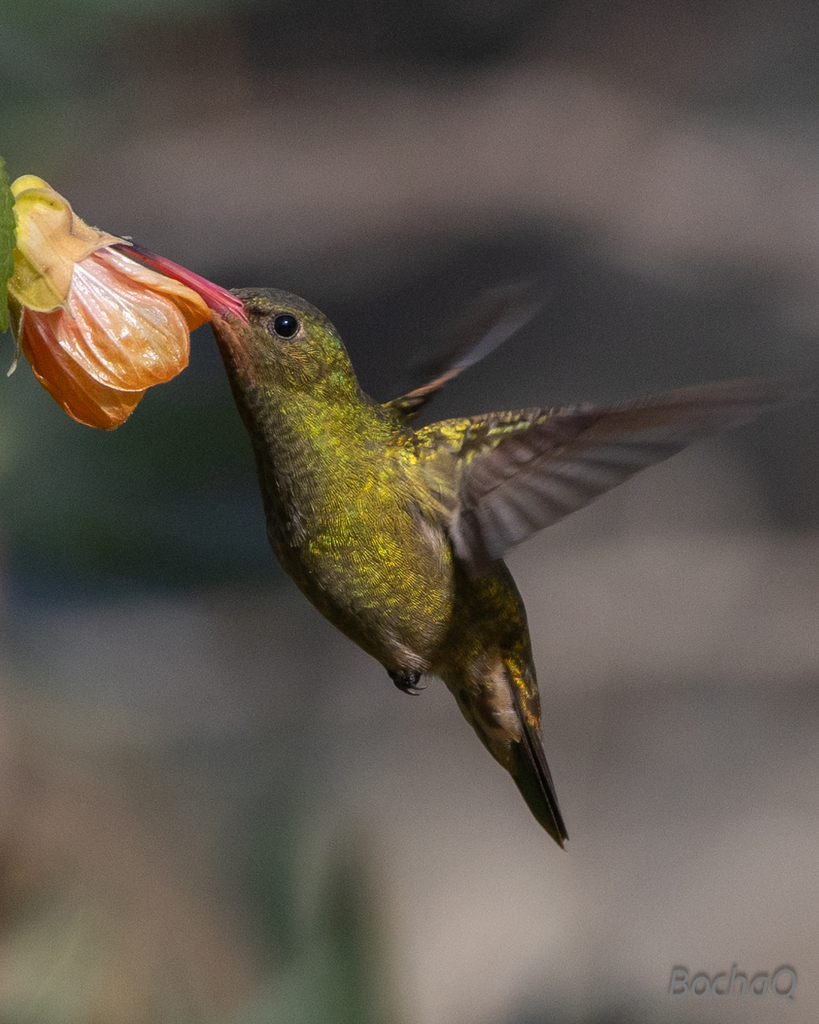
The gilded sapphire (Hylocharis chrysura), also known as the gilded hummingbird, is a species of hummingbird in the family Trochilidae. It is found in a wide range of open and semi-open habitats in southern Brazil, Bolivia, Paraguay, Uruguay and northern Argentina. It is generally common, and therefore considered to be of least concern by BirdLife International and consequently the IUCN. It is overall greenish-golden with a coppery tail, whitish-buff underparts, a rufous chin, and a slightly...
From the article Gilded sapphire on Wikipedia (CC BY-SA), quoted section by section
Description
The gilded sapphire is 8 to 10 cm (3.1 to 3.9 in) long and weighs 4 to 5 g (0.14 to 0.18 oz). Both sexes have a medium length, straight, coral red bill with a black tip. Adult males are mostly iridescent golden-green, with a pale rufous chin and a glittering golden-bronze tail. Adult females are almost the same, but duller overall and with a grayish lower belly. Juveniles are like the adult female with buff fringes on the feathers of the head.
Range & habitat
The gilded sapphire is found in northeastern to south central Bolivia, essentially all of Paraguay and Uruguay, central and southeastern Brazil, and northern Argentina. It inhabits open landscapes such as savannah with scattered trees, the edges and clearings of forests, plantations, and gardens. It is most numerous at elevations between 400 and 800 m (1,300 and 2,600 ft). It is regularly found down to 200 m (660 ft) and up to 1,000 m (3,300 ft), and locally even higher.
Wikipedia: “Distribution and habitat”
What it does
The gilded sapphire forages for nectar at a wide variety of native and introduced plants, shrubs, and trees. It seeks nectar at all levels of its habitat. In addition to nectar the species feeds on insects caught by hawking from a perch and also gleans spiders from webs.
Wikipedia: “Feeding”
Listen
Looking for field recordings…
Where it lives
Recorded sightings
—
geo-referenced records in GBIF, from museums, herbaria and field observers.
Drag the globe to turn it. Dots are where records exist, not a range map; darker means more records.
In the stacks
Searching the stacks…
Every page naming Hylocharis chrysura in the Biodiversity Heritage Library →
This page is assembled live from iNaturalist, GBIF, Wikipedia, the Source Library and the Internet Archive. It is not yet part of the hand-edited codex. iNaturalist taxon 5979.