- Animals
- ›Molluscs
- ›Gastropods
- ›Caenogastropods
- ›Littorinimorpha
- ›Naticoidea
- ›Moon Snails
- ›Polinicinae
- ›Neverita
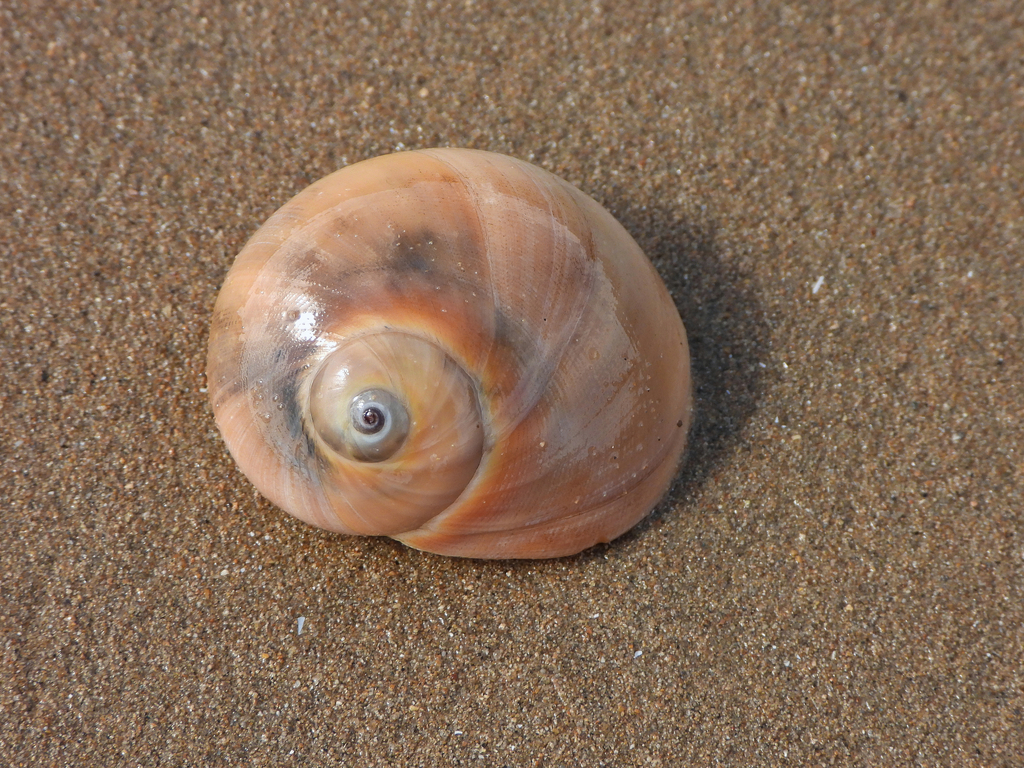
Bladder Moon Snail
Neverita didyma
Neverita didyma, common name the bladder moon snail or moon shell, is a species of predatory sea snail, a marine gastropod mollusc in the family Naticidae, the moon snails. Like all naticids, this species is a carnivore and a predator.
From the article Neverita didyma on Wikipedia (CC BY-SA), quoted section by section
Description
The size of an adult shell of this species is discoid and varies between 20 mm and 90 mm, and is noticeably smooth, glossy and thick. The spiral tip does not stick out, causing a spherical shape. The shell appears plain white, sometimes with pearly pastel shades with a narrow white spiral at the spire sometimes with irregular blotches of colors. The underside of the shell includes a brown blotch with a small depression. The operculum is smooth and made out of a thin, yellow, horn-like material. The snail's tentacles have opaque white bands around them.
Common misidentifications. The snail is often mistaken for Polinices mammatus, the bosom moon snail, that has a teardrop shaped shell and has an underside which is completely white with a bump instead of a depression. The Ball moon snail is less shy and doesn't retract immediately into its shell like the Bosom moon snail.
Range & habitat
This marine species is found in the Yellow Sea or off the coast of the Madagascar, Mozambique, South Africa of the Indian Ocean and Australia.
Habitat. The snail is commonly seen in sandy and muddy shores usually at night or a cool day. The snail is usually ploughing through sand for hunting near beaches with seagrass. It is often found hunting for button snails. Its predator is Argyrops spinifer.
Wikipedia: “Distribution”
At the table
In Korean cuisine the snails are used in a dish called golbaengi-muchim (moon snail salad). It is usually collected using fishing nets at depths of 2-10 m.
Wikipedia: “Culinary use”
In human culture
The snail gets its "moon" part of the name because its aperture is shaped like a crescent moon. The "didyma" part of the name could refer to either "testicles" or "twins". The "ball" part of the name is because the overall shape of the shell is almost shaped like a ball.
Wikipedia: “Etymology”
Where it lives
Recorded sightings
—
geo-referenced records in GBIF, from museums, herbaria and field observers.
Drag the globe to turn it. Dots are where records exist, not a range map; darker means more records.
In the stacks
Searching the stacks…
Every page naming Neverita didyma in the Biodiversity Heritage Library →
This page is assembled live from iNaturalist, GBIF, Wikipedia, the Source Library and the Internet Archive. It is not yet part of the hand-edited codex. iNaturalist taxon 59353.