- Animals
- ›Chordates
- ›Vertebrates
- ›Birds
- ›Swifts and Hummingbirds
- ›Hummingbirds
- ›Brilliants, Coquettes, and Allies
- ›Brilliants and Allies
- ›Heliodoxa
On eBird ↗
Rufous-webbed Brilliant
Live sightings near you, the range map, bar charts of when it is seen, and Macaulay Library photos and recordings.
Rufous-webbed Brilliant
Heliodoxa branickii
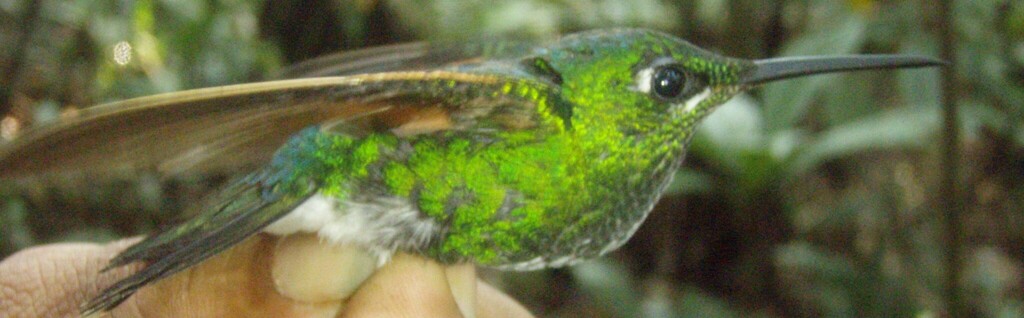
The rufous-webbed brilliant (Heliodoxa branickii) is a species of hummingbird in the family Trochilidae. It is found in the Andean foothills of Peru and possibly northwestern Bolivia. Its natural habitats are subtropical or tropical moist lowland forests and subtropical or tropical moist montane forests.
From the article Rufous-webbed brilliant on Wikipedia (CC BY-SA), quoted section by section
Description
The rufous-webbed brilliant is 11 to 11.5 cm (4.3 to 4.5 in) long. Males weigh about 5.8 g (0.20 oz) on average and females 5.4 g (0.19 oz). The species' English name comes from its cinnamon-rufous inner wing feathers; the rest of the wing is dusky. Both sexes have a black bill whose mandible base is paler. Males are mostly shining dark green. Their forehead is brighter glittering green and they have an iridescent rosy gorget. The undertail coverts are bright white. The central pair of tail feathers are green and the rest dark blue. Females also have shining dark green upperparts, flanks, and breast. They have a short white streak from the bill to below the eye. The throat and breast are white, with shining green tips to the feathers, and the belly is white to buffy. A gorget is often lacking, and when present is paler and yellower than the male's. The undertail coverts are bright white like the male's, but the blue outer tail feathers have white tips.
Range & habitat
The rufous-webbed brilliant has been conclusively recorded only on the east slope of the Andes from central to southern Peru. There are also unconfirmed records in Bolivia. It inhabits the interior and edges of humid montane forest at elevations between 650 and 1,700 m (2,100 and 5,600 ft).
Wikipedia: “Distribution and habitat”
What it does
The rufous-webbed brilliant primarily forages for nectar in the forest's understory and its edges, though the species of flowering plants it feeds at are only slightly known. It also eats small insects.
Wikipedia: “Feeding”
Listen
Looking for field recordings…
Where it lives
Recorded sightings
—
geo-referenced records in GBIF, from museums, herbaria and field observers.
Drag the globe to turn it. Dots are where records exist, not a range map; darker means more records.
In the stacks
Searching the stacks…
Every page naming Heliodoxa branickii in the Biodiversity Heritage Library →
This page is assembled live from iNaturalist, GBIF, Wikipedia, the Source Library and the Internet Archive. It is not yet part of the hand-edited codex. iNaturalist taxon 5925.