- Fungi Including Lichens
- ›Basidiomycete Fungi
- ›Higher Basidiomycetes
- ›Mushrooms, Bracket Fungi, Puffballs, and Allies
- ›Agaricomycetidae
- ›Common Gilled Mushrooms and Allies
- ›Agaricineae
- ›Field Mushrooms and Allies
- ›Agariceae
- ›Agaricus
- ›Pseudochitonia
- ›Bivelares
- ›Hortenses
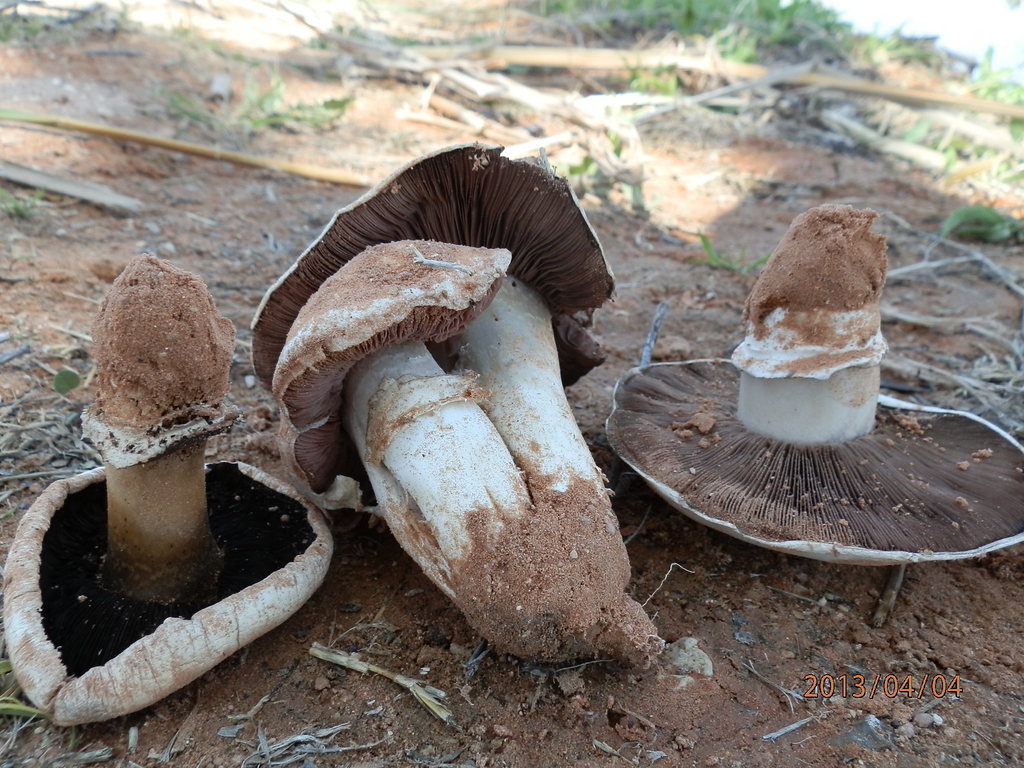
Pavement Mushroom
Agaricus bitorquis
Agaricus bitorquis is an edible white mushroom of the genus Agaricus, similar to the common button mushroom that is sold commercially. The name supersedes Agaricus rodmani. It is also commonly known as torq, the banded agaric, spring agaric, or pavement mushroom, as it has been recorded pushing up paving slabs.
From the article Agaricus bitorquis on Wikipedia (CC BY-SA), quoted section by section
Description
The cap is dry, smooth, and white (but stains yellowish in age), and measures 4 to 18 centimetres (1+1⁄2 to 7 in) in diameter, convex to flat, often with dirt on the cap. The gills are free, very narrow and close. They are a light pink color when young, becoming dark reddish-brown as the spores mature. The spore print is chocolate brown. The stipe is 3–11 cm long, 1–4 cm thick, cylindrical to clavate (club-shaped), stout, white, smooth, with a membranous veil and thick white mycelial sheathing near the base. Distinctively it has both a thick upper ring which is shaped like a funnel and a thinner skirt-like lower ring, giving rise to the species name bitorquis. The flesh is solid and firm, with a mild odor.
Microscopic details. The basidiospores are elliptical in shape, smooth, and with dimensions of 5–7 x 4–5.5 μm. Basidia are 20–25 x 6.5–8.5 μm, usually four-spored, but often with two-spored basidia present. Cystidia are present and numerous.
Similar species. The species is often confused with the briny-smelling Agaricus bernardii. It also resembles Agaricus campestris somewhat, but that species only has a single fragile ring.
Range & habitat
Agaricus bitorquis may be found growing solitary or in small groups in gardens (noted as growing in a gregarious manner), and at roadsides, usually on the pavement, often where salt is applied to combat ice in winter. Pushing through asphalt and slabs, it is subterranean, and often matures underground. Occurs in throughout North America, Europe, and Asia, as well as in New Zeeland, South Africa, and Australia.
Wikipedia: “Distribution and habitat”
At the table
Agaricus bitorquis is a choice edible species, with a typical 'mushroomy' taste. Specimens collected in the wild may be gritty due to its often subterranean habitat. As with all specimens picked from the wild, care should be taken to consider the suitability of the collection site, as this species can bioaccumulate toxic heavy metals, especially lead, from polluted areas. Nutritional analysis has shown this species to contain 18 amino acids, including all of the essential ones.
Wikipedia: “Edibility”
How it is grown
First cultivated commercially in 1968, A. bitorquis has several growth characteristics that have piqued the interest of mushroom cultivators looking for an alternative to the standard button mushroom, A. bisporus. For example, A. bitorquis is more resistant to various viral diseases, can grow at higher temperatures and CO2 concentrations, and has better resistance to bruising. Furthermore, high temperature-resistant strains have recently been developed which may help cultivators overcome problems associated with cooling production rooms during hot summer months.
Wikipedia: “Cultivation”
Where it lives
Recorded sightings
—
geo-referenced records in GBIF, from museums, herbaria and field observers.
Drag the globe to turn it. Dots are where records exist, not a range map; darker means more records.
In the stacks
Searching the stacks…
Every page naming Agaricus bitorquis in the Biodiversity Heritage Library →
This page is assembled live from iNaturalist, GBIF, Wikipedia, the Source Library and the Internet Archive. It is not yet part of the hand-edited codex. iNaturalist taxon 58696.