- Fungi Including Lichens
- ›Ascomycete Fungi
- ›Sac Fungi and Lichens
- ›Leotiomycetes
- ›Leotiales
- ›Leotiaceae
- ›Leotia
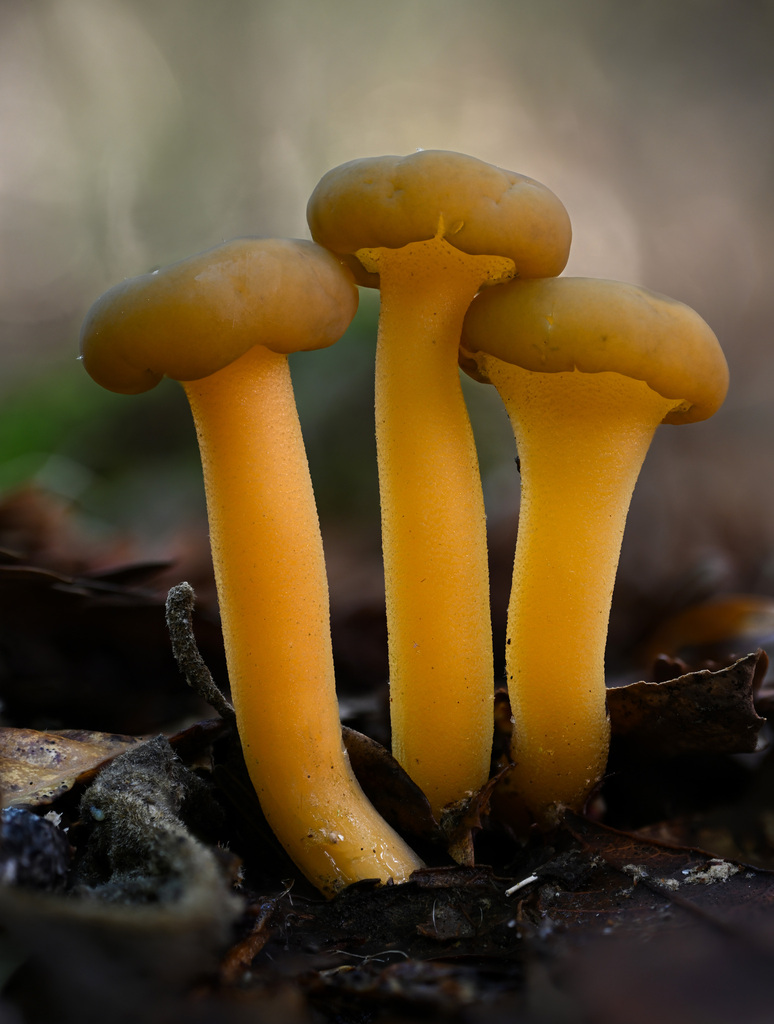
Ochre Jelly Club
Leotia lubrica
Leotia lubrica, commonly referred to as a jelly baby, is a species of fungus in the family Leotiaceae. L. lubrica was first validly described by Giovanni Antonio Scopoli, but it was later transferred to Leotia by Christiaan Hendrik Persoon. Its relationship with other members of the genus, of which it is the type species, is complicated.
The species produces small fruit bodies up to 6 centimetres (2+1⁄2 in) in height, featuring a "head" and a stalk. The youngest fruit bodies are small and conical, but the fertile head quickly grows from the stalk. Ochre with tints of olive-green, the heads are irregularly shaped, while the stalk, of a similar colour, attaches them to the ground. The appearance can be somewhat variable and is similar to a number of other species, including Cudonia confusa, C. circinans, L. atrovirens and L. viscosa.
From the article Leotia lubrica on Wikipedia (CC BY-SA), quoted section by section
Description
Leotia lubrica produces fruit bodies which range from 1 to 6 centimetres (1⁄2 to 2+1⁄4 inches) in height. The youngest fruit bodies are conical in shape. When the body reaches around 2 millimetres (1⁄16 in) in length, the tip of the cone begins to expand, forming the head. This is the stage at which the hymenium becomes differentiated from the rest of the body, and the bodies quickly reach their mature form, maturing only through growth after that point. Each fruit body has a single fertile "head" measuring 1–3 cm (1⁄2–1+1⁄4 in) across, which is an olive-greenish ochre and gelatinous. To the touch, the surface of the head can be smooth, clammy or slimey. While in shape it is convex, the head is made up of irregular lobes and undulations, and the edge is rolled inward. The underside is paler in colour than the upper surface, and smooth. The head is attached to a central stalk, which ranges from 2–8 cm (3⁄4–3+1⁄8 in) and 3–10 mm (1⁄8–3⁄8 in) wide, though thinner toward the substrate. The stalk is typically cylindrical, but can be flattened, and occasionally has furrows. The colour is similar to that of the head, though more yellow, and the surface is covered in very small granules of a greenish colour. The flesh is gelatinous in the head, while the stalk is mostly hollow, but it can be filled with gel. It has no discernible smell or taste.
Microscopic features. L. …
Range & habitat
Fruit bodies are typically encountered from late summer to late autumn in Europe, and from late spring to autumn in North America, where it is the most common Leotia species. It has also been recorded in eastern Asia, in China and Tibet, as well as in New Zealand and Australia. L. lubrica favours damp deciduous woodland, but can also be found under conifers. Particular favoured habitats include path sides and underneath bracken, while favoured substrates include soil, moss and plant waste. Fruit bodies are typically found growing in large numbers, sometimes in clumps, though solitary specimens are occasionally encountered. Several bodies can be connected at their bases, or younger bodies can grow out of the bases of older ones.
Wikipedia: “Distribution and habitat”
What it does
While it has been conventionally regarded as a saprotroph, molecular, isotopic and other lines of evidence have suggested that L. lubrica forms ectomycorrhizae. Fruit bodies can be infected by the mould Hypomyces leotiarum (asexual reproduction form of Hypomyces leotiicola).
Wikipedia: “Ecology”
Toxicity
Its fruit bodies are of little culinary interest, and, contrary to what is suggested by the common name, are often described as inedible by field guides. It has also been reported that the species is in fact edible yet insipid. Charles McIlvaine even considered it good, although others describe it as bland. L. lubrica fruit bodies have been found to contain low levels of monomethylhydrazine, a toxic chemical associated with the poisonous false morel Gyromitra esculenta.
Where it lives
Recorded sightings
—
geo-referenced records in GBIF, from museums, herbaria and field observers.
Drag the globe to turn it. Dots are where records exist, not a range map; darker means more records.
In the old herbals & bestiaries

In the stacks
Searching the stacks…
Every page naming Leotia lubrica in the Biodiversity Heritage Library →
This page is assembled live from iNaturalist, GBIF, Wikipedia, the Source Library and the Internet Archive. It is not yet part of the hand-edited codex. iNaturalist taxon 58669.