- Animals
- ›Chordates
- ›Vertebrates
- ›Ray-finned Fishes
- ›Carps, Characins, Catfishes and Allies
- ›Minnows, Suckers, Carps, and Loaches
- ›Carps and Minnows
- ›True Minnows
- ›North American Minnows
- ›Luxilus
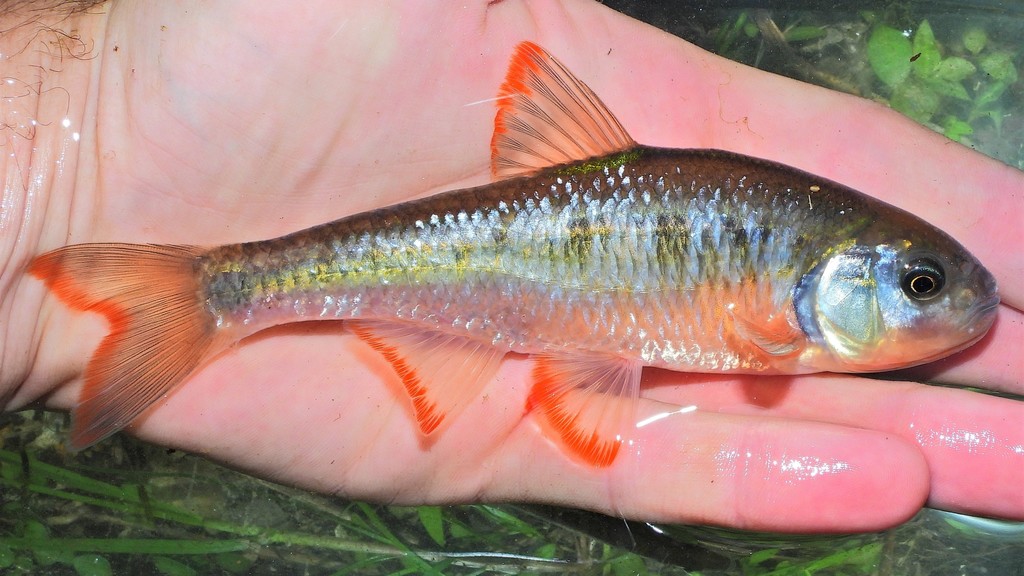
Common Shiner
Luxilus cornutus
The common shiner (Luxilus cornutus) is a species of freshwater ray-finned fish belonging to the family Leuciscidae, the shiners, daces and minnows. This fish is found in North America. It ranges in length between 4 and 6 inches (10 and 15 cm), although they can reach lengths of up to 8 inches (20 cm).
From the article Common shiner on Wikipedia (CC BY-SA), quoted section by section
Description
The common shiner is silvery colored (sometimes bronze) and has an "olive back with a dark dorsal stripe."
The common shiner is a freshwater fish found in North America. Adults inhabit rocky pools in small to medium rivers. They can live to be approximately 6 years old. They are considered sexually mature by 7.4 centimetres (2.9 in). Breeding males have a pinkish tint over most of their body and small bumps or tubercles on their head.
In comparison with Notropis, the common shiner's head, eyes, and mouth are large.
What it does
The common shiner eats "terrestrial and aquatic insects, vegetation, and other fishes."
Wikipedia: “Diet”
In human culture
The common shiner can be found in cool clear creeks and small to medium rivers, usually in the faster pools near riffles and in the shallow littoral of ponds and lakes. They usually concentrate on pools. Its preferred water temperature is 21.9 °C (71.4 °F). The common shiner reaches sexual maturity by 1–2 years of age, and produces between 400 and 4000 eggs per year. Common shiners spawn in spring between May and June, at temperatures of 16–26 °C (61–79 °F). Common shiners often spawn over the nest of a creek chub, river chub, or fallfish, although some males will make their own small nests. Gravel in riffles is also possible. Spawning males are territorial and will often engage in fights with other males. Once the eggs are ready the male guards the nesting site. Common shiners are known to hybridize with other shiner species. Common shiners live for about 4–6 years.
Wikipedia: “Life history”
Where it lives
Recorded sightings
—
geo-referenced records in GBIF, from museums, herbaria and field observers.
Drag the globe to turn it. Dots are where records exist, not a range map; darker means more records.
In the stacks
Searching the stacks…
Every page naming Luxilus cornutus in the Biodiversity Heritage Library →
This page is assembled live from iNaturalist, GBIF, Wikipedia, the Source Library and the Internet Archive. It is not yet part of the hand-edited codex. iNaturalist taxon 58618.