- Animals
- ›Chordates
- ›Vertebrates
- ›Birds
- ›Swifts and Hummingbirds
- ›Hummingbirds
- ›Brilliants, Coquettes, and Allies
- ›Coquettes and Allies
- ›Oreotrochilus
On eBird ↗
Wedge-tailed Hillstar
Live sightings near you, the range map, bar charts of when it is seen, and Macaulay Library photos and recordings.
Wedge-tailed Hillstar
Oreotrochilus adela
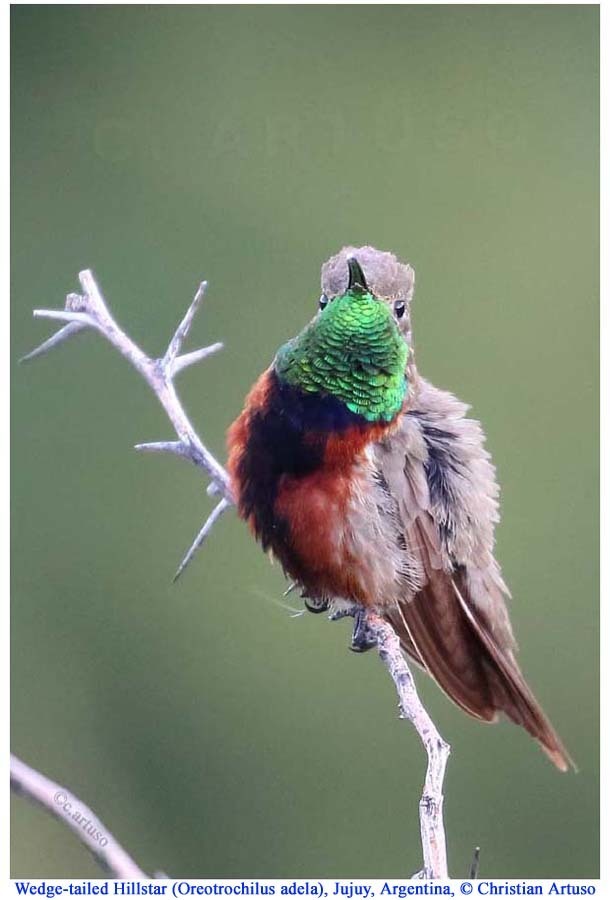
The wedge-tailed hillstar (Oreotrochilus adela) is a species of hummingbird in the family Trochilidae. This sexually dimorphic species is found in scrub and woodland at altitudes of 2,600 to 4,000 metres (8,500 to 13,100 ft) in the Andes of Bolivia and far north-western border region of Argentina. It is threatened by habitat loss. Uniquely among the hillstars, the flanks of the male are deep chestnut, while the underparts of the female are orange-buff.
From the article Wedge-tailed hillstar on Wikipedia (CC BY-SA), quoted section by section
Description
The wedge-tailed hillstar is 11 to 13 cm (4.3 to 5.1 in) long and weighs 7.4 to 8.3 g (0.26 to 0.29 oz). Adults have a medium length slightly decurved black bill. Both sexes' upperparts are gray-brown with a bronzy cast. The adult male has a glittering green gorget and chestnut underparts with a bold black stripe down the center. The tail is graduated and mostly blue-black; all but the central feathers have cinnamon inner webs. The adult female's throat is white with grayish and green spots and the rest of the underparts are pale rufous. The tail is blue-black and the outer three or four pairs of feathers are white at their tips. Juveniles are similar to the adult female.
Range & habitat
The wedge-tailed hillstar is found from southern La Paz Department in central Bolivia south barely into Jujuy Province in extreme northwestern Argentina. It inhabits semi-arid to seasonally humid areas of the Andes below the puna grasslands. It typically is found among mesophytic shrubs and also often occurs in gullies or basins with stands of Polylepis trees. It will inhabit degraded habitat as long as Dodonaea bushes, taller bushes, and columnar cacti remain. In elevation it ranges from 2,600 to 4,000 metres (8,500 to 13,100 ft).
Wikipedia: “Distribution and habitat”
What it does
The wedge-tailed hillstar feeds on nectar from flowering plants; examples include those of genera Barnadesia, Mutisia, and Puya; various mistletoes; and columnar cacti. It also feeds on insects.
Wikipedia: “Feeding”
Listen
Looking for field recordings…
Where it lives
Recorded sightings
—
geo-referenced records in GBIF, from museums, herbaria and field observers.
Drag the globe to turn it. Dots are where records exist, not a range map; darker means more records.
In the stacks
Searching the stacks…
Every page naming Oreotrochilus adela in the Biodiversity Heritage Library →
This page is assembled live from iNaturalist, GBIF, Wikipedia, the Source Library and the Internet Archive. It is not yet part of the hand-edited codex. iNaturalist taxon 5846.