- Animals
- ›Arthropods
- ›Chelicerates
- ›Arachnids
- ›Spiders
- ›Typical Spiders
- ›Entelegyne Spiders
- ›Salticoid Spiders
- ›Jumping Spiders
- ›Typical Jumping Spiders
- ›Dendryphantini
- ›Dendryphantina
- ›Phidippus
- ›Phidippus cardinalis
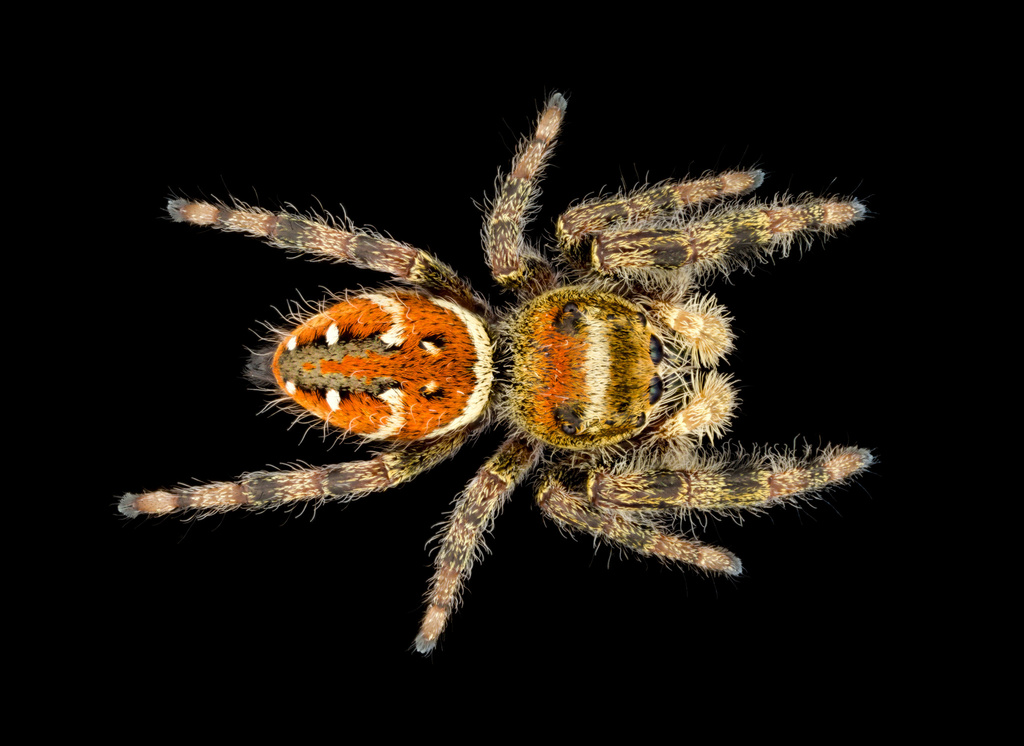
Brilliant Jumping Spider
Phidippus clarus
Phidippus clarus, also known as the brilliant jumping spider, is a species of jumping spider (family Salticidae) found in old fields throughout eastern North America. It often waits upside down near the top of a plant, which may be useful for detecting prey, and then quickly jumps down before the prey can escape. The spider is one of 60 species in the genus Phidippus, and one of about 5,000 in the Salticidae, a family that accounts for about 10% of all spider species. P. clarus is a predator, mostly consuming insects, other spiders, and other terrestrial arthropods.
P. clarus is a relatively large salticid that is able to take prey up to the size of an adult earwig. In an experiment, P. clarus was offered as many fruit flies as it could eat in a four-hour session. On average individuals took 17 flies, with the maximum amount taken was a striking 41.
From the article Phidippus clarus on Wikipedia (CC BY-SA), quoted section by section
Description
Jumping spiders have a distinctive rectangular carapace, and that of female Phidippus clarus average 4.05 millimetres (0.159 in) wide, while the carapaces of males average 3.20 millimeters (0.126 in). They are typically a red/brown coloration, but can sometimes be a lighter yellow or brown with darker markings on their bodies.
Range & habitat
Phidippus clarus is found in old fields throughout most of the United States and southern Canada. It has also been recorded from western Mexico. It lives among flowers, often sharing habitats with the small to medium-sized crab spider Misumena vatia, which waits for prey. P. clarus often waits upside down near the top of a plant such as basil leaves, a position which may be useful for detecting prey and then quickly jumping down before the prey can escape. In a 2002 survey of jumping spiders in Minnesota, P. clarus accounted for 52% of the total found.
Wikipedia: “Habitat and distribution”
What it does
Almost all jumping spiders are predators, mostly preying on insects, other spiders, and other non-aquatic arthropods. The most-common procedure is sighting the prey, stalking, fastening a silk safety line to the surface, using the two pairs of back legs to jump on the victim, and finally biting the prey. Most jumping spiders walk throughout the day, so that they maximize their chances of a catch. After capturing the prey, P. clarus settles in one spot and does not move again until it has discarded the undigestible hard remains of the prey. If P. clarus has gone without food for a few days, it eats slowly. P. clarus, which is large by the standards of salticids, takes prey up to the size of an adult earwig. In an experiment, when jumping spider were offered as many fruit flies as they could eat within a 4-hour sessions, specimens took 17 flies on average - while one took 41. When the courtship display of wolf spider Schizocosa ocreata combines visual signals with vibrations, P. clarus responds to its wolf spider prey more quickly than when the wolf spider presents only one of the types of signal.
Wikipedia: “Feeding”
Where it lives
Recorded sightings
—
geo-referenced records in GBIF, from museums, herbaria and field observers.
Drag the globe to turn it. Dots are where records exist, not a range map; darker means more records.
In the stacks
Searching the stacks…
Every page naming Phidippus clarus in the Biodiversity Heritage Library →
This page is assembled live from iNaturalist, GBIF, Wikipedia, the Source Library and the Internet Archive. It is not yet part of the hand-edited codex. iNaturalist taxon 58416.