- Animals
- ›Arthropods
- ›Chelicerates
- ›Arachnids
- ›Spiders
- ›Typical Spiders
- ›Entelegyne Spiders
- ›Salticoid Spiders
- ›Jumping Spiders
- ›Typical Jumping Spiders
- ›Dendryphantini
- ›Dendryphantina
- ›Phidippus
- ›Phidippus otiosus
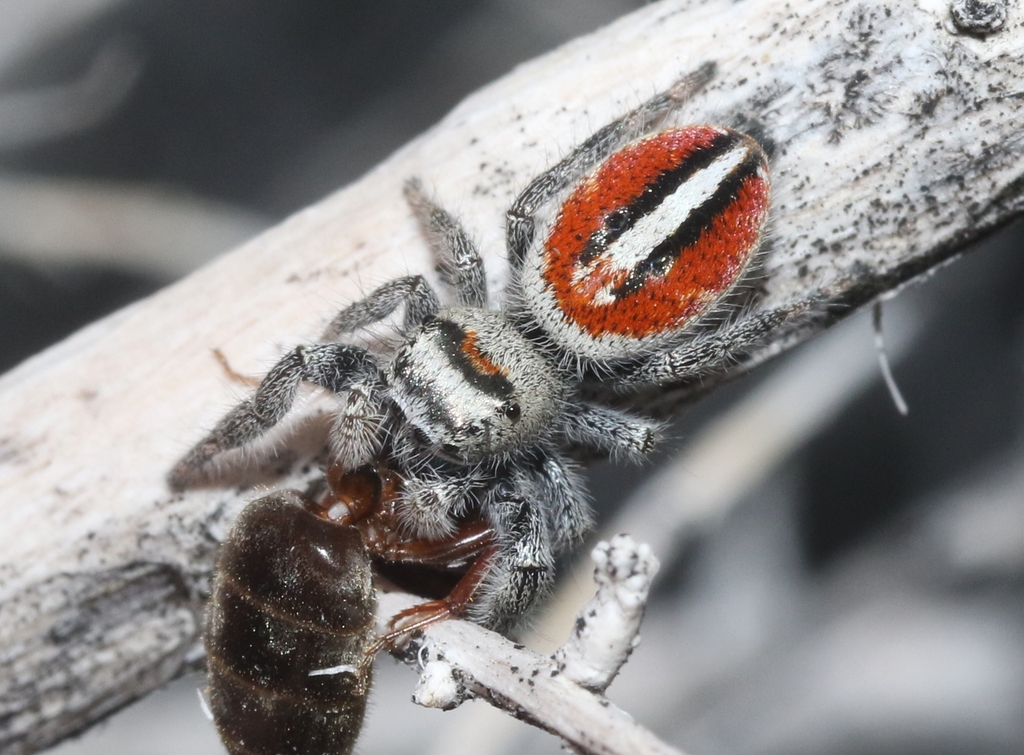
Phidippus californicus
Phidippus californicus is a species of jumping spider. It is found in the southwestern United States (California, Arizona, New Mexico, Nevada, Texas, Utah) and northern Mexico (Baja California peninsula, and Sonora).
From the article Phidippus californicus on Wikipedia (CC BY-SA), quoted section by section
Description
Females can reach 12 mm body length, males 7 to 11 mm. Both sexes have blue-green iridescent chelicerae, a black cephalothorax and limbs, and a bright red abdomen with a median black stripe (similar to the female P. johnsoni). Between the black and red areas on the posterior part of the dorsal abdomen there are two minute white spots. At the sides of the abdomen there are light diagonal bands, and there is also a light transverse anterior band on the dorsum. These markings vary in conspicuousness: the bands and spots may be only a somewhat lighter shade of red than the remainder of the abdomen, while the median black stripe may be so reduced in width and length that the abdomen appears solid red. Sometimes, the basic color is orange rather than red, and very old spiders may even be yellow. In this species, the adult males and the adult females are similar in coloration, and this is also true of P. apacheanus. It is more usual for the males of Phidippus to have iridescent chelicerae and a distinctive adult coloration while the females of this genus remain similar to the immature spiders (e.g., P. clarus, P. octopunctatus, P. …
Range & habitat
Phidippus californicus occurs in the sagebrush community of the Great Basin Desert. These large jumping spiders are found on bushes such as the sagebrush (Artemisia tridentata), the rabbitbrush (Chrysothamnus nauseosus), and the Four-winged Saltbrush (Atriplex canescens). P. californicus prefers bushes that grow on slopes with thin, stony soils, and appears to avoid conifers and moist habitats (e.g., the proximity of irrigation ditches). In the same habitat, often on the same bush, two other Phidippus species are found: P. apacheanus and P. octopunctatus.
Wikipedia: “Habitat”
What it does
Phidippus californicus is active from mid-morning until dusk, and can be seen in bushes running along branches or poised near their tips. Running is interrupted frequently: the spider stops, turns to one side and then the other, apparently scanning its surroundings. It builds a retreat, consisting of a slightly flattened tube of silk, surrounded by guy-lines that attach it to the twigs or leaves of the bush. Molting and breeding nests are similar, but use much more silk. These are found under stones at the base of the bush. When a male and an unmated female meet, it takes about 30–60 seconds of courtship until mating occurs. Males have been observed to initially court females laden with eggs, females from different Phidippus species, or even simples models out of clay with a pair of wires as appendages. Previously mated females may retreat, or attack the male as prey.
Courtship. Male courtship display is similar to that of P. apacheanus, P. clarus, or P. octopunctatus. The male begins his display by holding the carapace very high, shifting the abdomen to one side, and raising the first pair of legs. In this position, he moves before the female, stopping after each few steps. The male advances in a zig-zag pathway, shifting his abdomen to the other side at the end of each oblique approach. …
Wikipedia: “Behavior”
Where it lives
Recorded sightings
—
geo-referenced records in GBIF, from museums, herbaria and field observers.
Drag the globe to turn it. Dots are where records exist, not a range map; darker means more records.
In the stacks
Searching the stacks…
Every page naming Phidippus californicus in the Biodiversity Heritage Library →
This page is assembled live from iNaturalist, GBIF, Wikipedia, the Source Library and the Internet Archive. It is not yet part of the hand-edited codex. iNaturalist taxon 58415.