- Animals
- ›Chordates
- ›Vertebrates
- ›Birds
- ›Swifts and Hummingbirds
- ›Hummingbirds
- ›Bee Hummingbirds, Emeralds, Mountain-gems, and Allies
- ›Mountain-gems and Allies
- ›Lampornis
On eBird ↗
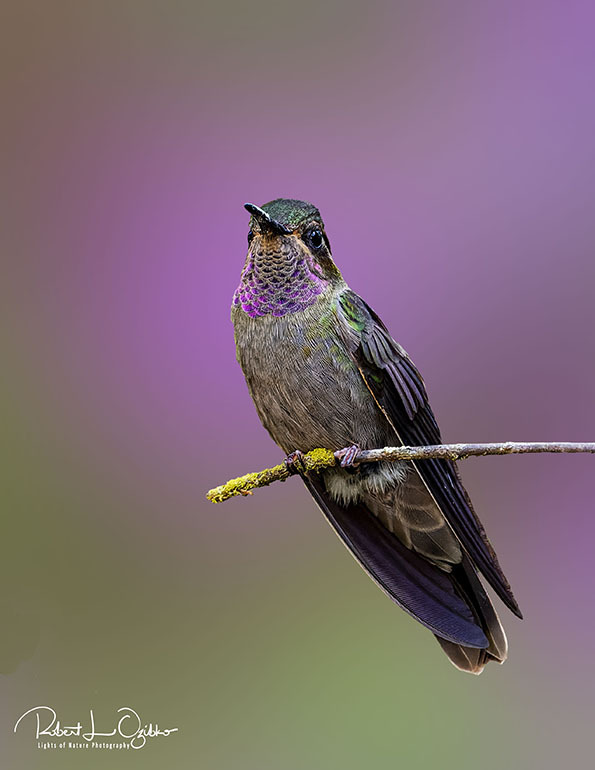
Amethyst-throated Mountain-gem
Live sightings near you, the range map, bar charts of when it is seen, and Macaulay Library photos and recordings.
Amethyst-throated Mountain-gem
Lampornis amethystinus
The amethyst-throated mountaingem or amethyst-throated hummingbird (Lampornis amethystinus) is a species of hummingbird in the family Trochilidae. It is found in El Salvador, Guatemala, Honduras, and Mexico. Its natural habitat is subtropical or tropical moist montane forests. One confirmed sighting of a male Amethyst-throated hummingbird had occurred in West Texas by Cornell Lab of Orthinology on one of their online live webcams on October 15, 2016.
From the article Amethyst-throated mountaingem on Wikipedia (CC BY-SA), quoted section by section
Description
The amethyst-throated mountaingem is 11.5 to 12.5 cm (4.5 to 4.9 in) long. Males weigh 5 to 7.8 g (0.18 to 0.28 oz) and females 5 to 5.8 g (0.18 to 0.20 oz). Both sexes of all subspecies have a medium-length straight black bill, dark auriculars, a whitish stripe behind the eye, and a broad slightly forked tail. Adult males of the nominate subspecies have a dark green crown and back, a bronze rump, and blackish uppertail coverts. The tail is black with gray tips on the outer feathers. It has a brilliant rosy pink gorget. The breast and belly are dusky gray and the undertail coverts pale buff. The female is almost the same but has a cinnamon throat. Juveniles are similar to females but males may have a few pink feathers on the throat. Subspecies L. a. circumventris and L. a. salvini are almost indistinguishable from the nominate. Males of L. a. nobilis have more bronzy green upperparts than the nominate, a purple rump, and purplish-black uppertail coverts. The gorget is reddish purple and the underparts dark smoke-gray. Females are also more bronzy above and darker below than the nominate, and have a duller and darker cinnamon throat. Subspecies L. a. margaritae differs the most from the nominate. Both sexes are much darker overall and the male's gorget is violet to royal blue instead of the red to reddish purple of the other four subspecies. …
Range & habitat
The subspecies of amethyst-throated mountaingem are found thus:
L. a. amethystinus, central and eastern Mexico from Nuevo León and Tamaulipas south to Veracruz and northern Oaxaca L. a. margaritae, southwestern Mexico from Nayarit and Jalisco south to Michoacán and western Oaxaca L. a. circumventris, Sierra de Miahuatlán in southwestern Oaxaca L. a. salvini, from Chiapas in southern Mexico south through Guatemala into El Salvador L. a. nobilis, Honduras There are two records north of Mexico, a male in Saguenay–Lac-Saint-Jean, Quebec, in July 2016 and a male in the Davis Mountains of Texas in October 2016. The amethyst-throated mountaingem inhabits the interior and edges of montane evergreen and pine-oak forest. In Mexico in ranges in elevation from 900 to 3,000 m (3,000 to 9,800 ft).
Wikipedia: “Distribution and habitat”
What it does
The amethyst-throated mountaingem feeds mostly on nectar, from a wide variety of flowering plants. It tends to feed in the lower and mid-story of the forest by trap-lining, visiting a circuit of nectar sources rather than defending patches of them. It also feeds on insects. They are subordinate to larger hummingbirds but dominant over smaller ones.
Wikipedia: “Feeding”
Listen
Looking for field recordings…
Where it lives
Recorded sightings
—
geo-referenced records in GBIF, from museums, herbaria and field observers.
Drag the globe to turn it. Dots are where records exist, not a range map; darker means more records.
In the stacks
Searching the stacks…
Every page naming Lampornis amethystinus in the Biodiversity Heritage Library →
This page is assembled live from iNaturalist, GBIF, Wikipedia, the Source Library and the Internet Archive. It is not yet part of the hand-edited codex. iNaturalist taxon 5821.