- Plants
- ›Vascular Plants
- ›conifers
- ›conifers
- ›pine family
- ›pines, spruces, larches, and allies
- ›Pinus
- ›Strobus
- ›Parrya
- ›Cembroides
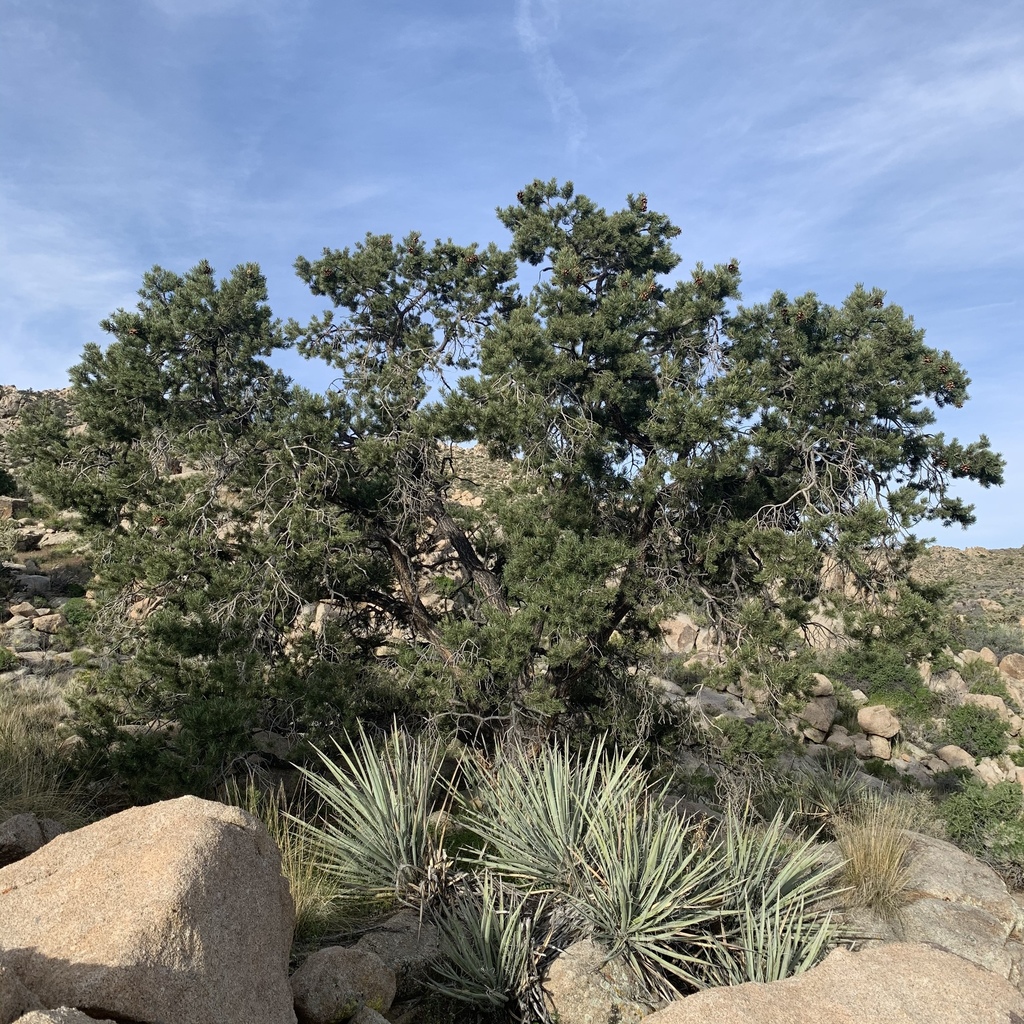
Colorado Pinyon
Pinus edulis
Pinus edulis, the pinyon pine, Colorado pinyon, or simply pinyon (US: /ˈpɪnjən/ PIN-yuhn, UK: /piːˈnjɒn/ pee-NYON, or /pinˈjɑn/ peen-YAHN), is a species of pinyon pine from the southwestern United States noted for its large, edible seeds. Although all of the species in its section of the pine genus are called pinyon pines this is the species most associated with the name.
From the article Pinus edulis on Wikipedia (CC BY-SA), quoted section by section
Description
The pinyon pine is a shrub to moderate sized tree growing to as much as 21 meters (69 ft) in height, but is more typically 5 to 15 meters (16–49 ft) tall. When young the crown of the tree is fairly pyramid shaped, but becomes more rounded with age. Young trees also have branches nearly at ground level and only losing them once the tree is quite mature. With increasing age the crown can become more open and irregular with a gnarled appearance. The crown is usually nearly as broad as the tree's height. A pinyon pine with a trunk diameter of 1.72 meters (5 ft 8 in) has been documented, though a thickness of 60 cm (2 ft) at breast height is more typical of fully mature trees. The bark is sepia-brown thin, and scaly when new, eventually becoming unevenly furrowed and gray. The twigs are lite red-brown to tan that fade to gray and are usually rough with small warty nodules, but can occasionally be smooth. The needle-like leaves are usually two to a bundle, but might also be three to a bundle or solo, but the sheath at the base of the bundle is lost early. They curve upwards and are 2–4 centimeters (0.8–1.6 in) long and just 0.9–1.5 millimeters wide. Solitary needles have two groves while those in two-needle bundles have two sides. When three are three needles to a bundle they will have three sides. …
Range & habitat
The central part of the pinyon pine's native range is in Colorado, New Mexico, Utah, and Arizona forming a primary part of the pinyon–juniper woodlands in these states. There are additional small area outside this primary range in Oklahoma, Texas, Wyoming, and possibly California and Nevada. In Wyoming it grows in only the most extreme southern portions of the state in Laramie County in the east and Sweetwater County in the west. In Texas it is found only in the Trans-Pecos in the Guadalupe Mountains and the Sierra Diablo range. In Oklahoma it is confined to just Cimarron County at the end of the Oklahoma panhandle. A small population of trees growing in the New York Mountains of Southern California are considered to be Pinus edulis in sources such as The Jepson Manual, but alternatively they are described by other sources as a population of Pinus monophylla with two needles or as part of separate species called the California pinyon (Pinus californiarum). Similarity, in Nevada it only grows in eastern parts of the state in White Pine County, but this population is not considered to be Colordo pinyons by the Flora of North America. In total the range of the species is about 14.9 million hectares (37 million acres) with very little of this range outside the four primary states. …
Wikipedia: “Range and habitat”
What it does
The pinyon is a slow growing species that is adapted to relatively dry climates and not an intense competitor for sunlight, like fast growing pines from moist habitats with many other species. The pinyon is enormously dependent on and has co-evolved with the pinyon jay (Gymnorhinus cyanocephalus), a modest sized bird in the crow family with blue-gray plumage and a thin beak. As with most trees, the pinyon does not produce a heavy crop of seeds every year, with large numbers being produced every six years on average. The upright cones with the wide open scales are thought to be an adaptation to allow animals to more easily disperse the seeds. The new cones can be damaged by late spring frosts, causing the crop to fail the following year across large areas and too lengthy spring rains can prevent their fertilization by the wind-borne pollen. Along with the single-leaf pinyon, Colorado pinyons are a principle host for the parasitic plant pinyon dwarf mistletoe. Pinyon pines are attacked by the pinyon ips beetle (Ips confusus). Under normal conditions they thin stands of already damaged or stressed trees, but large populations of the beetles can eliminate whole groves of otherwise healthy pinyon pines.
Wikipedia: “Ecology”
At the table
Pinyon nuts are a traditional food of the Western Apache, Hopi, Tewa, and other native peoples of the southwest. Traditionally the Hopi people used pitch from the pinyon tree to prepare some dyes, set turquoise into mosaics, and to waterproof and repair pottery. In traditional funerary practices the resin was also put coals after the funeral to produce a strongly scented smoke. Archaeologist Harold S. Gladwin described pit-houses constructed by southwestern Native Americans c. 400–900 CE; these were fortified with posts made from Pinyon trunks and coated with mud. The pine nuts continue to be gathered in large amounts for the local markets by the Navajo and the Hispanos of New Mexico. The pinyon seeds are typically gathered following the first frost of the year. In areas where it is common, the resinous pinyon is used as firewood. The pinyon pine is grown as a landscape tree or shrub, particularly in areas where low water usage is a priority. Even moderate watering can result in an unappealing shape. However, the very resinous nature of the tree often causes persons or objects beneath it to be abundantly covered in drops of gum or pitch. It is infrequently used as a cut or live Christmas Tree near its native range and cut trees were sold outside the region, but this use was declining by the 1990s.
Wikipedia: “Uses”
In human culture
The piñon pine is the state tree of New Mexico. It was officially designated as a state symbol by the legislature on 16 March 1949. In the years before legislative action the New Mexico Federation of Women's Clubs had a series of votes to select a tree to recommend as a state symbol, the piñon won out narrowly over the quaking aspen. Both before and after statehood the piñon nut has been an important part of state culture with roots in Spanish and native food traditions.
Wikipedia: “In culture”
Where it lives
Recorded sightings
—
geo-referenced records in GBIF, from museums, herbaria and field observers.
Drag the globe to turn it. Dots are where records exist, not a range map; darker means more records.
In the stacks
Searching the stacks…
Every page naming Pinus edulis in the Biodiversity Heritage Library →
This page is assembled live from iNaturalist, GBIF, Wikipedia, the Source Library and the Internet Archive. It is not yet part of the hand-edited codex. iNaturalist taxon 57902.