- Animals
- ›Molluscs
- ›Gastropods
- ›Caenogastropods
- ›Littorinimorpha
- ›Periwinkle Snails and Allies
- ›Periwinkle Snails
- ›Littorininae
- ›Littoraria
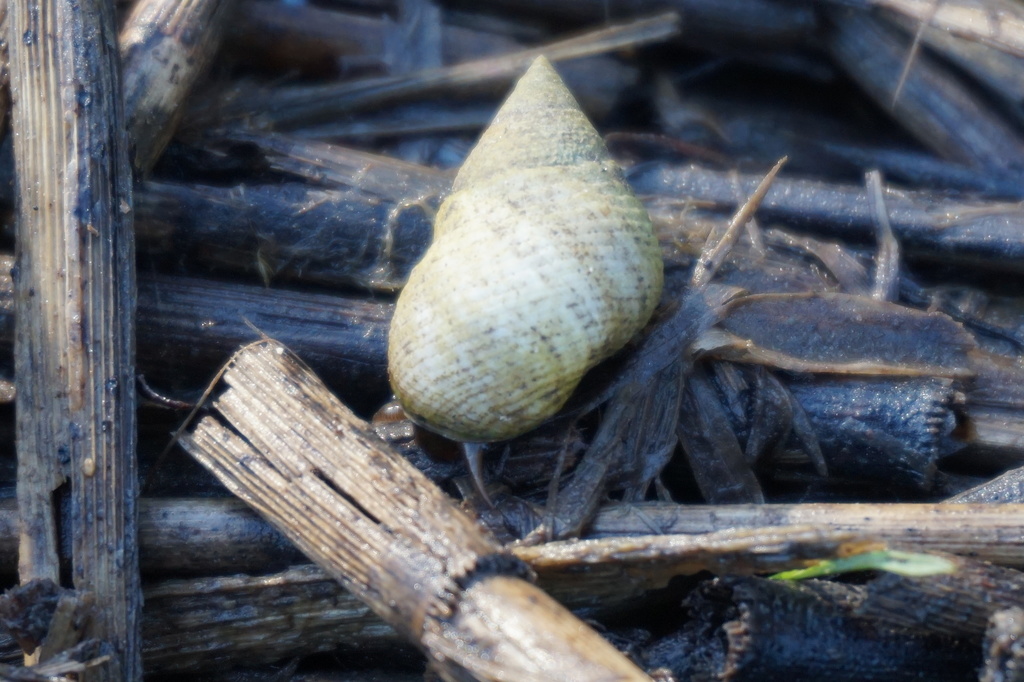
Marsh Periwinkle
Littoraria irrorata
Littoraria irrorata, also known by the common name the marsh periwinkle, is a species of sea snail, a marine gastropod mollusk in the family Littorinidae. The specific epithet irrorata means 'moistened' or 'dewy.'
This species occurs in salt marshes on the Atlantic coast and Gulf Coast of North America, from Massachusetts to Texas.
From the article Littoraria irrorata on Wikipedia (CC BY-SA), quoted section by section
Description
The maximum recorded shell length is 29.2 millimetres (1.15 in). L. irrorata is extremely temperature tolerant. The snail has the ability to retract its foot into its shell when experiencing thermal stress which allows them to avoid water loss by evaporation and survive in high temperatures.
Range & habitat
This species can be found along Ireland, the Northwest Atlantic Ocean and the Gulf of Mexico. Spatial distributions of L. irrorata in salt marshes likely depend on predation pressures and vary with geography. It is possible that S. alterniflorus stem density plays a role in the local distribution of L. irrorata.
Wikipedia: “Distribution”
What it does
Littoraria irrorata feeds on fungi that it encourages to grow. It creates and maintains wounds on the grass, S. alterniflorus, which are then infected by fungi, probably of the Phaeosphaeria and Mycosphaerella genera. Such fungi are the preferred diet of the snail. L. irrorata also deposits faeces on the wounds that they create, which encourage the growth of the fungi because they are rich in nitrogen and fungal hyphae. Juvenile snails raised on uninfected leaves do not grow and are more likely to die, indicating the importance of the fungi in the diet of L. irrorata. The diet of L. irrorata also consists of algal mats on the salt marsh floor, dead S. alterniflorus, live S. alterniflorus, and marsh sediment. L. irrorata is capable of having a strong top-down control of S. alterniflorus production due to its grazing of the live shoots.
Wikipedia: “Feeding habits”
Where it lives
Recorded sightings
—
geo-referenced records in GBIF, from museums, herbaria and field observers.
Drag the globe to turn it. Dots are where records exist, not a range map; darker means more records.
In the stacks
Searching the stacks…
Every page naming Littoraria irrorata in the Biodiversity Heritage Library →
This page is assembled live from iNaturalist, GBIF, Wikipedia, the Source Library and the Internet Archive. It is not yet part of the hand-edited codex. iNaturalist taxon 57788.