- Animals
- ›Arthropods
- ›Chelicerates
- ›Arachnids
- ›Harvestmen
- ›Eupnoan Harvestmen
- ›Phalangioidea
- ›Phalangiid Harvestmen
- ›Gyinae
- ›Dicranopalpus
- ›Dicranopalpus ramosus
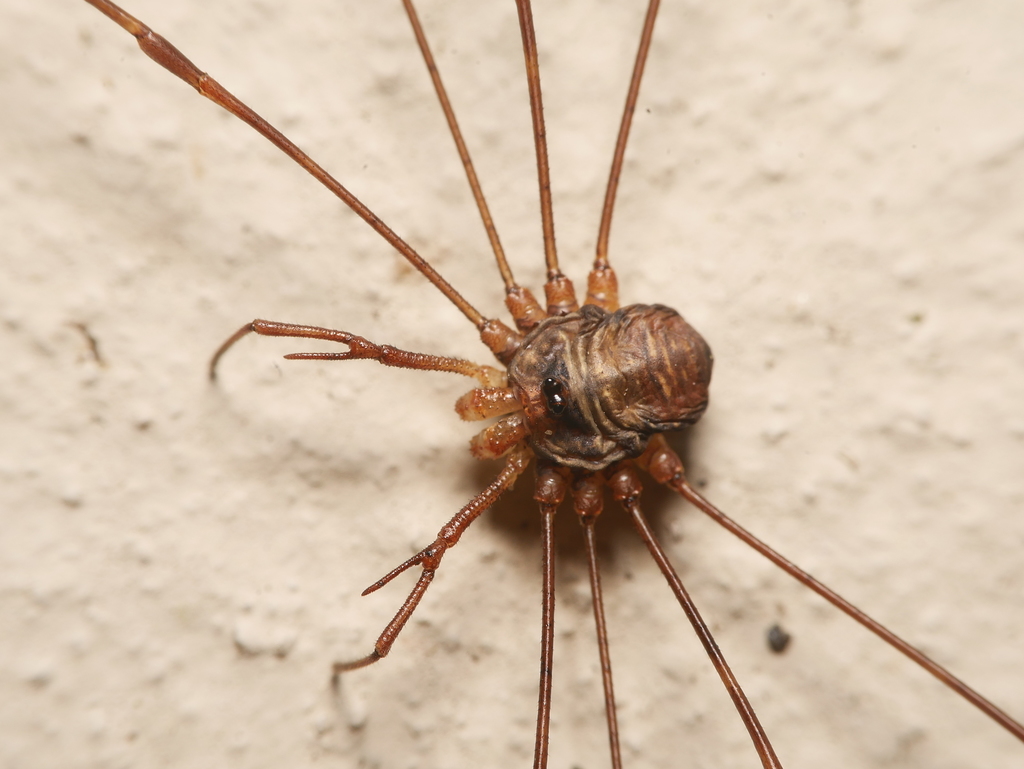
Fork-palped Harvestman
Dicranopalpus ramosus
Dicranopalpus ramosus is a species of harvestman. Males are up to 4 mm long, females can reach up to 6 mm. Both sexes have very long legs (especially the second pair can reach up to 5 cm), with a distinct elongated apophysis that reaches almost to the end of the tibia. This makes their pedipalps look forked. Their body is brownish with dark markings, the females being lighter colored.
From the article Dicranopalpus ramosus on Wikipedia (CC BY-SA), quoted section by section
Description
Males are up to 4 mm long, females can reach up to 6 mm. Both sexes have very long legs (especially the second pair can reach up to 5 cm), and the pedipalps have a forked appearance due to a distinct elongated apophysis that reaches almost to the end of the tibia. Their body is brownish with dark markings, the females being lighter colored. Adults can be found from August to November, mostly in gardens and on outer walls, but sometimes also inside. The forked pedipalps and the resting posture, with the legs stretched to the sides, makes this species easy to identify, although the traditional method of collecting invertebrates does not prove adequate: of 103 individuals captured in Belgium, only one was found in a pitfall; all others were collected by hand.
Range & habitat
Originally the species was found in Morocco. Later it spread into Europe, with first reports in Portugal (1948), where it spread to Spain (1965) and France (1969). The Netherlands were reached in 1992. Since 2004 it has been known to occur in Germany. As early as 1957, it was reported in Bournemouth, southern England, from where it spread all over Great Britain, reaching Scotland in 2000. From 2010, it has been established in most of Denmark, and from 2012 southern Sweden. In 2019, an individual photographed by iNaturalist user "kiwikiu" at Cannon Beach, Oregon, suggested the species' introduction into the United States. Since then, the species has been documented several times in the area. The very similar and closely related D. gasteinensis is found in the Alps.
Wikipedia: “Distribution”
Where it lives
Recorded sightings
—
geo-referenced records in GBIF, from museums, herbaria and field observers.
Drag the globe to turn it. Dots are where records exist, not a range map; darker means more records.
In the stacks
Searching the stacks…
Every page naming Dicranopalpus ramosus in the Biodiversity Heritage Library →
This page is assembled live from iNaturalist, GBIF, Wikipedia, the Source Library and the Internet Archive. It is not yet part of the hand-edited codex. iNaturalist taxon 57396.